

jeyifous rehearses the future through speculative utopias
For Olalekan Jeyifous, the future is not a distant horizon but a parallel condition: a condition that exists alongside the present, waiting to be visualized. He was trained as an architect, but worked fluidly installationillustration and public artthe Brooklyn-based artist and designer has created a practice based less on solving problems than on reframing them. His work does not suggest general plans or fixed results. Instead, it operates in the fertile ground of speculation, where design becomes a narrative tool and utopian a method of inquiry.
“I think a lot of these speculative works exist in the now, but in an alternate reality,” Jeyifous says, describing a practice that collapses temporal boundaries and places possibility in the present.
This persistence in the “now” is key. Jeyifous’s visions, dense, vivid and often infrastructurally improbable, are not escapist fantasies. They are counterfactuals, deliberate reconfigurations of social, political, and environmental systems that reveal the contingencies of the world as it is. While speculative planning is often dystopian, Jeyifous positions utopia as a productive counterweight, not as a naïve ideal, but as a critical strategy. His works do not ignore the crisis. Many are shaped by climate change, displacement and systemic inequality. However, they deny the inevitability of these conditions, suggesting alternative trajectories based on community resilience and cultural distinctiveness.

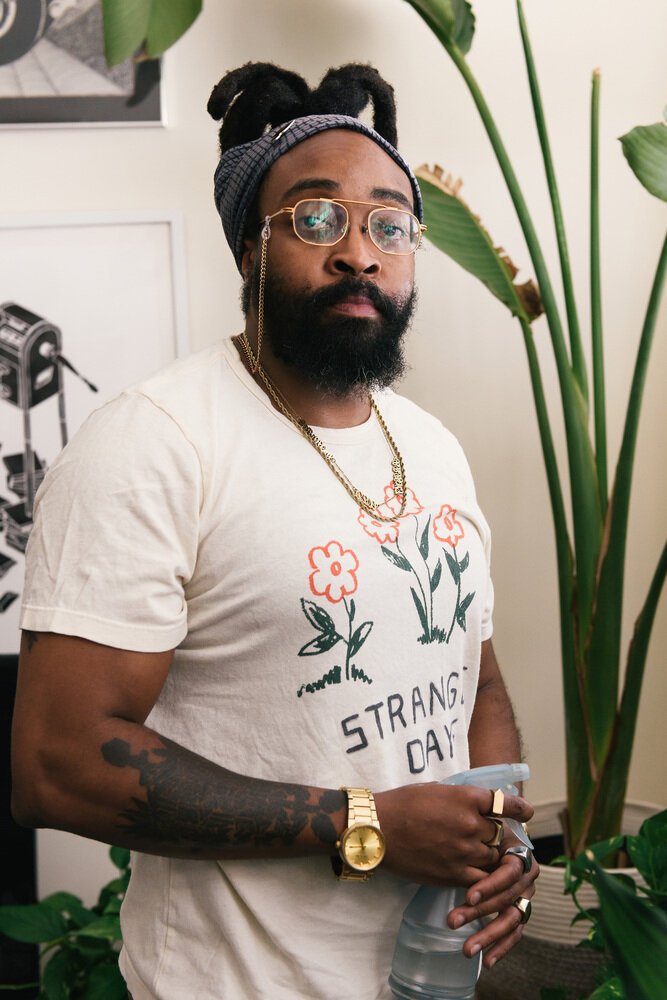
portrait of Matt Dutile
speculative design as spatial narrative
Jeyifous’s work is often described through the prism of Afrofuturism, but its functional logic is architecture. Plans look like elevations and sections. The installations read like fragments of fictional cities. However, unlike traditional architecture, these projects do not aspire to be built. It is, as he says, a way of “using design as a tool for imagination rather than problem solving.”
Emerging from an early engagement with architectural representation, his practice has expanded to include collage, animation and large-scale public works, each medium chosen for its ability to convey narrative. Through this expanded toolbox, Olalekan Jeyifous constructs layered worlds that are both familiar and alienating. Lagos is rendered as a vertical patchwork of informal settlements. Brooklyn is transforming into a network of climate-adapted micro-ecosystems. For-profit infrastructure combines municipal ingenuity with futuristic technology.
These environments are not neutral. At the fore are issues of access, equity and participation, concerns rooted in the spatial politics of the black diaspora and the lived realities of cities undergoing rapid transformation. His work consistently returns to the relationship between architecture and power, examining how built environments encode systems of exclusion while also holding the potential for collective re-imagining.

Jeyifous imagines: New York Institute of Etherism & Alchemy Department of Urban Habitat & Plant Engineering
jeyfous uses Utopia as a critical tool
In projects such as ‘Nairobi 2081 AD’ and ‘Shanty Megastructures’, informal architecture becomes a site of innovation rather than scarcity. High-rise buildings clad in salvaged materials, speckled with vegetation and solar systems, reverse dominant narratives of development by incorporating technological progress into local contexts. Rather than imposing a homogenized futurism of glass and steel, these works suggest that the future can and should emerge from the textures and stories of place.
Similarly, with “Bodega Ecohaven,” Olalekan Jeyifous reimagines Brooklyn as a network of self-sustaining microclimates, where community infrastructure evolves in response to environmental pressures. Bubble farms, rainwater harvesting systems and energy-generating flora form a speculative ecology that is as imaginative as it is based on existing technologies. Here, utopia functions not as perfection, but as a rehearsal, a way of testing how different systems can co-exist. This approach aligns with Jeyifous’s broader understanding of design as a cultural and political act. His work challenges viewers to examine the relationships between art, politics, popular culture and the cultural imaginary, positioning the future as a contested space shaped by competing narratives.

Nairobi 2081 AD, illustration for Ikiré Jones fashion collection lookbook, Vigilism, 2013
between public space and the imaginary
While much of Jeyifous’ practice unfolds in visual imagery, he also extends into physical space through public art and installations. Works such as ‘Crown Ether’ and ‘The Boom and the Bust’ translate his thematic concerns into sculptural form, drawing audiences into shared environments and embedding speculative thinking into everyday experience. These works often function as what might be called “utopian fragments,” partial manifestations of larger imaginary systems. They do not attempt to fully realize the future depicted in his designs. On the contrary, they create moments of encounter that invite viewers to settle, even briefly, into an alternative spatial logic.
This oscillation between the imaginary and the material is central to Jeyifous’s methodology. Moving between representation and realization, he resists the binary between art and architecture, using each to inform the other. Speculative images gain weight through their connection to real-world environments, while structured interventions gain new levels of meaning through their association with imagined futures.

‘Crown Ether’ at Coachella 2017 | Image courtesy of Olalekan Jeyifous
we imagine the terms of the future through alternative gifts
At its core, Jeyifous’ practice is concerned with who can imagine the future and how. His work challenges the dominance of Western, technocratic visions of progress, proposing instead a multiplicity of futures shaped by different cultural perspectives and lived experiences. This is particularly evident in his engagement with cities such as Lagos, which recur throughout his work not as sites of deficiency, but as laboratories of possibility. By centering these frameworks, Jeyifous disrupts conventional hierarchies of development and reframes informality as a source of innovation.
Utopia, in this sense, becomes less about achieving an ideal state and more about expanding the realm of the imaginable. It is a method of questioning assumptions, revealing inequities and articulating alternative solutions, a way of thinking through design rather than just designing solutions. At a time marked by overlapping crises, Jeyifous’s work offers a different kind of optimism, grounded in complexity, attentive to history, and open to contradiction. His speculative worlds promise no easy answers. Instead, they invite us to think that the future is not something to be predicted or controlled, but something to be written collectively, one image, one narrative, one possibility at a time.



