

Arthur Casas Rethinking an existing framework in Brazil
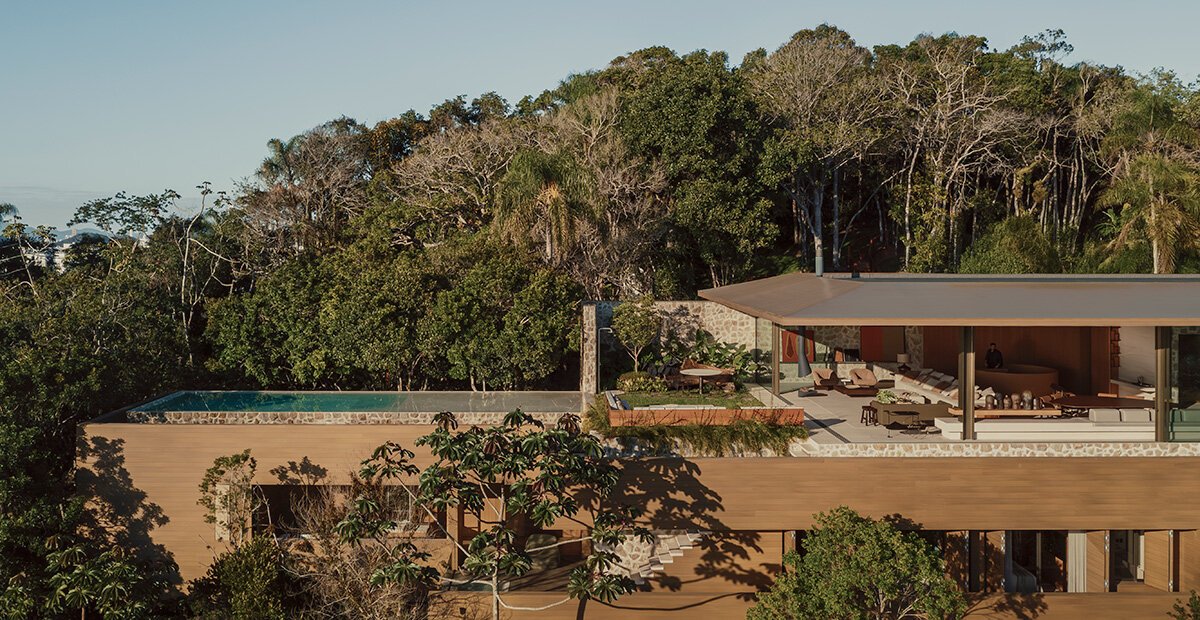
In Itajaí, BrazilArthur Casas transforms an unfinished speculative structure into Bravíssima House, a family home shaped by its steep, green location overlooking Praia Brava. The studio retains most of the assets concrete context and reconstructions to suit the everyday life of a couple with two children. The result looks less like a fixed object and more like something that settles into the slope, opening out to the sea while remaining closely tied to the surrounding vegetation.
Wood runs throughout the work, from the facade on ceilings and built-ins, giving interiors a warm, cohesive feel. A spiral staircase becomes a key feature of this palette, connecting the levels in a more sculptural way. Limestone stone floors extend from inside to outside, softening the boundaries between the two, while plastered walls and metallic details add texture without overwhelming the spaces.

all images from Cesar Bejar
a compartmental division between openness and privacy
The main living spaces are located at the entrance level, where the house opens up into a continuous series of living, dining and pool areas, all oriented towards the view. Below, the bedrooms and more private spaces are tucked into the ground, offering a quieter atmosphere without losing contact with the landscape. This separation makes the house feel both open and sheltered.
Inside, the atmosphere is relaxed and lively, combining pieces designed by Arthur Casas’ team with Brazilian modern classics. Furniture by Jorge Zalszupin and Percival Lafer sit alongside artworks by Mano Penalva and José Bechara, creating a balance between design and art without feeling overly staged. In the dining room, a custom bench keeps the view open while adding a practical layer for everyday use, complemented by sculptural works by Marco Tulio Rezende.
The landscape, designed by Renata Tilli, follows the same logic of collaboration with what already exists. Existing vegetation is retained and paths are gently introduced to connect different parts of the site. In this way, the house does not dominate its setting, but blends into it, becoming part of a larger, continuous environment shaped by the terrain, plants and views.

the house reads as a horizontal extension of the ground

the house is revealed from above as a series of terraces embedded in dense vegetation

the house lays blocks of wood in the dense vegetation



