

ensemble studio builds the real instead of imagining it
In an architectural landscape increasingly dominated by frictionless returns and speculative futures, Ensemble Studio it redirects attention to something heavier and more down-to-earth. Led by Antón García-Abril and Débora Mesa, the practice does not reject technological progress but reframes it through a material lens. Their work suggests that the future of architecture lies in a deeper engagement with the physical world, involving gravity, mass, resistance and time.
Ensemble Studio suggests a ‘Utopia of the real’ which is imagined as a functional condition embedded in the construction itself. It is not about projecting ideal future perspectives, but about extracting latent potential from already available materials and systems.
The duo positions architecture as an active negotiation with reality, perceiving matter as a partner. Location is not a blank slate, but a system of forces, histories, and constraints that must be directly engaged.

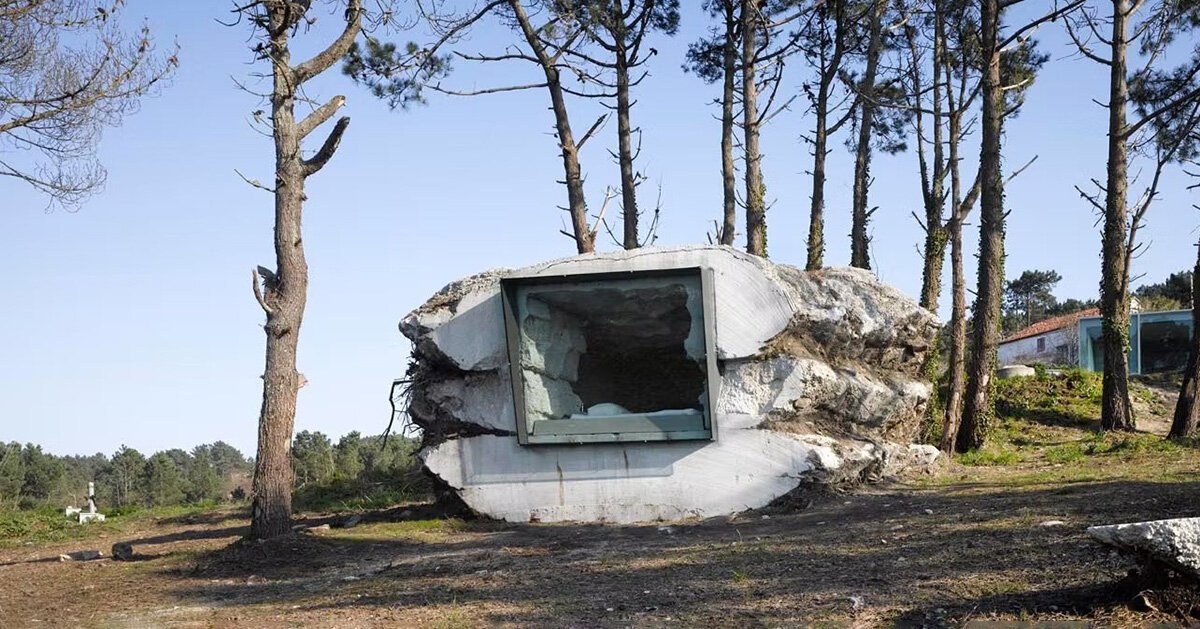
The Truffle | all images courtesy of Ensamble Studio
primitive futures as construction logic
The concept of the “primitive future” functions as both a conceptual and a practical framework in Ensamble Studio’s work. THE Architects based in Madrid and Boston they understand the primitive as a set of fundamental logics that persist regardless of technological progress. Compaction, erosion, agglomeration, casting and excavation are not obsolete techniques but ongoing processes that can be reinterpreted through modern tools.
This reframing allows the studio to break down the distinctions between past and future. In the same continuity belong a quarry wall scanned with laser technology and an earth mass shaped by manual excavation. What matters is not the tool itself, but how it reveals the intrinsic behavior of materials. In this sense, innovation lies in the intensification of the relationship between material, process and structure.
Construction becomes a form of inquiry, where knowledge is produced through construction rather than representation. Plans and models are subordinated to the intelligence of the process itself. The architect turns from composer of objects to manager of forces, orchestrating interactions between weight, pressure, friction and time, leading to an architecture where structure is fully exposed, performing both technical and spatial roles. There is no separation between support and expression, between system and experience. The built environment feels inevitable, as if it could only have emerged through the precise conditions that produced it.

Missing pieces
the truffle: architecture excavated by a cow
Completed in 2010 in Galicia, The Truffle represents one of the most radical and distilled expressions of Ensamble Studio’s methodology. It begins not with a plan, but with an excavation. A void is carved into the ground and displaced soil is piled around its perimeter, forming a loose and unstable mold. Within this cavity, a volume of hay is arranged to define the future interior, creating conditions for deformation, for imprinting, for interaction with the material that will surround it.
Concrete is then poured into the space between the earth and the hay. At the moment, the project is entering a phase of material negotiations. The wet concrete exerts pressure on both the surrounding soil and the hay, while at the same time absorbing their characteristics. The soil imprints its texture and irregularities on the outer surface, while the hay begins to compress, fold and resist from within. When the concrete hardens and the outer soil mold is removed, what remains is not a building in the conventional sense, but a solid mass, a manufactured stone. It doesn’t have an interior yet, just the potential for one.
The transformation from mass to space is accomplished through an unexpected factor. A calf named Paulina is introduced into the structure after strategic openings are cut in the concrete shell and begins to consume the hay that occupies the interior. Over the course of a year, this act of feeding gradually excavates the inner space.
This process introduces a biological dimension to construction, challenging conventional notions of efficiency and control. The resulting interior is shaped by the interplay between pressure, compression and consumption. The walls retain the imprint of the hay bales, their fibers and folds fossilized in the concrete surface. The ceiling appears fluid, as if the material had been captured in a moment of suspension. The space feels simultaneously prehistoric and modern, primitive and highly controlled. It is a cavern produced through engineering, a void created through accumulation rather than subtraction. In this sense, Trufa does not imitate nature but reproduces its processes.

Trufa represents one of the most radical and distilled expressions of the Ensamble Studio methodology
ca’n terra: discovering space instead of building it
If Trufa builds mass to reveal space, Ca’n Terra starts with space and works towards architecture. Located in a former sandstone quarry in Menorca, the project includes a vast, already excavated interior that bears the marks of industrial mining. Ensamble Studio adopts a position closer to that of an archaeologist than a builder. Using terrestrial laser scanning, the studio captures millions of points on the quarry’s surfaces, translating its irregular geometry into a digital model that becomes a tool of understanding as it reveals structural logics, spatial hierarchies and latent connections that would otherwise remain invisible.
The project focuses on removing that which obscures the clarity of the space. Debris is cleared. Leftover partitions from its use as storage space are disassembled. The quarry returns to a state where its scale and continuity can be experienced again. Concrete floors are introduced only where necessary to support habitation. A single cut in the rock brings light deep inside, transforming the atmosphere without altering the overall form. Light curtains define zones of use while maintaining the openness of the volume.
This approach allows domestic life to co-exist with the monumentality of the quarry, adapting the conditions enough to be habitable while maintaining the feeling of being inside a geological formation. Ca’n Terra proves that architecture can emerge through abstraction, through the careful removal of excess rather than the addition of new elements.
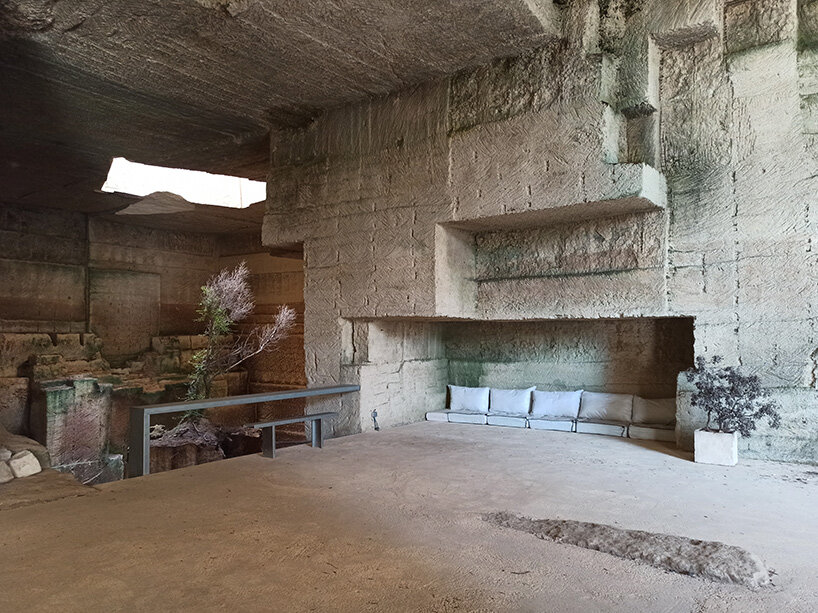
Ca’n Terra
from land to infrastructure: scaling up the experiment
With Hemeroscopium House, Ensamble Studio shifts its focus from geological processes to the logic of infrastructure. The project assembles large prefabricated elements, commonly used in bridges and civil engineering projects, into a home structure that appears to defy gravity. The house consists of a sequence of beams stacked in a precise hierarchy, culminating in a granite counterweight that stabilizes the entire system.
Despite the sheer scale of its components, the house feels unexpectedly light. This is achieved not by reducing weight, but by orchestrating its distribution. The assembly process, completed in just a few days, stands in stark contrast to the extensive calculations required to ensure balance.
Cyclopean House extends this exploration by inverting the relationship between mass and weight. Here, the appearance of gravity is achieved through lightweight components, with structural beams made up largely of foam. These elements maintain the visual presence of solid construction while significantly reducing the load. The project is fully prefabricated and shipped as a kit, allowing it to be placed on top of an existing structure without additional foundations. Programmatically, the house concentrates services and functions within a series of specialized beams, freeing up the central space for flexible use.

Cyclopean House, Brookline, MA, USA, 2015
the landscape as structure
On a territorial scale, projects like those at the Tippet Rise Art Center extend the studio’s methodology to the landscape. Construction in this field is understood as a continuation of geological processes, with concrete being cast directly into the ground to capture its texture and form. The resulting structures function as both shelters and markers, providing orientation within a vast and otherwise undifferentiated landscape, not introduced to the site but derived from it.
These works blur the distinctions between architecture, sculpture and land art. They function simultaneously as spaces to inhabit, objects to perceive and instruments to frame the environment.
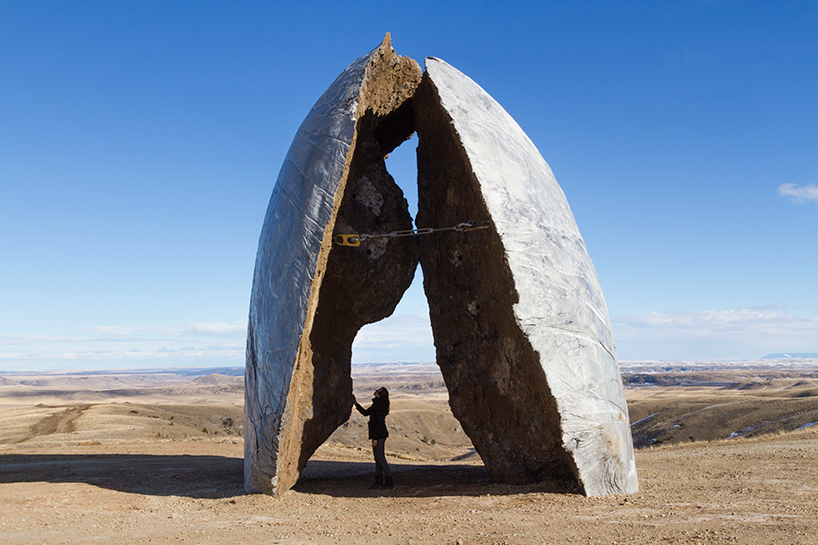
Tippett Rise Art Center
ensemble fabrica and the industrialization of the process
Ensamble Fabrica represents the consolidation of the studio’s research into a dedicated space for experimentation and production. Here, prototypes are developed, materials are tested and manufacturing systems are perfected in a controlled environment.
The focus shifts from the design of end objects to the design of processes. By controlling how something is made rather than prescribing exactly what it should look like, the studio allows variability and adaptation to remain part of the result, recognizing that architecture is always subject to contingencies and that these contingencies can be productive rather than problematic.
Through initiatives such as WoHo, Ensamble Studio extends its methodology into the realm of housing and urban development. Prefabrication, low-carbon materials and integrated systems combine to produce architecture that is both materially efficient and expressive.
The goal is not to standardize intelligence. Systems are being developed that can adapt to different environments while maintaining a consistent relationship between material, structure and space. This opens up the possibility for a more accessible form of architecture, where quality is not sacrificed for speed or cost.
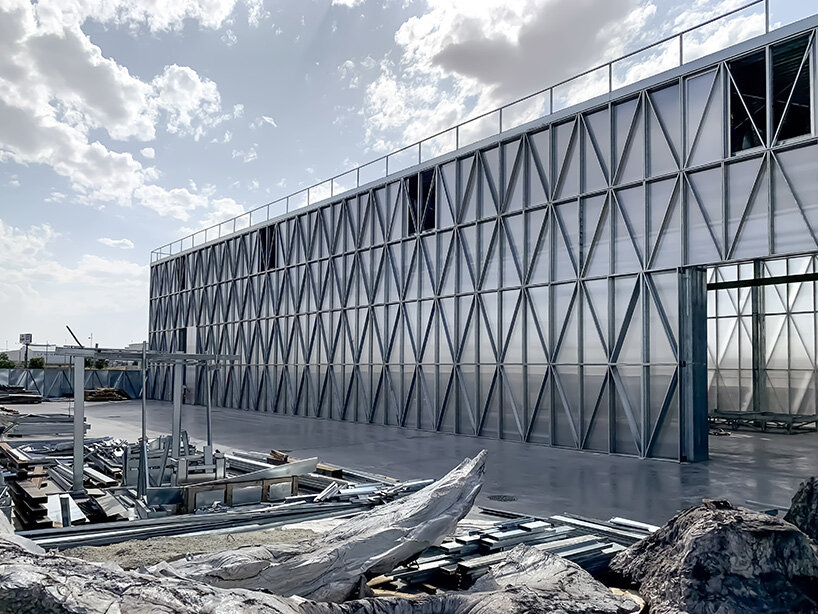
Factory assembly in Madrid

the ground imprints its texture and irregularities on the outer surface

a biological dimension in construction

Ca’n Terra proves that architecture can emerge through abstraction

Heeroscopium



