
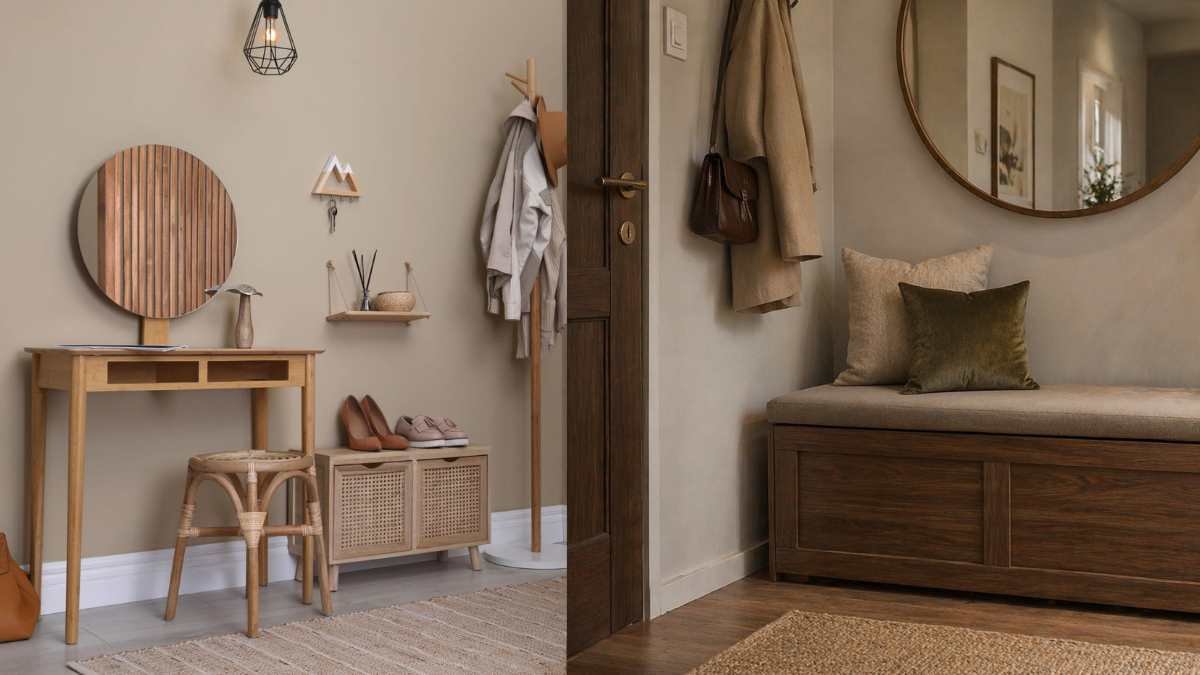

The entrance is one of those spaces that is underestimated until it starts to get very crowded. Shoes left visible, bags placed wherever they are, jackets stacked, small items that never find an exact location. This is where the bench can work better than a traditional shoe rack, because it not only contains: it organizes, illuminates and makes the environment more livable.
Unlike the classic vertically developed shoe rack, which often results in a closed, tall and visually heavy piece of furniture, the bench works with a more fluid logic. It remains low, follows the line of the wall, allows the upper part of the space to breathe and above all introduces an additional function, that of the seat. This detail changes a lot, because it turns a container piece of furniture into a really useful item in your everyday life.
Sitting down to take off your shoes, putting down a bag upon entering, having a neat but not stiff support point makes the entrance more homely and less ‘service’. In addition, from a visual point of view, a bench does not break up the room like a taller piece of furniture: the eye continues to read the wall, mirror or paintings above and the environment immediately appears more open. In a small house this effect is even more evident, because every low and well-proportioned element contributes don’t close the space.
Because the bench works better than a traditional shoe rack
The bench’s strength lies precisely in its functional ambiguity. It is not just a piece of furniture where you can hide your shoes, but a hybrid element that combines storage, seating and visual order. This makes it smarter than the classic shoe rack, especially in narrow entrances, open spaces or entryways where it is necessary to avoid “Furniture Wall”.
A traditional shoe rack tends to be designed just to solve the problem of shoes, and often does so in a rigid way, with fixed compartments and depths that don’t always fit everything well. The bench, on the other hand, allows more flexible management: they can be placed under the models used every day, you can place baskets or boxes inside, dedicate a place to accessories such as gloves, scarves, folding umbrellas or even leashes if there are animals at home. In practice, it works not only on containment, but on managing the daily chaos.
Even from an ergonomic point of view, it offers something that the shoe rack does not: comfort. In a well-organized entrance, the possibility of sitting is a huge advantage, especially for families with children, the elderly or simply for those who want to make a gesture that is repeated every day easier. Then there is an aesthetic aspect that should not be underestimated.
A bench never feels like a “technical” piece of furniture, so it helps make the entryway more like a real room and less like a makeshift transit area. When chosen well, with clean lines and materials consistent with the rest of the house, it immediately manages to give onemore refined impressionalmost by design, even if it actually just solves a practical problem.
The right bench changes a lot depending on the style of the environment, and this is perhaps the most important part, because even a very practical solution can look out of place if it does not communicate well with the context. In a Scandinavian or contemporary home, for example, a light wood bench works very well, with a simple structure, straight lines and perhaps a smooth or lightly padded seat in off-white, sand or warm gray fabric.
This type of choice goes well with white or beige walls, light colored floors, thin hangers made of black or natural wood and mirrors with a minimal frame. The end result is bright, tidy, very light.
If, however, the home has a warmer and more classic modern style, you can choose a bench in medium oak, walnut or in a bolder finish, perhaps with a seat covered in dove grey, cream or dusty sage fabric. In this case the entrance gains more presence and depth, especially if next to it there is a table lamp, a soft carpet or a wall painted in a warm neutral.
In more elegant settings, almost like a boutique hotel, a padded bench works very well, perhaps with a hidden container, in matte velvet or bouclé, in shades of beige, stone gray or light brown. This solution is ideal when you want the entrance to be seen more sophisticated and less utilitarian.
If, however, the style is industrial or urban, then you can work with a black metal structure, a seat in dark wood or leather, accompanied by details such as a mirror with a metal frame, black wall lamps and light but not cold walls, for example gray or dove gray. In a boho or natural home, however, the most successful bench is often one made of raw or woven wood, perhaps with fiber baskets underneath and washed linen cushions on top. In this case the result is soft, lively, welcoming. The point is not to choose the bench only based on its function, but to treat it as a real piece of furniture capable of setting the tone of the entrance.
The right combinations to make it really look like a stylish choice
A bench alone can already greatly enhance the entrance, but it is the whole that makes the difference between a useful solution and a truly beautiful solution. Above the counter, for example, a large mirror is often the most effective combination, because it reflects light, visually expands the space and completes the function of the entrance corner. If the mirror is round, it softens the very straight lines. if it is rectangular and vertical, it makes everything more orderly and architectural.
Wall hooks can be placed next to or above, but must be consistent with the style of the counter: satin brass or matte black in modern environments, wood or more refined iron in warm or rustic environments. The carpet also plays an important role, because it helps to visually “build” the area. If the bench is linear and minimal, a rug made of jute, straight wool or with a subtle texture accompanies it well without stealing attention.
If, however, the bench is simple and very neutral, the rug can become the detail that adds character, perhaps with a soft geometric pattern or earthy tones. On the sides, if there is room, a tall plant, an elegant basket or a slim floor lamp can complete the corner without overloading it. Even small details, such as a tray with a key, a decorative box or a well-chosen pillow, change it perception of furniture.
The most common mistake is to use the counter as an improvised container, leaving everything on top or piling shoes indiscriminately in view. If, however, it is viewed as part of a composition, with free space above, a few selected objects and a cohesive palette, the entry changes completely. It no longer looks like a storage space, but one real part of the houseneat, welcoming and much more stylish.



