
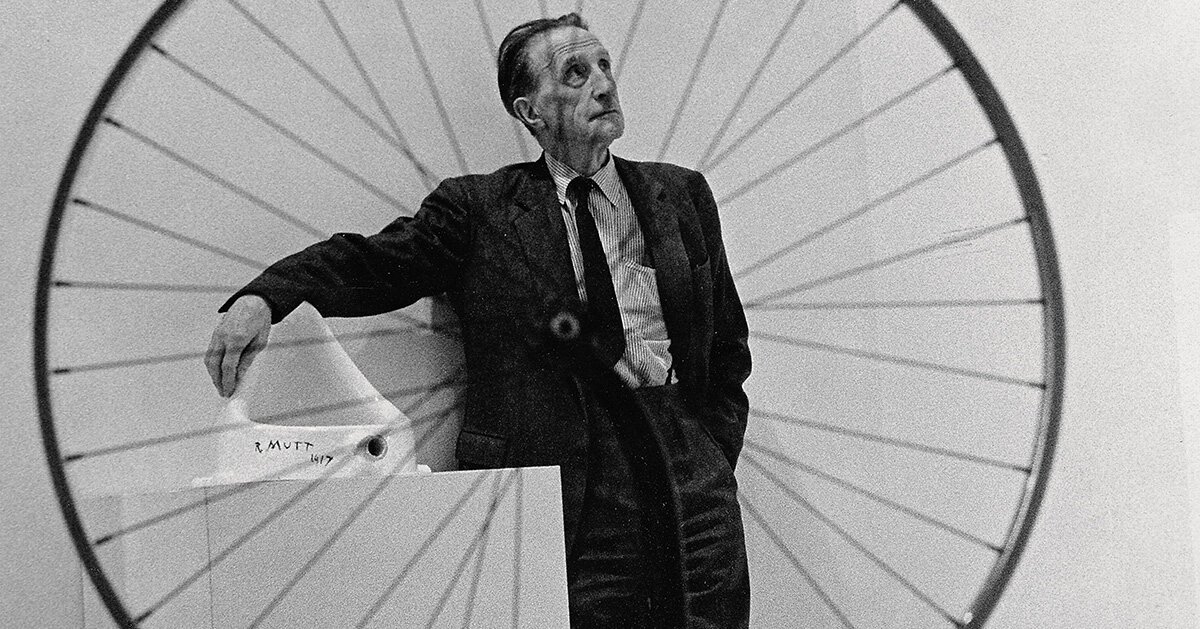

Marcel Duchamp and the object, reactivated
Marcel Duchamp’s bicycle wheel, with its spokes spinning over an aimless wooden kitchen stool, is arguably the most consequential non-art work in art history. Not a sculpture in the traditional sense, not an object, it hovers in a state of suspension between utility and thought, action and speculation. Combined with Fountain (1917), a porcelain urinal rotated ninety degrees and signed with the pseudonym R. Mutt, these objects usher in a change in the way form, writing and meaning are understood. it never fully resolved itself.
What Duchamp started was a slow-release mechanism, a way of thinking that drifts, mutates and reappears in time, activating new meanings each time we encounter it. Now, more than a century after their creation, two at the same time exhibitions in New York, a major retrospective at Museum of Modern Artand a focused presentation of the Schwarz editions of 1964 in Gagosianthey bring ready-mades back into focus, not as historical relics, but as what they have always been: productive, unsolved challenges.

Alfred Stiglitz. Fountain (photo by Marcel Duchamp ready). New York, 1917. Gelatin silver print. Box in a Valise Archive, private collection, USA. © Association Marcel Duchamp / ADAGP, Paris / Artists Rights Society (ARS), New York 2026
ready and The grammar of displacement
Duchamp identified two mechanisms that transform an ordinary constructed object into a conceptual event: displacement and determination. Displacement removes the object from its functional environment and deposits it in the gallery, where its “useful meaning” evaporates. A urinal on a pedestal is no longer hydraulic. it’s a suggestion. Determination is the dominant act that makes it possible, the artist’s choice, not his hand, constitutes the creative gesture. Whether or not Duchamp made the object is completely beside the point. The fact of selection, the act of pointing and naming, is what elevates the object to the dignity of a work of art.
If displacement and designation are the structural mechanisms of the ready, language is its volatile accelerator. The titles Duchamp gave his objects were instructions for misreading. In Advance of the Broken Arm (1915) anchors a static snow shovel in a future narrative of accident and consequence. Trébuchet (1917), a coat rack nailed to the floor, borrows a chess term for a pawn positioned to trip an opponent while simultaneously hitting the trébucher, to trip, making the object a physical and linguistic trap for the unsuspecting visitor. LHOOQ (1919), in which a mustache painted on a postcard of the Mona Lisa hides a crude French phonetic joke, performs what Duchamp called the “rectified readymade,” a repudiation of high culture through the mechanism of vulgar puns.

Marcel Duchamp Porte-chapeaux (Hat Rack), 1964 (after 1917 original lost) Wood, 9 × 18 × 13 in (23 × 45.7 × 33.3 cm), ‘Ex Arturo’ (1 of 2 AP) + edition 8 + 2000, HC Marcelists/Duchamp Society (ARS), New York 2026. Photo: Rob McKeever
The indifferent eye
Central to Duchamp’s methodology is the deliberate suspension of aesthetic taste in the selection of objects. The choice of a bottle rack, snow shovel or comb was made on the express condition that neither attraction nor repulsion played a role. By evacuating the object of conventional beauty, be it good taste or bad, Duchamp forces the viewer to confront a more fundamental question than ‘Is this beautiful?’ The question becomes, simply, “Is this art?’ This question, deceptively direct, turns out to have no fixed answer. It continues to be reborn, to change shape with each new context in which the work appears, and it is precisely this inexhaustibility that gives the finished product its structural resilience over more than a century of institutional, critical, and cultural change.
The Schwarz editions of 1964 complicate the logic of the ready-made in ways that Duchamp almost certainly anticipated with satisfaction. Created in collaboration with Italian gallerist Arturo Schwarz, these are replicas of works that, in many cases, no longer exist physically, handcrafted reconstructions of objects that were themselves industrially produced. An original copy of a copy, made by hand to look like something made by machine, circulating in a market organized around the myth of uniqueness. These versions do not undermine the authenticity of the finished product. extend his argument. If the first gesture declared that choice, not art, was the condition of art, the Schwarz editions declare that the concept, not the physical object, is where authenticity lies. The work survives its disappearance.

Marcel Duchamp. Bottlerack, 1961 (copy of 1914 original). Galvanized iron, 23 3/8 x 21 1/4″ (59.4 x 54 cm). Philadelphia Museum of Art: Gift of Jacqueline, Paul and Peter Matisse in memory of their mother, Alexina Duchamp, 4-23-1998
in mom, the artist becomes the chosen one
The MoMA retrospective, the first major North American survey of Duchamp’s work in more than fifty years, runs through August 22, 2026. Co-curated by Ann Temkin, Michelle Kuo, and Matthew Affron, the exhibition spans three hundred works over six decades and is organized with what the curators describe as “deadpan accuracy.” The copies appear at the moment in Duchamp’s career when they were created, rather than as stand-ins for lost originals, a decision that activates rather than resolves the retrospective logic at the heart of the practice.
Duchamp’s transition from artist-creator to artist-as-chooser, from retinal to cerebral, is fully captured here, beginning with his early Impressionist and Cubo-Futurist paintings and ending with his Box in a Valise (1935-41) portable museum, in which miniatures represent his original copies. The central argument of his career, that the creative act belongs to both the viewer and the artist, becomes structurally legible throughout the arc of the research.

Marcel Duchamp, Bicycle Wheel, 1951 (third edition, after the lost 1913 original). Metal wheel mounted on painted wooden stool, 51 x 25 x 16 ½” (129.5 x 63.5 x 41.9 cm). Museum of Modern Art, New York
Gagosian repeats the 1964 Schwartz editions
Opening on April 25, 2025, the Gagosian exhibit at 980 Madison Avenue carries a more specific historical charge. The gallery’s new ground floor space opens with Schwarz’s 1964 readymades, the same works that made their American debut in the same building, then occupied by Cordier & Ekstrom Gallery, more than sixty years ago. The exhibition includes the only surviving example of the 1964 bicycle wheel that is not held in a permanent museum collection.
The decision to open with Duchamp positions these works, carefully crafted replicas produced by artisanal means in deliberate imitation of industrial production, as the conceptual foundation from which contemporary practice extends.

Marcel Duchamp. LHOOQ, 1919. Pencil reproduction of Leonardo da Vinci’s Mona Lisa, 7 ¾ x 4 ⅞” (19.7 x 12.4 cm). Private collection
Meaning as a relational field
What both reports make visible is the extent to which the ready refuses resolution. Displaced from its functional context and repositioned on a pedestal or the floor, the object loses its useful meaning and becomes something less stable: a constant oscillation between thing and point. Duchamp’s titles, In Advance of the Broken Arm (1915), Trébuchet (1917), LHOOQ (1919), are not descriptive but productive, using puns, temporal displacement and linguistic misdirection to keep the object in perpetual motion.
Meaning, in this system, is produced in the encounter between the object, its title, the space it occupies, and the viewer who tries to bridge the gap. “The viewer brings the work into contact with the outside world” Duchamp argued in his 1957 lecture The Creative Act, a formulation that envisages not only conceptual art and installation practice, but the logic of the viral image, the meme, the screenshot that circulates without context. As Michelle Kuo notes, Duchamp anticipated our prediction markets, the idea of speculation, and even virality, positioning LHOOQ as a proto-meme that entered and continues to circulate in the cultural bloodstream.
Taken together, MoMA’s retrospective and Gagosian presentation offer something rare: sustained, rigorous attention to works designed to resist just that. The ready continue to keep open the question of what art is, who makes it, and where meaning lives.

Marcel Duchamp. Fountain, 1950 (copy of 1917 original). Porcelain urinal, 12 x 15 x 18 inches (30.5 x 38.1 x 45.7 cm). Philadelphia Museum of Art: 125th Anniversary Acquisition. Gift (by exchange) of Mrs. Herbert Cameron Morris

Marcel Duchamp Fresh Widow, 1964 (after 1920 original) Paint, wood, metal, leather and glass, 30 × 20 ⅛ × 4 in. (76.5 × 53 × 10.2 cm) “Ex Arturo” (1 of 2 AP) + ADPchamp, published by Paris/Artists Rights Society (ARS), New York 2026. Photo: Owen Conway



