

A bench that carries more than rest
Francesco Faccin unveils Pancalpina, a hybrid bench designed for alpine landscapes and developed in Trentino, Italy. The project serves as a solid piece of infrastructure for rest and emergency shelter. Placed along mountain paths, it initially reads as a familiar object, positioned for a pause and oriented towards distant vistas. Its proportions and stance align with the trail bench typology, a quiet presence against rock, grass and sky.
Spend a moment with him and the plan begins to change. The volume under the seat has a hidden system that can be activated when conditions change. What appears stable and unique reveals a second function, one that extends the function of a simple bench into a piece of survival equipment.

Pancalpina is a hybrid bench designed for alpine landscapes in Trentino | image © Studio Francesco Faccin
Structure, materials and transformation
The manufacture of Studio Francesco Faccin it is direct and easy to read. Solid pine wood forms the main structure, chosen for its durability and ability to weather at high altitude. Stainless steel fittings reinforce joints and anchor points, ensuring the item remains stable through seasonal changes, humidity and temperature extremes. Surfaces are left with a tactile honesty, grain visible and edges precisely defined.
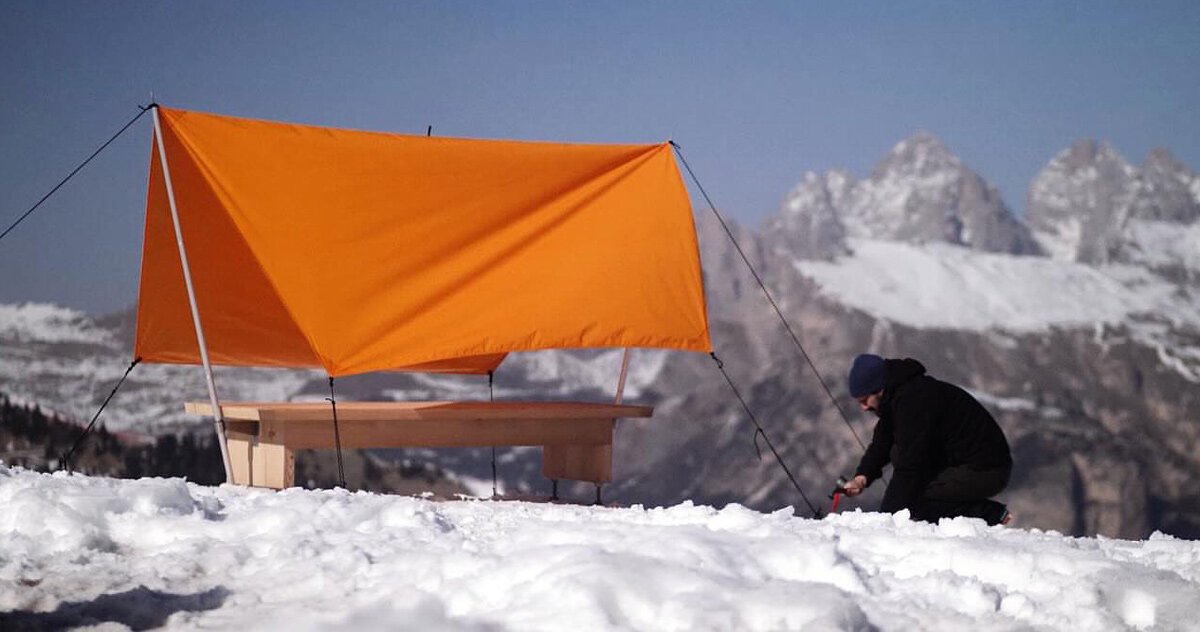
The transformation from bench to shelter is based on the structure itself. Components built into the frame support a lightweight tent that can be assembled using the bench as a base. The inner compartment stores essential items: thermal blankets, shovel, torch and tools needed to attach the temporary cover. The process is simple, designed for clarity in moments that require quick decisions.

the object is both a place of rest and a point of orientation along paths | image © Fabio Petronilli
A response to the change of use of the mountain
Francesco Faccin approaches Pancalpina as a response to the increasing pressure on alpine environments. Warmer seasons extend access to higher elevations and more people move through these landscapes with varying levels of preparation. The project addresses this shift through a small, distributed intervention rather than a large construction.
Located on a network of paths, the object offers a point of orientation and a measure of safety. It recognizes the mountain as a place that can change quickly, where weather and visibility change without warning. The bench remains unobtrusive in its formal configuration, contributing to the landscape without drawing attention away from it.

a hidden compartment turns the bench into a minimal emergency shelter | image © Studio Francesco Faccin
Between infrastructure and object
Within the wider family of alpine elements, Pancalpina is somewhere between furniture and infrastructure. Shelters and bivouacs mark more permanent sites, often visible from a distance. Benches operate on a smaller scale, tied to moments of rest. This project expands on that role, adding a level of readiness without increasing visual impact.
The decision to integrate the survival kit inside the bench keeps the intervention compact. There is no separate storage unit or additional enclosure. Everything is contained in a single object that maintains a consistent footprint whether in use or at rest.

the structure uses solid pine wood and stainless steel for high altitude durability | image © Studio Francesco Faccin
Production and collaboration
The project was commissioned by Provincia Autonoma di Trento and coordinated by Trentino Sviluppo, supported by Trentino Marketing and curated by Paolo Baldessari and Aldo Colonetti. Fabrication by Falegnameria Decrestina brings design into a context of local production, where knowledge of materials and climate informs construction.
Studio Francesco Faccin collaborated with Alberto Manca and Luigi Bailon to develop the object to the level of detail required for outdoor use. Every component is considered for longevity, assembly and maintenance, with the goal of keeping the system reliable over time.

the bench supports a light tent assembled from its own frame | image © Fabio Petronilli



