
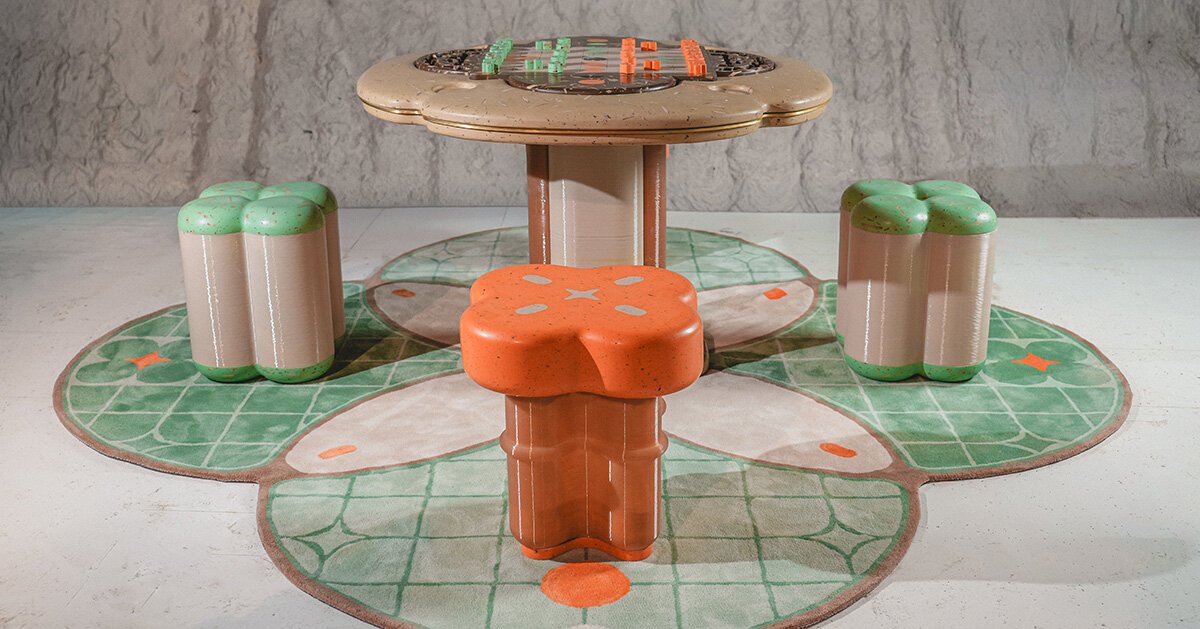

recycled bamboo chess table and tea waste from reEDIT
At Milan Design Week 2026, upcycled design studio reEDIT makes its European debut with The Upcycled Gambit — Bamboo & Brew Chess Table Set, an installation that reframes the chessboard both as an object and as a social infrastructure. Exhibited at Isola’s No Space for Waste reportthe work draws from the everyday scenes of Xiangqi games that take place on the streets of Hong Kong, where the game becomes a ritual and the public space becomes a place of exchange. Installed at the Fabbrica Sassetti, the project translates this collective memory into a habitable object. A chess set and stools invite visitors to gather, sit and engage, echoing the informal gatherings that inspired it.
THE material The logic of the project is based on reuse. Scrape bamboo derived from construction scaffolding, milk tea waste and recycled plastic combine into a complex system that balances structural clarity with narrative material. Bamboo, long embedded in Hong Kong’s urban fabric, becomes a structure and a symbol. Tea waste, usually discarded after brewing, is reworked into the surface language of the piece, incorporating traces of daily rituals into the object itself. The result is less about aesthetic innovation and more about continuity, extending the life cycle of materials while maintaining their cultural associations. Designed to be disassembled and rebuilt, the chess set functions as an open system, aligned with circular design principles that prioritize longevity and adaptability.

all images courtesy of reEDIT unless otherwise noted
no room for waste: a broader context
Upcycled Gambit is at No Space for Waste, one of Isola’s recurring exhibitions focusing on circularity, slow production and material experimentation. Now in its third edition, the showcase expands on previous themes explored in Materialized, Circolare and Is One Life Enough?, bringing together designers working with discarded or underutilized resources.
At Fabbrica Sassetti, this framework unfolds alongside several parallel exhibitions. Isola Design Gallery’s seventh edition explores collectible and handcrafted pieces across an international roster, while Rasa — The Indian Collective explores the emotional dimension of design through craft traditions and contemporary reinterpretations. The Dutch Atelier highlights designers based in the Netherlands, emphasizing conceptual clarity and experimentation. Together, these exhibitions construct a multi-layered narrative around material, process and identity, positioning waste not as a residue but as a starting point.

reEDIT makes its European debut with The Upcycled Gambit — Bamboo & Brew Chess Table Set
live production and adaptive systems
Beyond static displays, several installations activate the space through process. LE LABO 1.0 by Baguette Studio functions as a live production environment where lamps are formed on site using removable natural wax, bringing to the fore a reversible and waste-free manufacturing approach. Nearby, IAMMI’s UNIT-01 constructs a translucent modular volume from second-life plastic, while the University of Montenegro’s MOCK UP JUNK LAB re-examines discarded materials through student-led experimentation.
Among the standout items in the wider Isola program is the Brutalist Pink – Vinyl Listening Station from YONT Studio. Originally developed for a hybrid record store in Berlin’s Mitte district, the piece translates the exploration of raw interior space and studio musical culture into a compact, sculptural listening device.
Constructed of a wooden frame with a layer of dense foam and finished in colored epoxy, the object combines storage, playback and acoustic calibration in a single volume. Its presence in Milan extends the narrative of adaptive reuse and hybrid typologies, where retail, performance and social space converge.

an installation that reframes the chessboard

exhibited at Isola’s No Space for Waste exhibition

the work draws from the everyday scenes of the Xiangqi games

Upcycled Gambit is inside No Space for Waste | image ©designboom

the project translates this collective memory into a habitable object

inviting visitors to gather, sit and engage

YONT Studio vinyl listening station | image ©designboom

Isola Design Festival 2026, Isola Design Gallery | image ©Anwyn Howarth
project information:
name: The Upcycled Gambit — Bamboo & Brew Chess Table Set,
designer: reEDIT | @re_edit_lab
report: There is no room for wasteIsola Design Festival 2026
location: Sassetti Factory, via Filippo Sassetti 31, Milan, Italy



