

S-AR reinterprets a chapel through thin concrete walls
Inside a garden in Santiago, Nuevo León, Mexicothe Oratory Chapel from S-AR understood as a small-scale structure that reinterprets a previous one chapel once stood in the same place. The project reuses elements from the older construction, establishing a spatial and material continuity between past and present.
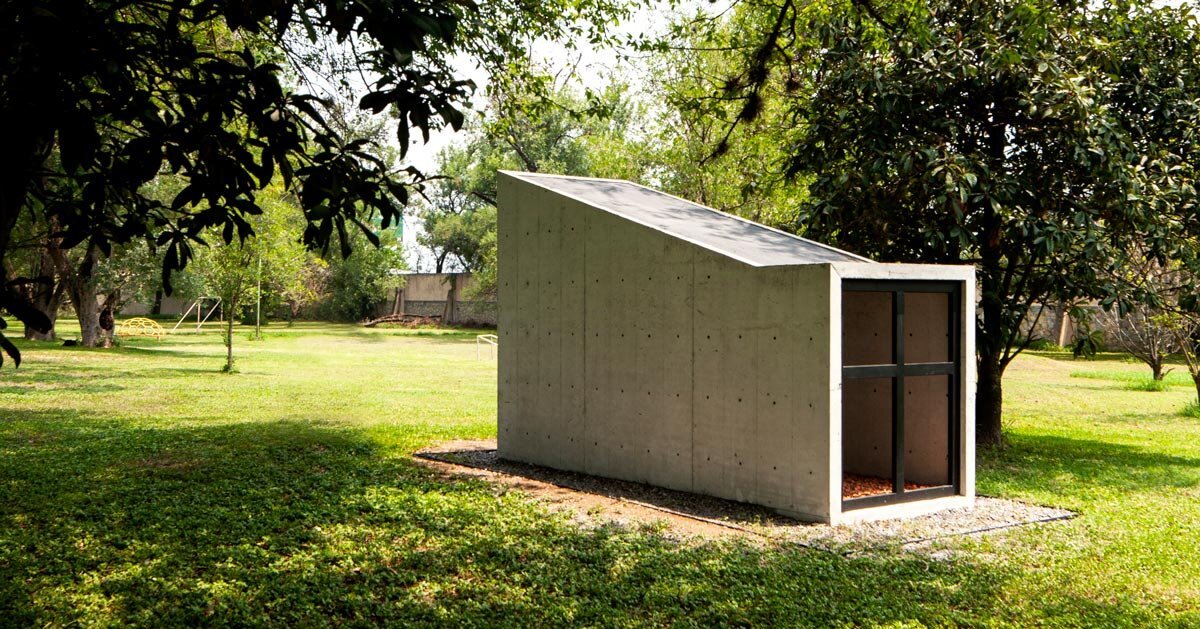
The chapel is defined by two reinforced concrete walls, each 8 cm thick, placed at various heights along a diagonal. These walls support a thin 6.5 cm concrete slab, forming a narrow tunnel-like space. The construction follows a regular formwork configuration, while openings left within the wall system allow light and air to pass through, softening the enclosure. At one end, the increased height allows access to the interior space formed between the structural elements.

all images courtesy of S-AR
reused bricks and steel carry the memory inside the chapel
Inside, a wooden bench rests on a crushed red brick floor, introducing a contrasting texture to the concrete envelope. At the lower end of the structure, a geometric iron cross made of metal profiles defines the boundary of the space. This element, together with the broken brick, exposed rebar and existing foundation, comes from the earlier chapel, which was built to the same orientation and scale.
Through this reuse, the project by S-AR Studio it functions as a continuation rather than a replacement. Materials from the previous structure are reassembled in a new configuration, allowing the chapel to retain traces of its former presence. The result is a compact architectural intervention that integrates memory, material and location into a single, continuous form.

the Oratory Chapel by S-AR is located inside a garden in Santiago, Nuevo León

the project reinterprets a chapel previously built on the same site

elements from the previous structure are reused in the new structure

Two reinforced concrete walls define the form of the chapel



