
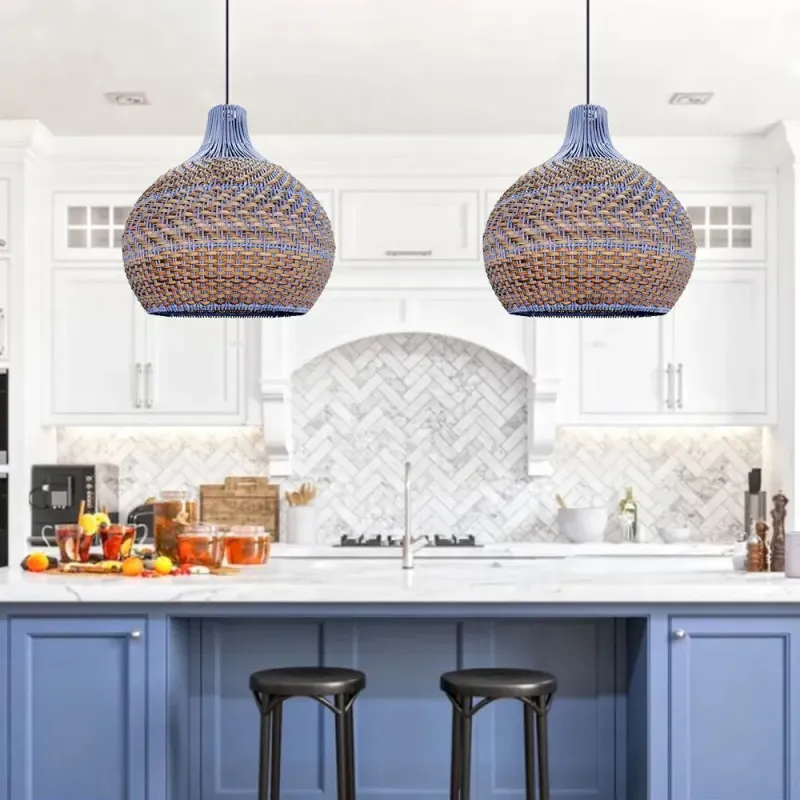

Blue pendant lights it can do two things: make a room look sharp and purposeful, or make it feel like a rental that’s trying too hard. The difference is in shade, size and height – not the marketing copy on the box.
If you are going to use blue pendant lights in a kitchen, dining room or seaside interior, you have to commit. Pale, faint blues disappear. Strong cobalt, navy or deep Aegean actually read as a statement and don’t get washed out by daylight or bright white walls.

Why Blue Pendant Lights Work (When You’re Not Playing It Safe)
Blue pendant lights they are pendant lights with blue shades – usually glass, but also metal, ceramic or even wood with a blue finish. They are popular in kitchen islands, dining rooms and in beach rooms because blue looks fresh, cool and architectural.
But here’s the problem: most people choose a soft icy blue because it looks “light and airy” online. Then they install it and wonder why the kitchen gets cold and the pendants disappear as soon as the sun comes out.
If you really want a focal point, choose:
- Cobalt blue – saturated and bright, works with both warm woods and crisp whites.
- Navy blue – more refined, goes well with brass, black or polished nickel.
- Deep Aegean glass or sapphire – gives a rich glow instead of that cheap LED blue look.
These deeper tones still feel coastal and calm, but they actually show up in a real room, not just a product photo.

The best types of blue pendant lights for kitchens and dining rooms
Blue Glass Pendant Lighting: What Really Works in Real Life
Blue glass pendant lamp looks great in photos and brutally honest in real life. Clear blue glass over a busy kitchen island will advertise every fingerprint, grease splatter and dusty LED bulb. If you cook more than once a week, that gets old fast.
Best options:
Translucent, deeper blue glass. Consider cobalt or navy-colored glass that still lets light through, but hides dirt and the lamp a bit. You get shine, not shine.
Textured or ribbed blue glass. Corrugated, bubbled or seeded glass hides smudges and looks more expensive. It also softens the light, which is useful above a dining table.
Opaque or semi-opaque shades of blue. Glazed metallic, ceramic or painted shades in navy or blue ink give very clean lines and focused downlighting – ideal for island task lighting.

Shape Meaning: Bell, Sphere, Dome & Mini Locket
Different shapes do different jobs:
Bullets. Ideal for modern and mid-century kitchens. Clear or lightly colored spheres fit the islands if you use a lot of pendants, but they get bigger than you think. Three tiny globes above a 3m island look like an abandoned track beacon.
Bell-shaped shades. Classic and easy to live with. Bell pendants in navy or cobalt glass or metal work well in both traditional and transitional kitchens.
Dome pendant. Stronger “object” presence, great for dining rooms and over islands when you want blue to read clearly from the side.
Mini pendant. Nice over small peninsulas or a narrow bar. Above a large kitchen island, three mini blue pendant lights are a design faux pas. Go bigger and bigger or skip the pendants altogether and use linear fixtures.

Blue pendant lights for kitchen islands: Right size and quantity
The kitchen islands are there blue pendant lights for kitchen island get attention – or you look like an afterthought. The common mistake? Small-sized, overmultiplied fixtures.
Basic sizing rules that really work:
1. Go beyond your gut. For a typical 2.4–3 m (8–10 ft) island, look at pendants in the 30–40 cm (12–16 in) diameter range. If you have a larger island, you can push to 45 cm (18 in) and be fine.
2. Two big beats three tiny. Two substantial navy blue pendant lights look purposeful and architectural. Three small pendants feel structurally and visually noisy. If you find yourself hovering over 15 different “mini” options, you’re already on the wrong track.
3. Don’t list a whole row of blue. If your cabinets or island are already blue, matching the pendants exactly makes the room look like a catalog “set.” Contrast is your friend: deep navy lights over light blue or white cabinets or vibrant cobalt over warm wood.

How high to hang pendant lights over an island
Hanging pendants too high are completely lost. They float in space and make your kitchen feel like a big store with random light fixtures.
The sweet spot for how high to hang pendant lights above island is very clear: aim for the bottom of shade 75–86 cm (30–34 in) above bench. This range works in almost any standard height kitchen.
Use this quick check:
Stand on the island where you are preparing food. The pendant should sit low enough that you feel connected to the island, but high enough that you won’t hit your head or look at the lamp when sitting on a stool. If you can clearly see the top of the shadow from across the room, it’s probably too high.
Adjustable laces are non-negotiable. Ignore any “modern” blue pendant sold on a solid, non-adjustable stem unless your ceiling height is the same as the screen photo – which it isn’t.

Coastal Blue Pendant Lights for Dining Rooms (Without the Beach Condo Look)
Blue pendant lights in seaside dining rooms can be lovely – until they’re thrown into a room already drowned out by seashell art, rope mirrors and ‘Beach House’ signs. Then your pendants become another cliché.
If you want seaside blue pendant lights for dining room when you feel grown up, do the following:
Keep the room mostly neutral. White or soft beige walls, wood or jute underfoot, simple linen or cotton fabrics. Let the blue pendant be the main color accent.
Use a strong statement. A larger blue dome or ball pendant centered over the table usually looks better than a cluster of small ones. The dining room needs a clear focal point, not a cluster.
Pay attention to the temperature. Shades of cobalt or Aegean blue look stunning with warm wood tables and brass or bronze hardware. Navy plays nicely with black accents and cooler grays.
Height guideline: hang the bottom part of the locket 75–90 cm (30–36 in) above the table. Lower in a tall room for intimacy. slightly higher if the fixture is very bulky or you have tall people in the house.





