


Anyone who has experienced a July with the wrong curtains knows what we are talking about. It’s not a matter of aesthetics: it’s a matter of degrees. West-facing rooms, those with large windows, studio apartments with a single window facing south, in some apartments the summer heat is not an inconvenience, it is a natural presence. However, the answer is there and it’s simpler than you think: change the curtains. Not as a seasonal decorative gesture, but as a functional choice that affects comfort, bills and sleep quality. We are in the middle of June.
The meteorological summer has already begun, the astronomical summer arrives in a week. The time to intervene is not after August 15, when the damage is already done: it is now, before the first really warm days transform the living room into something unsustainable. THE thermal curtains they are not all the same and the difference between a model designed for winter and one for summer is not only about the color or the weight of the fabric.
Summer and winter do not have the same enemies
In winter the problem is heat retention: thermal winter curtains act as an insulating layer, preventing the warm air from dispersing through the glass and creating a small air chamber between the fabric and the window. For this reason it is often Lined with technical materials, the most common being acrylic fabric with heat reflective treatment on the backit is sometimes combined with a layer of flannel or fleece and tends to be a heavy, stiff vertical drape with little or no sheer. They work well, but in the summer they become a problem: they absorb heat instead of rejecting it and limit natural ventilation even in the cooler hours.
Summer thermal curtains work with the opposite logic. Their purpose is reflect solar radiation before it enters the environment, not after. The difference is when the heat is interrupted: on the outside of the glass it is ineffective (that’s why there are awnings), but on the inside surface of the window, with the right fabric, it can block a significant part of the radiant heat.
Some residential thermal comfort studies show that reflective-coated curtains can reduce solar heat gain by up to 45% compared to an uncovered window, a figure that varies significantly depending on exposure and glass surface.
The summer models worth getting to know
The summer thermal curtain market has evolved in recent years and today it is no longer a matter of choosing between a total blackout and a transparent curtain. There are three main categories, with very different features and price ranges.
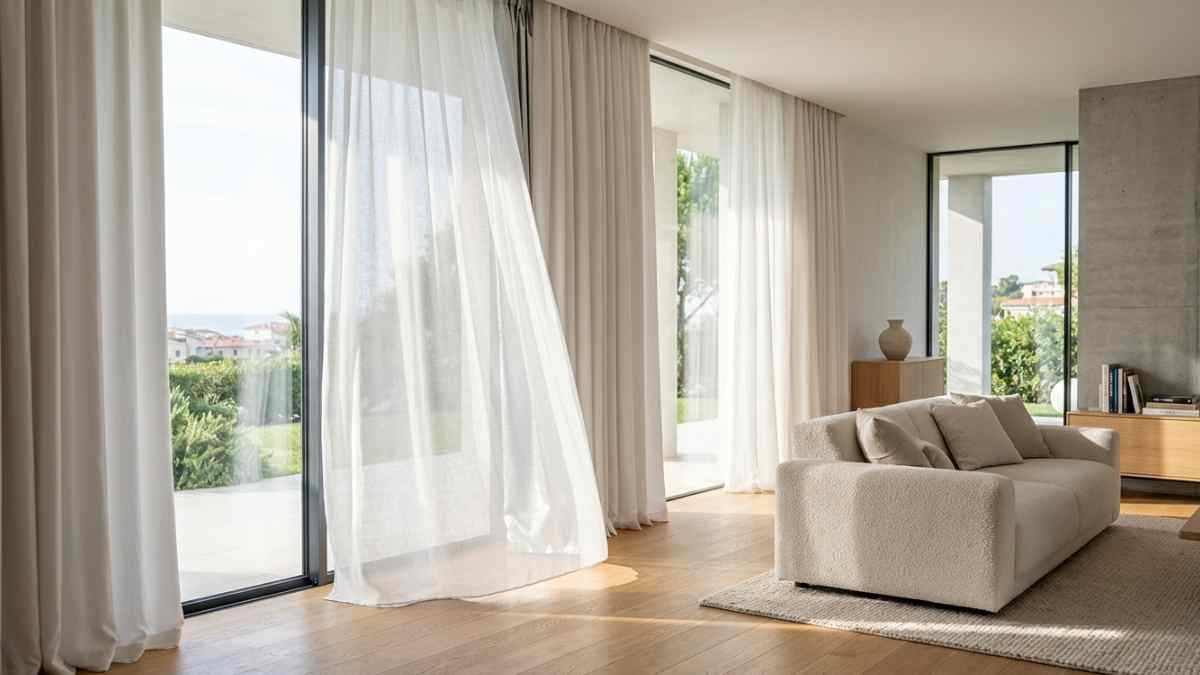
The first is the rolls with solar screen treatment. The fabric is a micro-perforated mesh that is technically an open fabric, with an opening percentage ranging from 3% to 10% that reduces direct radiation without eliminating the view to the outside. Ikea offers the Tretur range, with built-in blackout trim, starting at around €25 for standard sizes. For something more technical, Hunter Douglas with the Duette series offers cellular blinds with an internal air chamber, the most efficient system in terms of insulation with prices starting at 150-200 euros per window. The difference in performance is real, not just price.
The second category is the Roman or Roman blinds in treated linen. They have a more traditional look and are best suited to classic or rustic interiors. Natural linen, on its own, does not perform particularly well thermally. but some manufacturers such as Dedar or Rubelli in the high end or Zara Home for those looking for something more affordable, offer versions with a technical coating on the back that improve performance without changing the aesthetics of the front. Approximate cost: between 80 and 300 euros per panel, depending on construction and size.
The third option, which is often underestimated, is the sliding panel curtains in two-tone technical fabric white or light outside, darker inside. The principle is that of Venetian blinds with reflective slats: the light side reflects solar radiation outwards, the dark side absorbs less heat from the inside. They are practical, modern and adapt well to large windows and French windows. Prices from 40 euros per panel in large-scale distribution versions.
Because the switch is worth it, if only practically
The argument against seasonality is always the same: it’s inconvenient, you have to disassemble, put away, reassemble. But the issue needs to be addressed more directly. A heavy winter tent, in the summer, not only does not protect from the heat, it holds it back. The dense fabric heats up, becomes a secondary radiant surface and in the evening hours can increase the perceived temperature of a room by up to 3-4 degrees. This is no small thing, especially in bedrooms.
The seasonal change of curtains therefore coincides with a natural opportunity for wash the clothes: Heavy curtains accumulate dust, mites and allergens in the winter months. Storing them cleanly extends the life of the fabric and improves indoor air quality, a detail that becomes relevant for people with respiratory problems or small children.
On an economic level, the logic is simple. An 80 m2 apartment with five windows facing west or south, equipped with adequate summer thermal curtains, can reduce the use of air conditioning in the central hours of the day. If you consider a 2.5 kW air conditioner that works two hours less per day for 60 summer days, at 0.25 euro/kWh we are talking about 75 euro savings per season. Investing in average quality tents pays off in two or three summers.
How to choose without making a mistake
A recurring mistake when purchasing thermal roller blinds is underestimating its importance side placement. A curtain that leaves space between the edge of the roller and the wall or window frame loses much of its thermal efficiency: heat enters from the sides. For this reason, the systems with rigid side guides present in the more structured models such as those of the Ikea Fyrtio series or the Sunproject products offer a significantly superior performance compared to free installation, regardless of the quality of the fabric.
Standard sizes cover most Italian windows, but arched windows, French windows with protruding handles or blackout systems built into shades require customized solutions. In these cases, manufacturers such as Mottura or Coulisse Italia offer custom configurations with delivery times of two to three weeks, a detail to consider if you want to be ready before the July peaks.
The deadline for ordering and assembly is next week. Then comes summer and with it the first few nights wondering why we didn’t move sooner.



