


The bathroom is the room where silence should be guaranteed, and on the contrary it is often the noisiest in the house. It’s not the fault of those who live there, but how it’s built and covered: hard surfaces everywhere, floor to ceiling tiles, glass, steel, ceramics.
Materials designed for hygiene and durability, not acoustics. The result is an echo chamber in the home where the sound of a toothbrush bounces off the walls three times before disappearing. However, a few targeted choices are enough, some of which fit without altering the aesthetics, to transform a bathroom into a space that really approaches the idea of a sanctuary.
It’s not about luxury in the traditional sense of the term: rare marbles, contract catalog faucets, freestanding bathtubs. It’s a matter of physics and knowing how to intervene in the right place.
Because the bathroom looks like a cathedral
The echo experienced in a typical bathroom is not a manufacturing defect: it is the direct consequence of non-porous, non-textile, non-absorbent surfaces. Sound waves strike a tiled wall and return almost intact, with a reflection coefficient approaching that of a poorly equipped rehearsal room. The reverberation time, which in residential rooms should remain below 0.4-0.5 seconds, in a medium-sized bathroom can easily exceed one second. It does not sound like a separate echo, but like a continuous background noisea condensation of sound that tires you without understanding the source.
To complicate the situation, the pipes. In many houses built between the 1960s and 1980s, the waste pipes run through the walls without any acoustic protection, and the sound of running water becomes completely audible not only in the bathroom itself, but also in the adjacent rooms. The most recent Italian regulations, notably UNI 11173 and the passive acoustic requirements of buildings, have introduced more stringent standards, but the existing housing stock remains largely exempt from these measures.
The insulation you can’t see: walls, ceilings and how much it costs to get it right
Working on the bathroom file requires a fundamental distinction: theacoustic insulation (preventing sounds from entering or leaving) and sound absorption (reducing internal bounce) are two different problems that require different solutions. Confusion of them is the most common mistake in renovation projects.
For wall insulation, the most effective solution is a plasterboard false wall with stone wool interpolation. Knauf and Siniat, among the most popular manufacturers in the Italian market, offer dry systems with water-repellent sheets specifically for wet environments: a double sheet of 12.5 mm combined with high-density rock wool of 60-80 mm allows you to obtain a sound reduction index of Rw 50-55 dB, sufficient to significantly reduce the sound almost completely in the piping. The cost for a standard size wall is between 120 and 180 euros per square meter, including installation.
For the ceiling, a false ceiling made of waterproof plasterboard combined with stone wool performs both functions: isolates from the compartment above and reduces internal reverberation. The loss of clear height must be calculated in advance, usually between 10 and 15 cm, a critical factor in bathrooms with ceilings below 2.60 m.
The accent wall as a technical choice, not just an aesthetic one
In recent years the covering industry has developed products that combine an acoustic function and a decorative aspect, responding to the growing demand from those renovating without wanting to sacrifice the aesthetics of the bathroom. Technical fiberglass upholstery with sound-absorbing hearing support are among the most interesting solutions in this regard: brands such as Vescom or Arte (both of Belgian origin, also distributed in Italy) produce special collections for wet environments with vapor resistance certification and sound absorption coefficients between 0.20 and 0.35 NRC, values which with 4-5 square meters are reduced more on a wall.
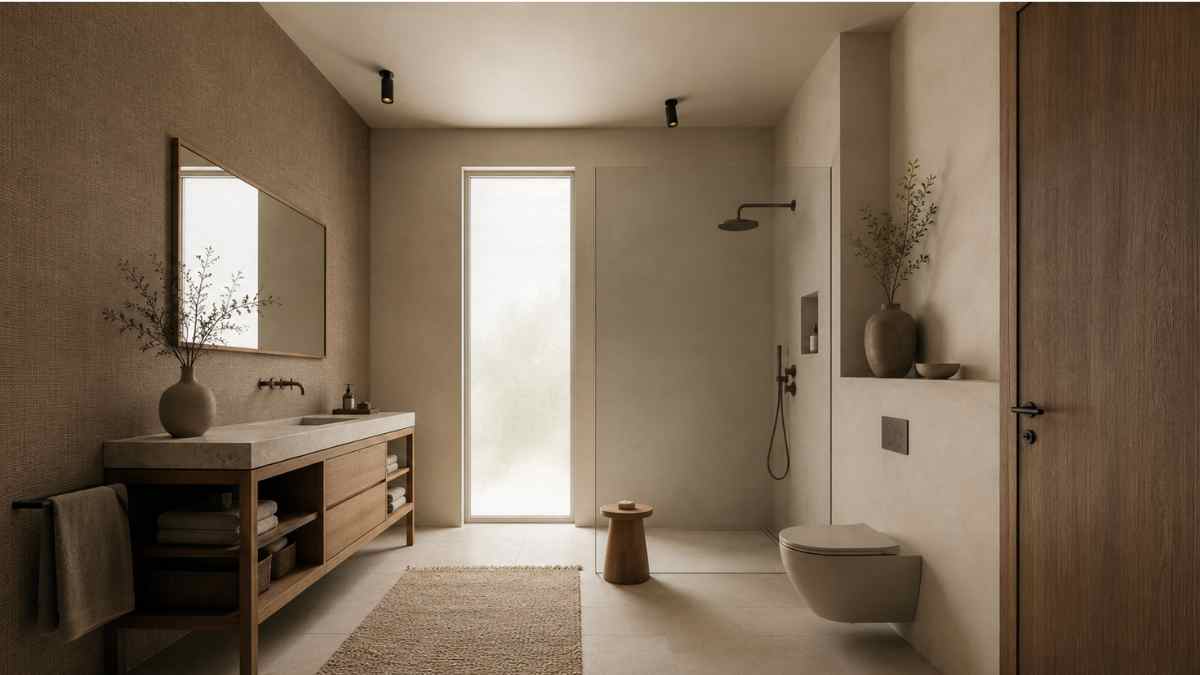
Application to a single wall, the one opposite the door or the one behind the tub or shower, It works well both technically and visually. It creates a focal point, breaks up the monotony of tiling, and introduces a texture that the sound meets rather than bounces off. A panel of acoustic fabric stretched on a frame, a solution used in the contract sector and increasingly adopted in residences, costs from 80 to 150 euros per square meter and can be applied without building work.
The soft elements: where to place them without compromising hygiene
The bathroom resists textiles for legitimate practical reasons. Moisture, condensation, the need for washable surfaces make it difficult to introduce soft materials. However, margins exist and exploiting them changes the acoustic performance of the space in a certain way.
A thick mat isn’t just for foot comfort: a 15-20mm thickness of cotton or wool (brands such as Abyss & Habidecor produce Egyptian cotton bath rugs with a pile height of up to 23mm) introduces absorbent bulk and porosity the middle frequencies, those of voice, mobile phone, flowing water. Heavy fabric shower curtains, in place of fixed panes, add a variable absorbent surface. A bathrobe hanging on the wall does more than meets the eye.
For those with enough space, an open cabinet with solid wood doors; or veneered, like the collections of Boffi or Antonio Lupi in the high range, it introduces a porous and irregular surface that disperses the sound waves instead of reflecting them. The rule of thumb in acoustics, namely that irregular surfaces diffuse better than smooth ones, applies here as well: a facade with moldings or three-dimensional texture works better than a mirror-lacquered panel.
Faucets, drains and the noise coming from inside
One aspect that is overlooked when considering bathroom acoustics is the noise generated by the systems themselves. Some faucets produce a hissing sound at high pressures, a phenomenon called hydraulic cavitationwhich can be solved with a pressure reducer installed upstream (cost: 30-80 euros, installation included). Floor drains with a siphon system and a noise-reducing case, such as those in the Geberit Silent-db20 series, reduce drainage noise by around 25 dB compared to standard solutions: the difference between hearing the water flow and not hearing it at all.
For built-in cisterns, choosing the Geberit Duofix waste system with integrated sound-absorbing sheet reduces the transmission of flushing noise to adjacent walls. It is not a small detail in apartments with shared walls or a bathroom located close to the sleeping area.
A quiet bathroom is like no other place in the house. It has its own dense quality that you can feel as soon as you close the door. Its construction requires attention to materials, plant details and surfaces. And some choices made before, not after.



