
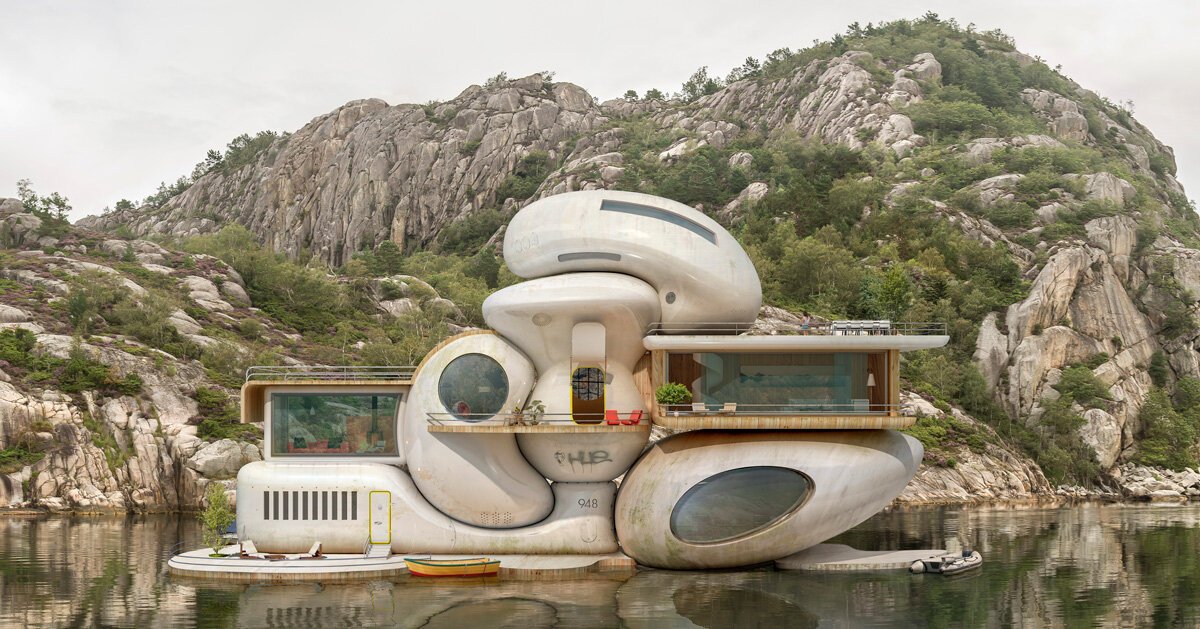

modern cabins in the Norwegian fjords
In ‘Wittgenstein’s Cabin’, visual Dionysios Gonzales envisions a group of fictional residences that in Norwegian fjords drifting between philosophical retreat and experimental habitat. Working in photography, digital manipulation and architectural fiction, the Spanish artist has long focused on redefining forms of life in overlooked or extreme contexts, from informal settlements to climate-exposed landscapes. In this series, González draws from Austro-British philosopher Ludwig Wittgenstein’s 1914 remote cabin, designed and built in 1914 on the craggy shore of Lake Eidsvatnet in Skjolden, to extend the logic of withdrawal into a fluid, unstable water setting. The result amphibious dwellings they function as prototypes for habitation and reflection, translating a historical model of solitude into a speculative architectural language shaped by present conditions.
“There is something revelatory and emphatic about Wittgenstein’s Norwegian cabin, and that is the juxtaposition, the frontality with the fjord, with the water behind the action of the glaciers.” Gonzalez explains. “Wittgenstein worked on his studies in logic on a boat sailed by his friend David Pinsent in the Sognefjord. This fact, this “fact” of research, learning and memorizing in a small water transport, which serves as an office, led me to consider the relationship of architecture with water and philosophy as an “amphibious” endeavour. How would Wittgenstein frame this organic building, this architectural construction in a fluid medium with today’s media? What would modern cabins look like in propagating wave diffraction settings like the Norwegian fjords?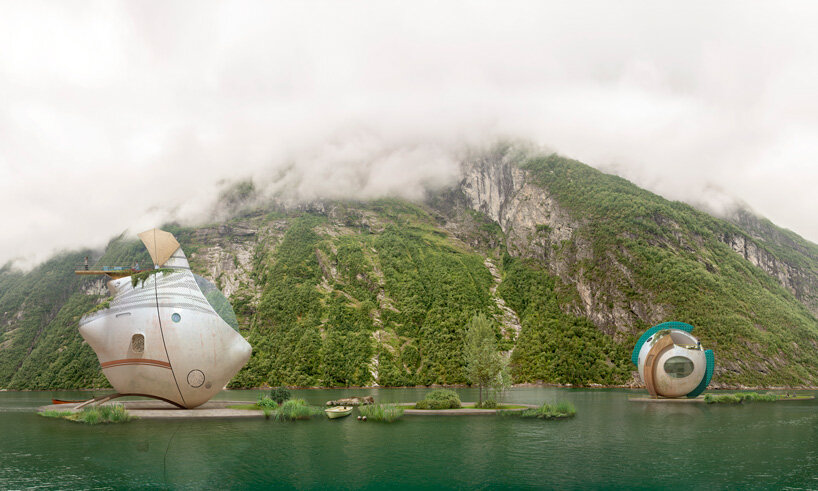
all images courtesy of dionisio gonzález
fantastic water architecture by Dionisio gonzález
Taking Wittgenstein’s Norwegian cabin as a point of departure, González analyzes the early structural design of architecture, the log cabin, as a space for reflection and isolation. “The acoustic properties of wooden houses are excellent, as the wood absorbs the waves it receives.” notes the Spanish artist. “The wooden house is a silent house. The walls of Heidegger’s cabin in the black forest were (are) clad in wooden shingles.’ At the same time, González singles out the encounter with water and the surrounding landscape in Wittgenstein’s cabin and translates it into fantastic examples of contemporary water architecture.
Wittgenstein’s logic studies on a boat sailed by his friend David Pinsent in the Sognefjord inspired González to explore the relationship between architecture and water. “Am Anfang war die Tat” (“in the beginning was the act”), Goethe’s verse to Faust, which Wittgenstein quoted approvingly, was perhaps the rubric, the statement of Wittgenstein’s whole later philosophy. And perhaps also the starting point from which we can face the challenge of building a water shelter. says the artist. “After all, the Austrian philosopher would say, don’t I come closer and closer to saying that logic cannot be described after all? You have to look at the practice of the language, then you will see it.That you will see it is the function of this series. This re-creation of a world of possibilities, complex but anchored in logic, can be perceived as real.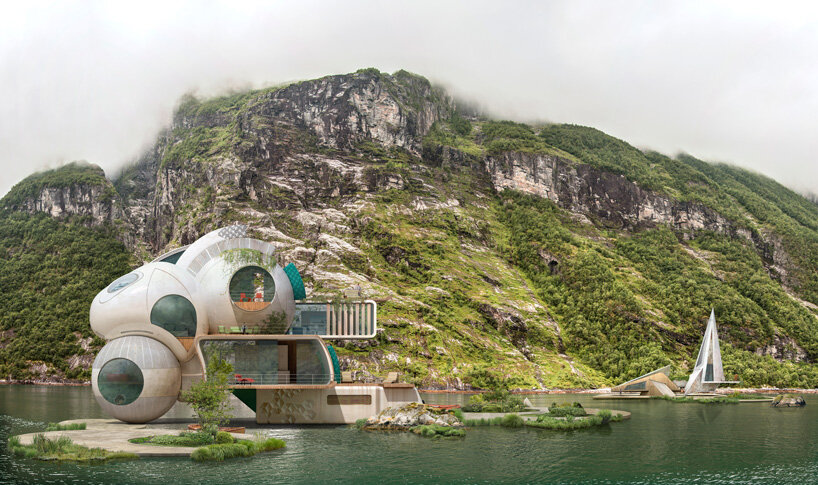
Wittgenstein’s historical model adapted to the present day
Explaining more about the context behind Wittgenstein’s Cabin, Dionisio González says: “In 1914, Ludwig Wittgenstein (1889-1951) sketched and planned the construction of a log house on the steep shore of Lake Eidsvatnet in skjolden, next to the Sognefjord in Norway. In that small space, on a hillside, Wittgenstein had found the tranquility he needed to work ascetically, like a hermit, on his studies in logic. After deciding on the location in which to “settle”, to disappear and concentrate on the work of thought and contemplation, he built a house and a small pier. To access it, one had to cross the lake by boat or walk over the ice in the winter months. It was built on a stone platform – typical of the local architecture – and of wood, with horizontal boards, a slate roof and rooms of different heights. one of its facades was asymmetrical.’
World War I delayed Wittgenstein’s return to Norway until 1921, and his last visit to Skjolden was during the September holidays of 1950, when he was recovering from prostate cancer. There, with his friend Ben Richards, he studied the foundations of Frege’s arithmetic. He intended to return again and bought a ticket on a steamer which was to leave Newcastle for Bergen in December, but by then he was too weak to start the journey. As Heidegger said, we are only capable of dwelling on the basis of rootlessness.
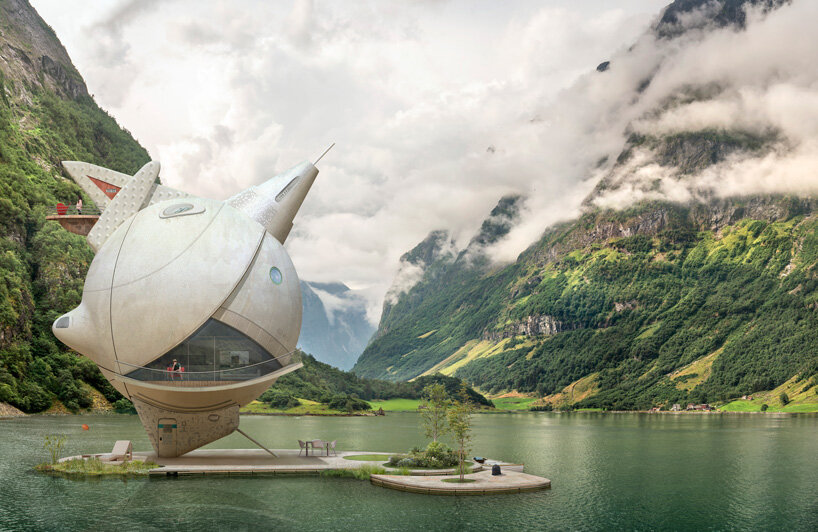
modern water architecture from wittgenstein’s cabin by dionisio gonzález
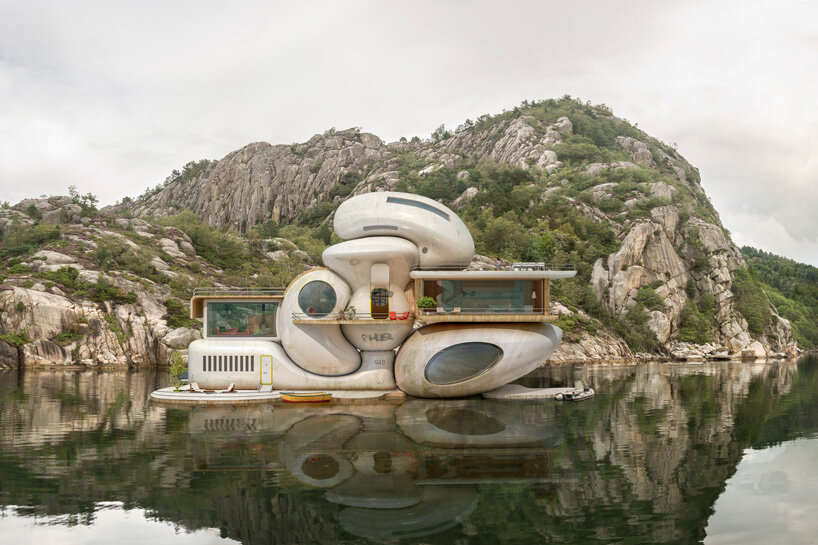
amphibious dwellings floating in the fjords of Norway



