
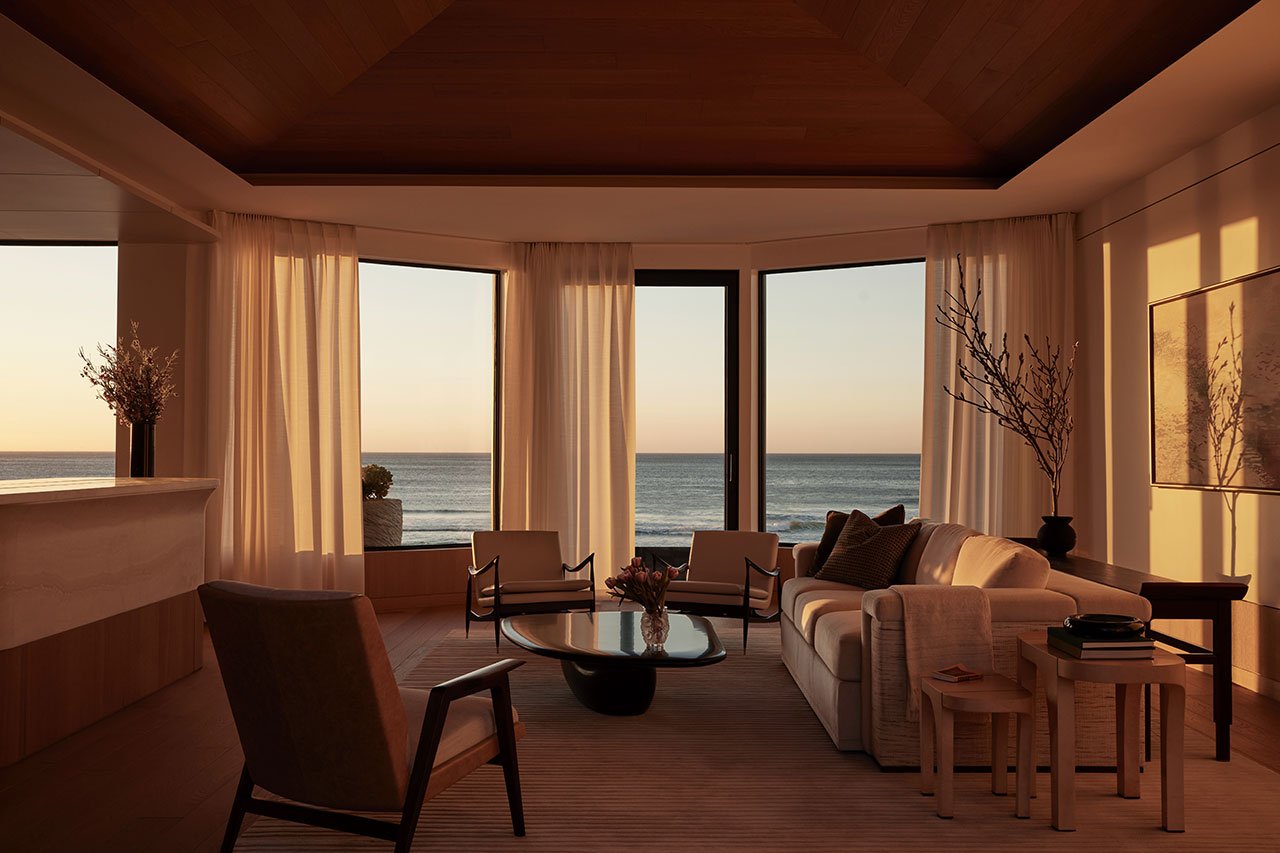

The fundamental tension at the heart of this San Diego residence is familiar to anyone who works along the California coastline: how to make something truly new out of a structure that, by regulation, must remain. Committed to a 1950s footprint that could not be completely demolished under Coastal Commission guidelines, architect Daniel Joseph Chenin approach it La Jolla waterfront project less of a renovation and more of a recalibration—working with a contractor Hill construction to strip the house down to its basic framework before reconstructing an interior that feels entirely recreated, but quietly in dialogue with what came before.


Beyond spatial reconfiguration, the result is a disciplined study in containment. The kitchen island, carved from solid onyx, becomes the project’s conceptual anchor—chosen not for decorative veins, but for its ability to hold and refract light, mimicking the rhythmic glow of the Pacific just beyond. Its sculptural, rounded form works in the round, shifting from workspace to bar, dissolving the boundaries between utility and hospitality. Above, a rudder-inspired fixture underscores this sense of orientation and balance, while warm oak runs throughout the home, creating a continuous tonal field in which these moments of expression can be recorded.


Nautical references appear repeatedly, though never as an overt motif. The living room’s oak-paneled ceiling is subtly overhead, reminiscent of a ship’s hull in a way that reads as structural logic rather than decoration. In the powder room, a louvered steel mirror frames a hand-painted underwater tableau, while a circular porthole window in the main living space captures a precise view of the peninsula—each gesture acts as a controlled opening, making the outward movement of the gaze feel deliberate, almost choreographed.


The same preoccupation extends to how the house manages light and movement over time. The morning sun first enters through a central courtyard – designed as both a threshold and a communal core – before the onyx, lacquered surfaces and finely tuned wood grain.

As the day progresses, the interior changes, textures are revealed gradually, never all at once. Rather than performing under a single, static condition, the material palette is calibrated to respond to change, allowing the house to unfold alongside the coastal atmosphere that surrounds it.


The owner’s brief – shaped by a life of travel and a preference for environments that feel both curated and calm – calls for calm and material authenticity over overt expression. Chenin’s response is a rigorous spatial treatment, where absence becomes an active design tool. Built-in storage, hidden systems such as a hidden TV lift built into the center bar, and furniture chosen for proportion and tactile quality rather than looks all contribute to a space that resists excess while remaining deeply sensual.


Even where conventional art may typically occupy walls, architecture itself assumes this role. Curved ceilings echo the movement of nearby waves, custom vanities combine wood, leather and metal in unique compositions, and every touchpoint is considered for its physical and emotional resonance. As Chenin notes, “In a house like this, everything the hand touches must feel exquisite,” reflecting a practice that elevates the everyday into something quiet ritual.


“He wasn’t looking for an elaborate or over-stylized space,” explains Chenin. “It was about distilling the essence of simplicity, order and material authenticity – an understated luxury that’s not overt, but felt.”


Architecture, material and light are kept in careful balance – each calibrated to the steady, effortless rhythm of the sea.


Architect Daniel Joseph Chenin
See this and other works by the internationally acclaimed company by visiting djc-ltd.com.
Photo by Tim Hirschmann and courtesy of v2com.




