


There is a precise moment, between seven and eight in the summer afternoon, when the sun low on the horizon comes in almost horizontally through the window and hits whoever is sitting on the sofa straight in the eyes. If in this part of the room there is also a mirror on the opposite wall, the problem is multiplied: the reflection bounces even deeper into the room, turning what should be a lighting trick into a source of daily annoyance, as well as heat concentrated in fabrics and surfaces that tend to fade faster over time.
The rule that interior designers informally call the deep mirror was created precisely to solve this summer paradox: how to take advantage of mirrors’ ability to multiply light without suffering the side effects when the sun, at this time of year, enters at a much lower and more direct angle than in winter.
Because the mirror in front of the window is not always the right choice in the summer
The most popular tip, a mirror on the wall opposite the central window, works great in winter when the sun is high and the light comes in from a sharp angle that illuminates the floor more than the eyes of those sitting in the room. In summer the solar orbit changes radically: the sun comes in almost parallel to the floor in the evening hours and a mirror placed directly in front sends this horizontal beam even further into the room, often directly towards the couch or bed.
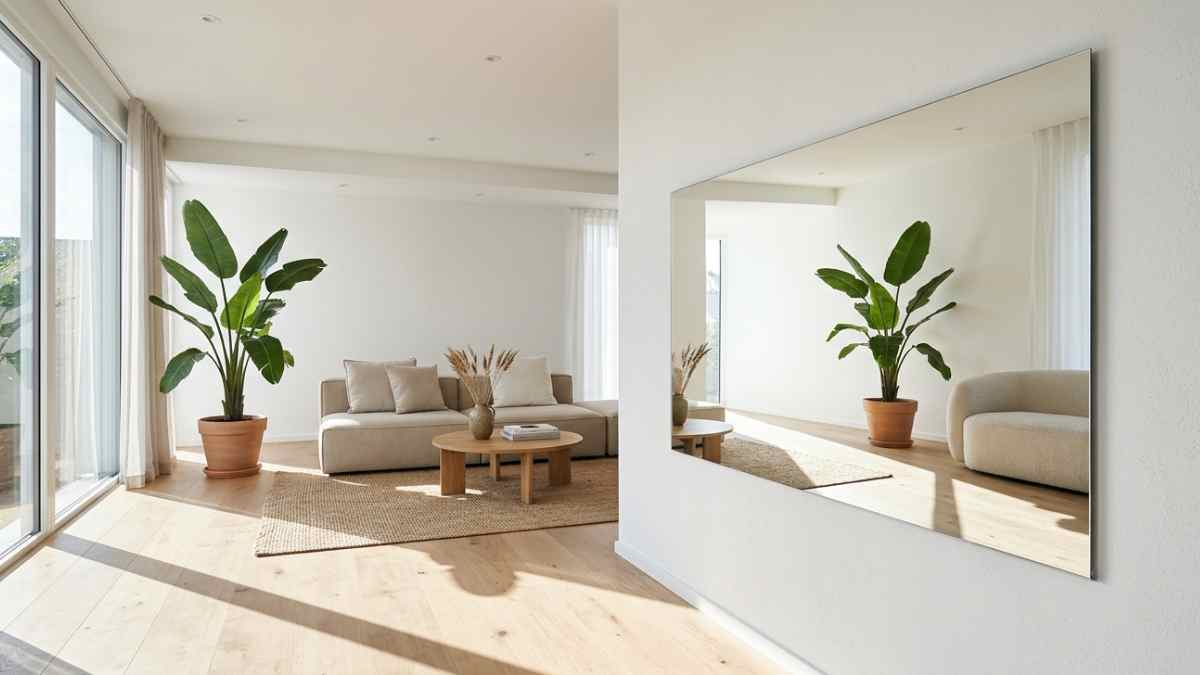
The result is not only temporary visual discomfort. Direct reflected light also gathers more heat in the affected area compared to the same natural diffused light, accelerating the yellowing of light-colored fabrics and the photodegradation of any light-colored wood finishes placed in that area of the room.
The vertical wall rule
The simplest solution is to move the mirror from the wall opposite the window to it perpendicular to the openinga ninety degree change that seems minimal but completely changes the behavior of the reflected light. In this position the mirror intercepts the light coming in from the side and sends it back to the corners of the room that remain in shadow, instead of projecting it back in a straight line to the center of the room where the occupant would normally be.
This placement exploits the same physical principle of angle of incidence and reflection that governs any specular surface: the angle at which the light hits the mirror determines the direction of its reflection, and orienting the surface ninety degrees to the source results in lateral diffusion rather than direct bounce to the room’s occupants.
The depth of the mirror counts as much as its position
Not all mirrors behave the same when properly positioned. A framed mirror, with a border that absorbs some of the light at the edges, produces a more subdued effect than a frameless full-wall plate. Brands like Rimadesioan Italian company specializing in wall-mounted mirror panels for residential environments, offers built-in mirror surfaces that cover the entire height of the wall, multiplying the diffusion effect compared to a traditional mirror of limited dimensions.
For those looking for a more limited and less dazzling effect, Reflex Angeloanother Italian manufacturer that works with glass and mirrors in a contemporary way, creates mirrors with smoked or bronze treatment, able to reflect a significant amount of natural light but with a softer intensity than traditional silver glass, a useful choice precisely in rooms that are more exposed to direct sun in the evening hours.
Where to put the mirror to light up without heating
The most suitable corners to receive a summer mirror are those that are to the side of the window, not frontally: a narrow corridor that receives light only from the opening of a door, a reading nook away from the window but on the same wall, or the wall next to a French window facing a shady balcony. At these points the mirror captures indirect light it has already been filtered by the environment, never being in the path of the low sun’s direct beam.
In any case, the placement in front of west-facing windows, the orientation that receives the lowest and warmest light of the summer afternoon, should be avoided: here even a vertical mirror risks blocking part of the direct beam at the most critical hours, and it is better to combine it with a curtain or a partial satin film on the window itself, to reflect the surface before it even reaches the surface.
In the end, the difference between a mirror that illuminates and a mirror that disturbs lies not in the chosen product, but in those ninety degrees of rotation in relation to the window that no furniture catalog ever explains clearly enough.



