
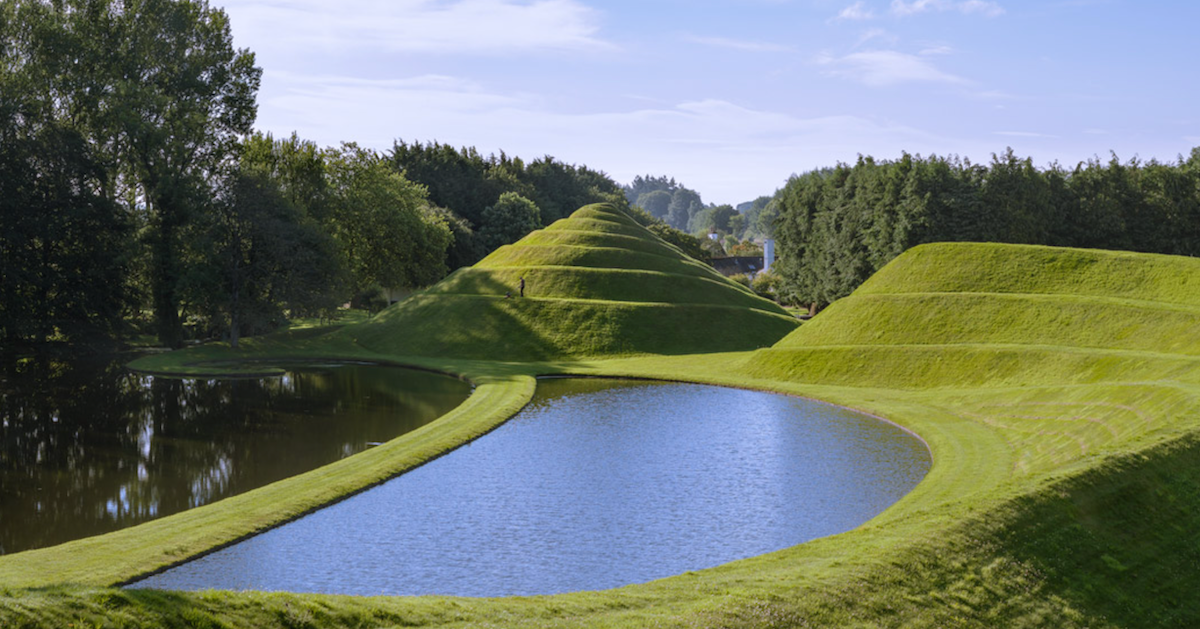

The garden of cosmic speculation translates knowledge into space
There is a point, moving through the Garden of Cosmic Speculation, where the orientation begins to change. The ground doesn’t just support movement, it redirects it, pulling the body into spirals, slopes and paths that seem to think as much as drive. What initially appears as a landscape gradually reveals itself as a constructed field of ideas, a field that translates the language of science into terrain.
Designed by American landscape architect and designer Charles Jencks with his wife, designer Maggie Keswickthe 30-acre sculpture garden on the land at their home in Scotland arose out of an abiding interest in how modern knowledge could reshape spatial practice. Beginning in the late 1980s, Jencks drew from cosmology, genetics, and complexity theory, not to depict them directly, but to transform them into a sequence of landforms that can be experienced on a human scale. “The universe is still being discovered,” he noted, and the garden reflects that state. Rather than depicting science in a didactic way, it tests how abstract knowledge can be spatialized and made accessible through design.
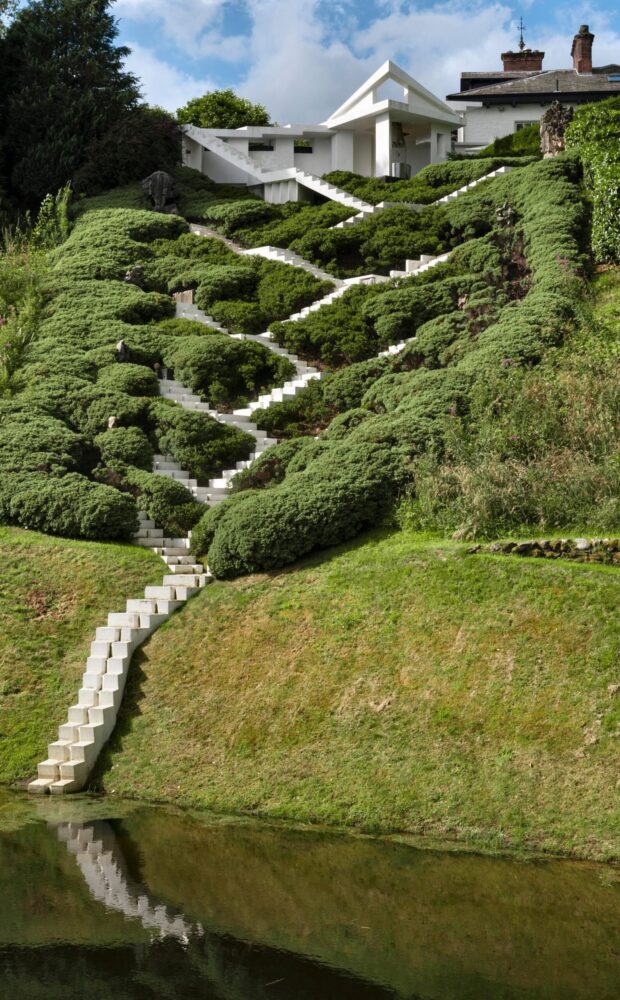
all images courtesy of The Garden Of Cosmic Speculation
Charles Jenks turns scientific concepts into experience
Jencks’ approach builds on his broader theoretical work, which argued that architecture and landscape can function as communicative systems. “If architecture is a language,” he wrote, “then it must communicate.” In this context, the garden becomes a form of environmental narrative, where meaning is embedded in geometry, topography and movement. Features such as spirals, fractals, and wave-like earthworks are not arbitrary aesthetic gestures, but references to scientific models, including DNA structures, black holes, and self-organizing systems. By incorporating these references to the ground, Jencks shifts scientific concepts from representation to experience.
Unlike traditional gardens that prioritize symmetry, axial design, or graphic composition, the Cosmic Mirror Garden is organized as a non-linear sequence of ideas. There is no single point of view from which the entire site can be understood. Instead, visitors move through a series of distinct zones, each exploring a different conceptual framework. This spatial structure reflects modern scientific thinking, where knowledge is temporary, distributed and constantly evolving rather than unified or fixed.
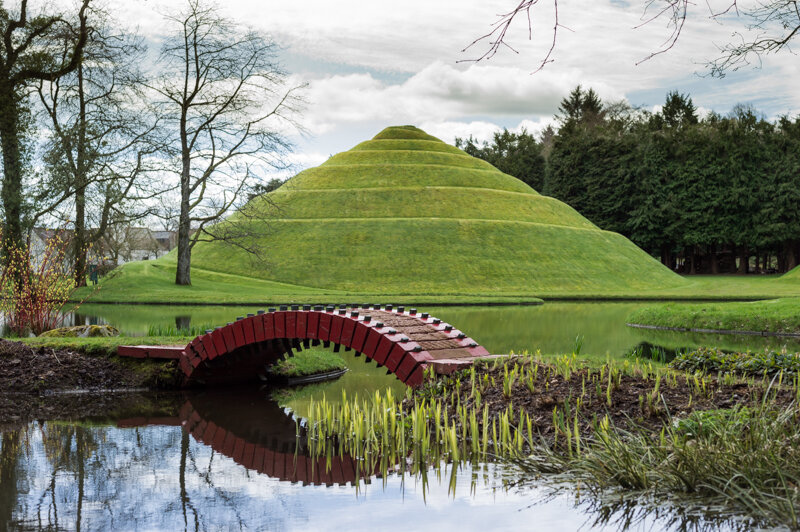
the garden is organized as a non-linear sequence of ideas
a garden that democratizes design thinking
At the same time, the project avoids becoming too technical or exclusive. While its forms are informed by advanced scientific theories, they remain readable and appealing to the general public. The garden requires no prior knowledge to make sense. Instead, it encourages intuitive engagement, allowing visitors to interact with complex ideas through walking, observation and physical orientation. This balance between intellectual rigor and public accessibility is central to its importance.
From a research perspective, the garden can be understood as an early exploration of how design can mediate between expert knowledge and public experience. It anticipates subsequent debates around data visualization, science communication and participatory design, suggesting that spatial environments themselves can act as interfaces for understanding. Rather than presenting information through text or images, Jencks uses landform as a medium, enabling a form of embodied knowledge where learning takes place through movement and perception.
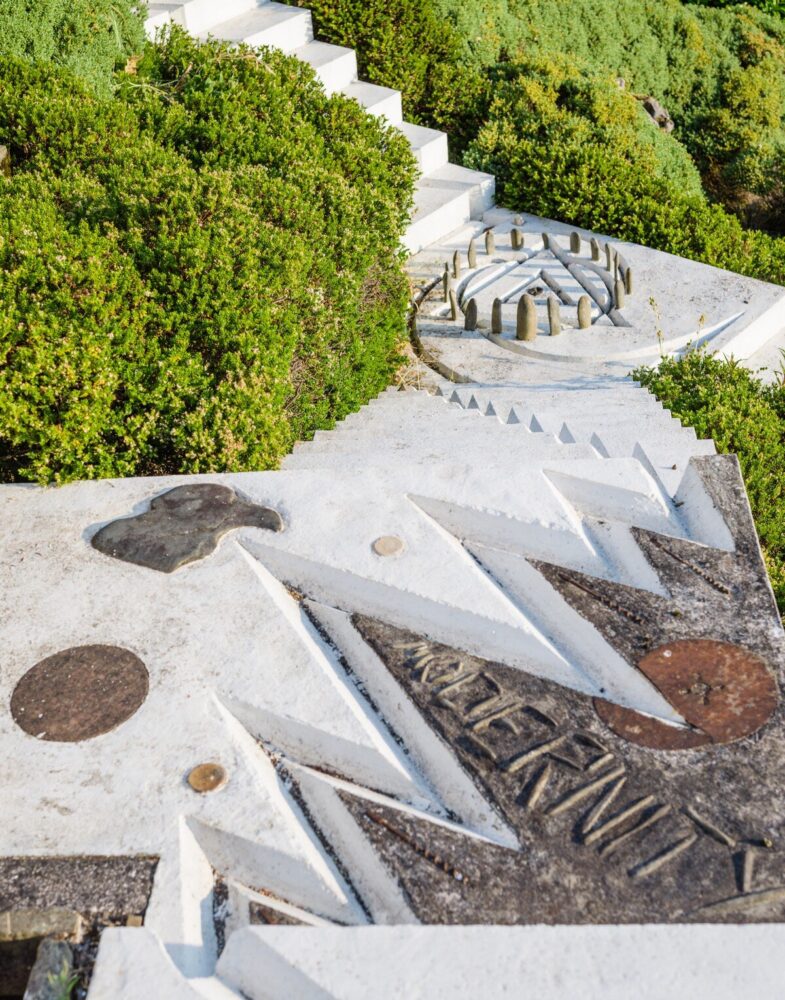
‘Wandering’
Collaborative learning and discovery are at the center
The garden also engages with broader questions of how environments can support collaborative learning. As a space accessible to the public, albeit only once a year, it places scientific research in a shared landscape rather than an institutional framework. Visitors encounter the same figures, follow similar paths and engage in a loosely structured process of discovery. In this way, the work frames knowledge not as an individual acquisition but as a social experience, shaped by presence, interaction and interpretation.
Its optimistic dimension lies in this commitment to accessibility and shared engagement. The Garden of Cosmic Speculation suggests that complex systems and ideas need not remain abstract or inaccessible. Instead, they can be translated into environments that provoke curiosity and participation. This is not a utopia defined by perfection, but a utopia based on the possibility of expanding the way knowledge is viewed and understood.
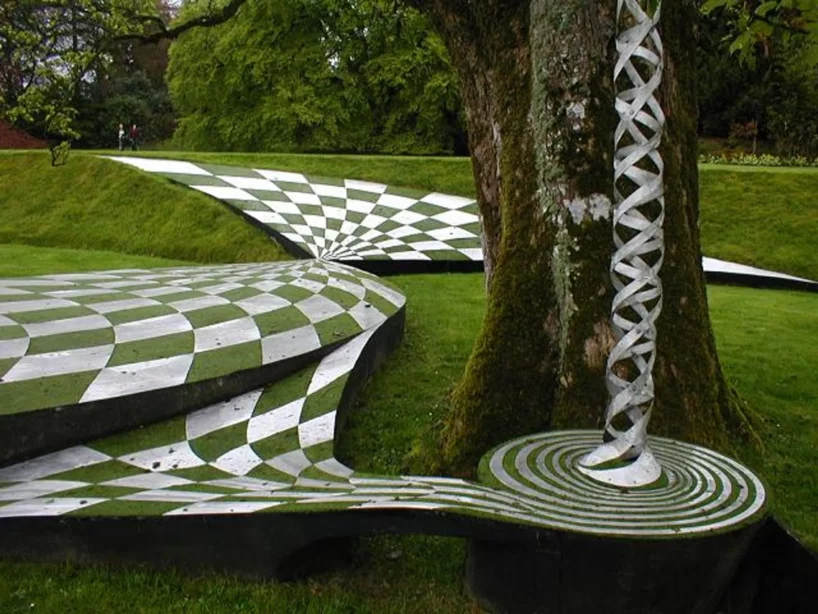
“black hole”
a case study for participatory design and data visualization
Importantly, the garden does not attempt to resolve the complexity referred to. The scientific models from which it draws remain open, and their translation into landscape does not produce a single, stable meaning. Visitors are not expected to decipher the website in a definitive manner. Instead, the work supports multiple readings, allowing for partial understanding, speculation, and constant reinterpretation. This aligns with Jencks broader interest in pluralism and complexity as defining features of modern culture.
The garden also raises questions about the relationship between designed and natural systems. His forms appear highly constructed, yet resonate with patterns found in nature, from erosion and growth to wave dynamics and repetition. This creates a dialogue between scientific abstraction and environmental processes, suggesting that the two are not separate but interrelated. More than three decades after its inception, the Garden of Cosmic Speculation remains a relevant case study of how design can work with scientific knowledge in a public and spatial way. It demonstrates that landscape architecture can move beyond aesthetic or functional concerns to act as a platform for research, communication and collective experience. In doing so, it offers a model of how utopian thinking might be redefined today: not as an idealized end-state, but as an ongoing effort to make complex ideas visible, accessible and shared.
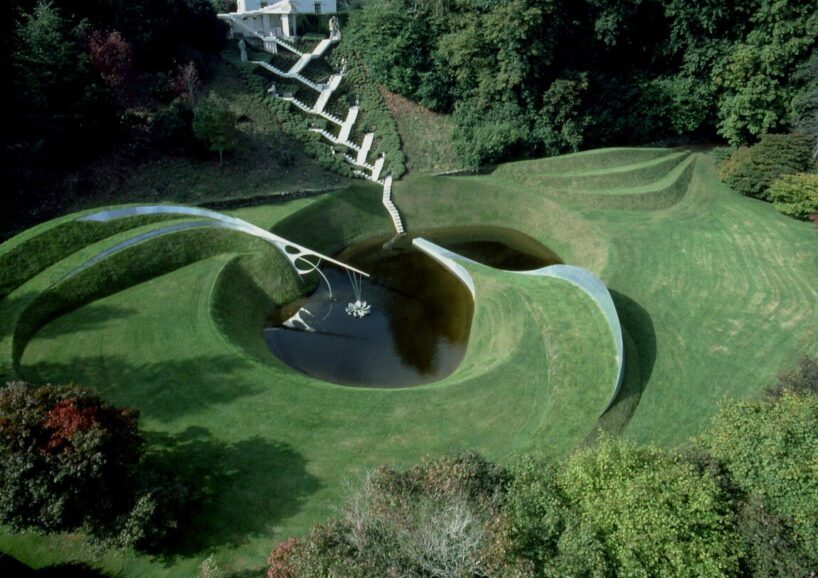
“Waterfall of the Universe”
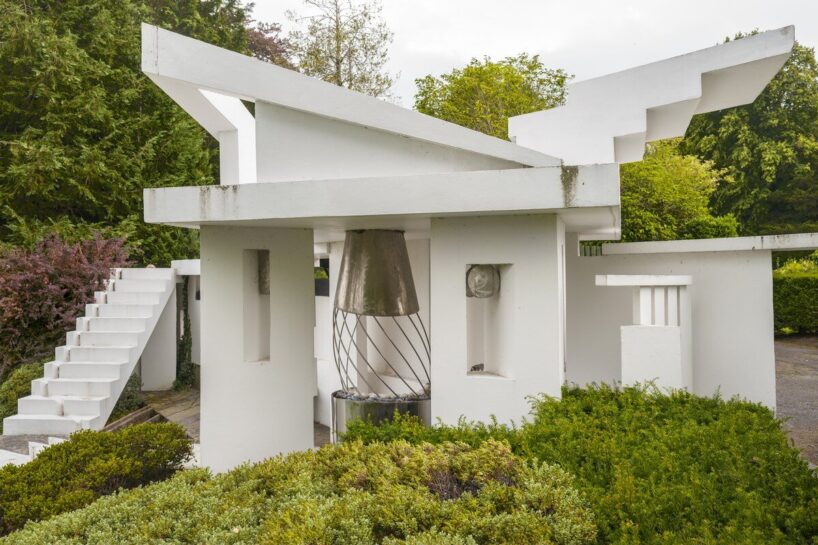
‘Deformation’



