Physical Address
304 North Cardinal St.
Dorchester Center, MA 02124
Physical Address
304 North Cardinal St.
Dorchester Center, MA 02124

The dining room corner is not only the place for sharing, but it is also, technically, the most complex area of the house to manage on a textile level. It is a high-traffic area, subject to constant mechanical stress due to sliding chairs, liquid stains and, above all, the inevitable falling of crumbs. If the choice falls on a carpet, the challenge is not only aesthetic, linked to the combination of colors and dimensions, but purely mechanical.
Two opposing construction philosophies collide in this space: the flat weave, known as Flatweave, and the shag carpet, commonly called Shaggy. Let’s break down why one represents the ideal technical solution and the other risks turning into a potential functional disaster for your home.
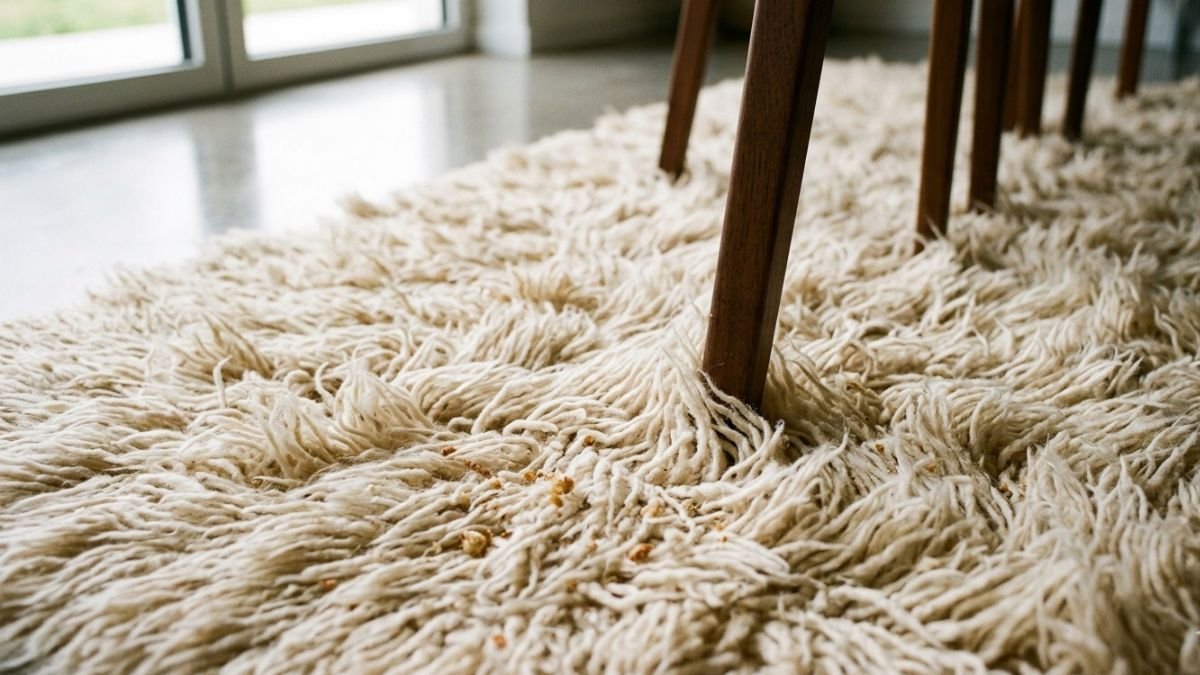
The Shaggy rug represents the apotheosis of visual comfort. With its high pile, often exceeding 2 cm, soft and irregular, it immediately conveys a feeling of warmth and relaxation. It is a perfect choice for environments such as the living room, a reading corner or even the bedroom, where physical contact and softness are priorities. However, when we bring it to a dining room, all of its strengths inevitably turn into a structural defect which undermines its daily use.
The main problem lies in what we can define as the mechanical crumb trap. Long hair does not form a continuous surface, but consists of a set of free and separate fibers. A crumb that falls on a shaggy rug doesn’t just settle on the surface, but inevitably slides in, between the fibers, until it reaches the underlying weave of the rug.
At this point, the crumb is literally trapped. Standard vacuum often does not have the power or ability to penetrate deep enough to remove it without sucking it and consequently damaging the fibers themselves, making cleaning a long and often ineffective task.
In addition to dirt management, an important one arises difficulty moving chairs. Moving a chair on a shaggy rug is a tedious operation because the legs naturally sink into the pile, creating constant resistance. This not only creates an uncomfortable tasting experience, but causes uneven and visible wear in the long term.
The hair is coming permanently pressed in some critical places, especially under the table where the weight is greater, while in others it remains swollen. This phenomenon permanently compromises the even surface and aesthetics of the carpet, making it look old and neglected way before its time.
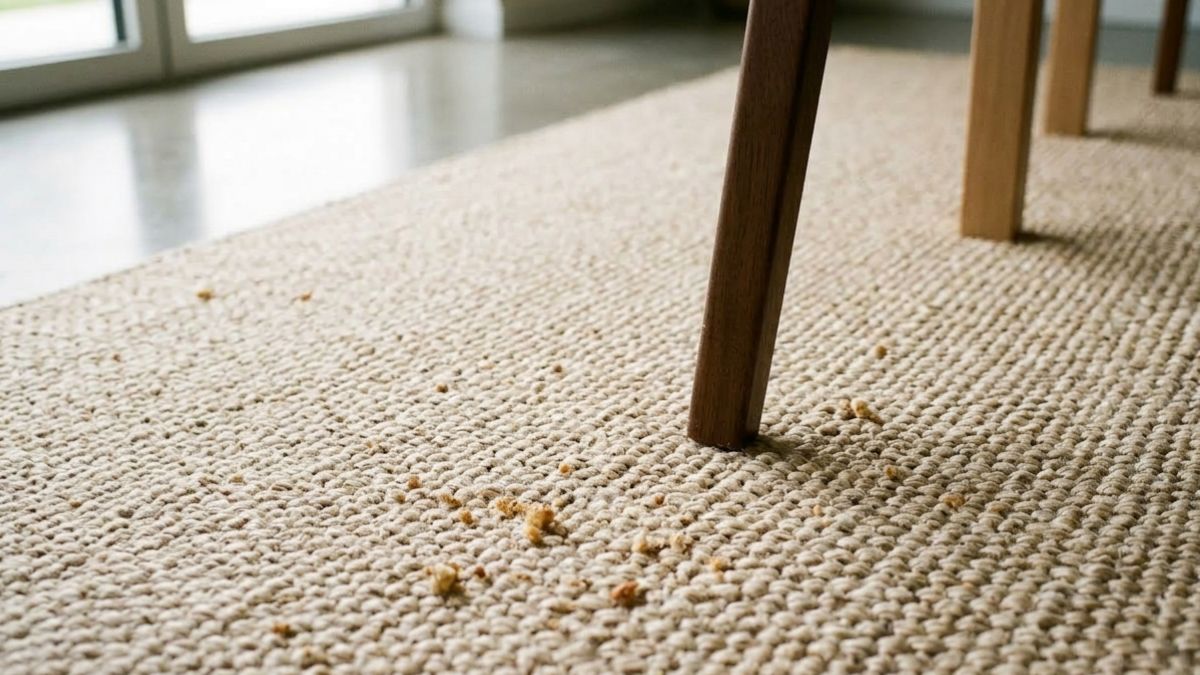
The flat-weave rug, often equated with terms such as kilim, durri or sisal and jute models, adopts a completely opposite construction philosophy. In this case there is no hair. The warp and weft are tightly woven together to create a continuous, smooth and very dense surface. This configuration represents the definitive technical answer to all standard dining room problems.
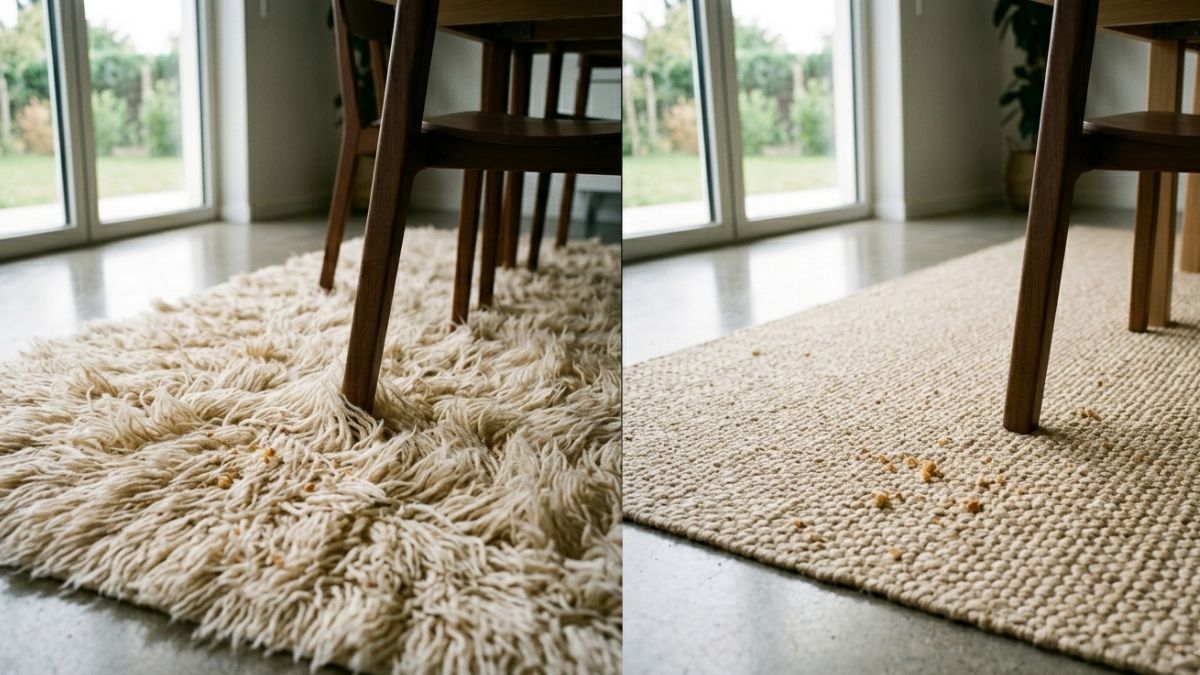
Thanks to the continuous surface and the complete lack of depth, the crumbs remain deposited on the top of the fabric, with no possibility of hiding between the fibers. Vacuuming a Flatweave therefore becomes a quick, efficient and satisfying operation.
Even when dealing with household accidents like liquid stains, the dense fabric performs superiorly. In fact, it tends to absorb liquids much more slowly than a Shaggy fiber, which instead “hugs” the liquid by spreading it over a large surface area. This guarantees you much more time to intervene immediately with a wet cloth, preventing the stain from penetrating into the heart of the thread.
THE leveling and sliding of the chairs is the other great technical advantage of this option: the solid surface allows the chair legs to slide without any resistance, just as if they were on the bare floor. There are no places where the chair buckles or creates deep depressions, which maintains the integrity of the carpet and ensures ergonomic stability necessary while sitting.
Finally, the reversibility and flexibility of the material should not be underestimated. Many Flatweave rugs are reversiblewhich means they can be flipped over, effectively doubling their useful life and allowing any signs of wear to be camouflaged. The Flatweave technique is ideal for using natural and robust materials such as e.g jute or the sisalwhich combine beautifully with modern concrete or light wood floors. These materials are inherently durable and offer a unique tactile experience while remaining highly practical.
For those who deeply love design, choosing a Flatweave rug in the kitchen should not be seen as a renunciation of softness, but as a true conscious style statement. It means that you give absolute priority to the clean lines and functionality of the home environment, choosing a material capable of interacting intelligently with the real use of the everyday space. It’s much better to make a targeted choice rather than being forced to include a material that’s inviting but functionally unsuitable for managing the stress of a dining room.
If you love touch and warmth, a kilim di lana or a sturdy jute rug, perhaps characterized by a bouclé weave, if the table has very strict and linear lines, it offers a visual warmth and a texture that has nothing to envy of a long rug with piles. The invaluable advantage is to have impeccable maintenance and a dining room that always remains tidy and ready for use, crumb resistant and perfectly functional to drag chairs every day.




