Physical Address
304 North Cardinal St.
Dorchester Center, MA 02124
Physical Address
304 North Cardinal St.
Dorchester Center, MA 02124

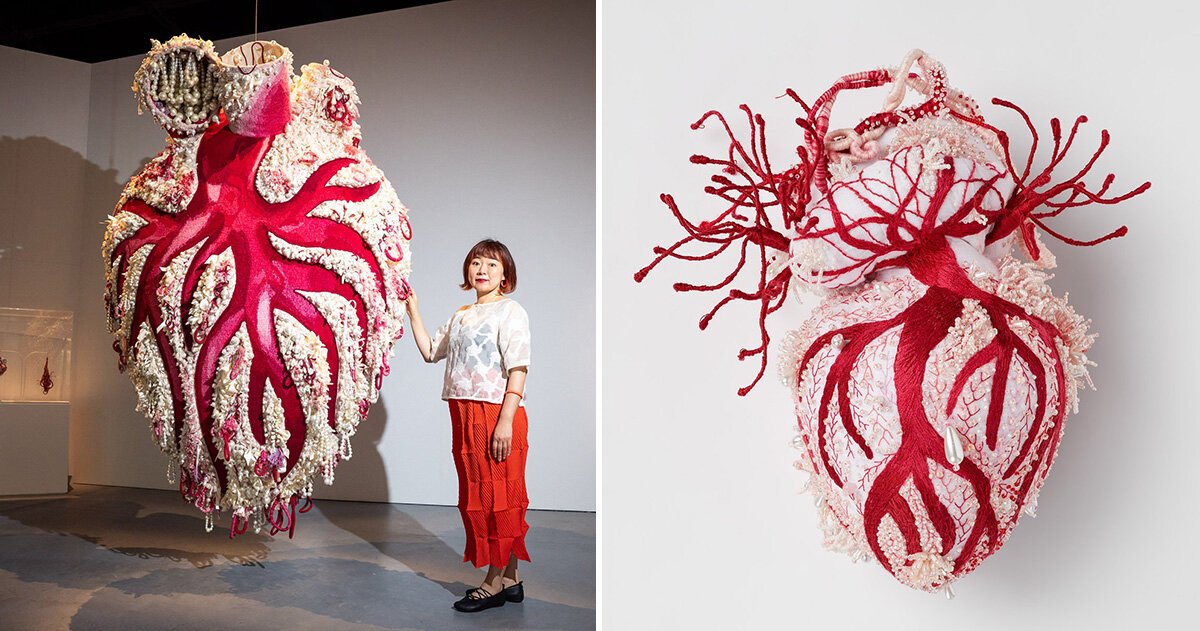
At the 2026 edition of the Biennale of Sydney, artist Ema Shin debuts a monumental embroidered heart, an expanded version of a form that has defined her practice for years. Suspended within the exhibition space, the piece occupies the room with a soft mass of red and white fabrics. Dense embroidery traces arteries and veins throughout, while clusters of beads and pearls gather along the contours. Even with this ambitious new scale, it retains the tactile intimacy of Shin’s smaller works.
The work looks almost anatomical. Swollen chambers rise from the top of the figure while branching red threads suggest a network of arteries. Thousands of stitches are piled across the surface to give the work a layered density that changes with distance. From afar it sculpture read as a single organic mass. Up close, the viewer encounters loops of thread, small knots and beads that reveal the slow labor behind its construction.
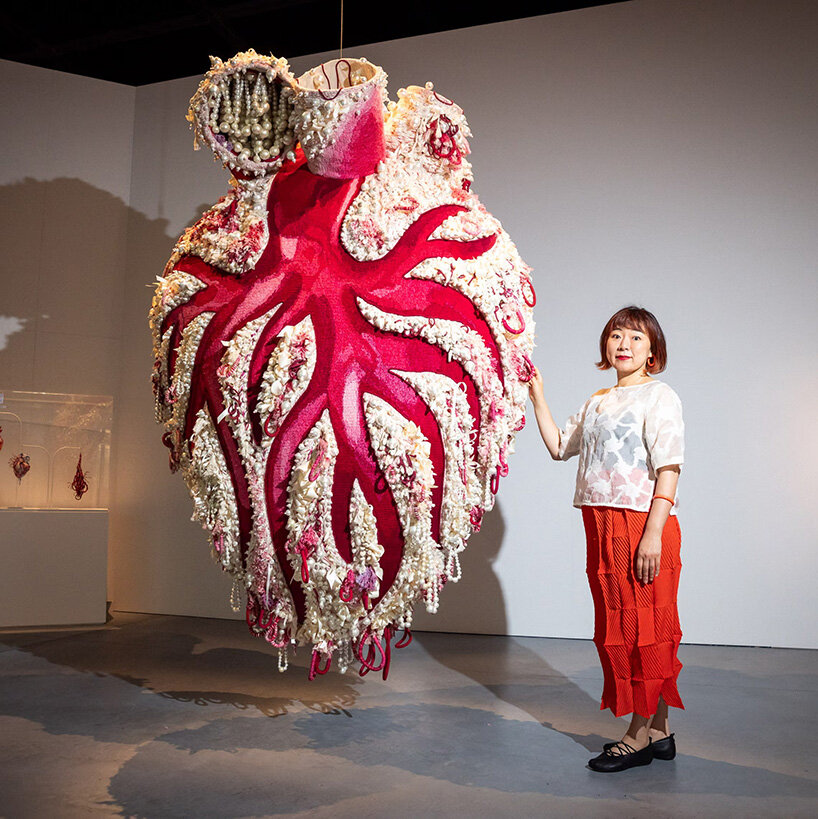
Hearts of Absent Women (Tree of Family), Ema Shin, Biennial of Sydney, image © Daniel Boud
The monumental piece develops directly from Ema Shin’s long-standing series of embroidered hearts, which she usually produces on a much smaller scale. Many of these projects fit comfortably in the palm of her hand. The fabric is shaped into anatomical forms and then layered with embroidery, beading and stitched structures that resemble vessels and connective tissue.
The work is part of Shin’s ongoing project Hearts of Absent Women (Family Tree), designed in response to her own family tree, where records only listed male relatives and mothers of sons. Hearts is a celebration of women’s domestic duties that often happen silently and behind the scenes. They are both representations of these women’s feelings, as well as talismans for their protection.
‘This project, Hearts of Absent Women, is dedicated to previously unrecognized women,‘ the artist explains. ‘I was born in Japan and raised in a traditional Korean Family. My grandfather kept a treasured family tree book for 32 generations, but it only included names of male descendants, not daughters. In my art I have always tried to celebrate women and their historical crafts.
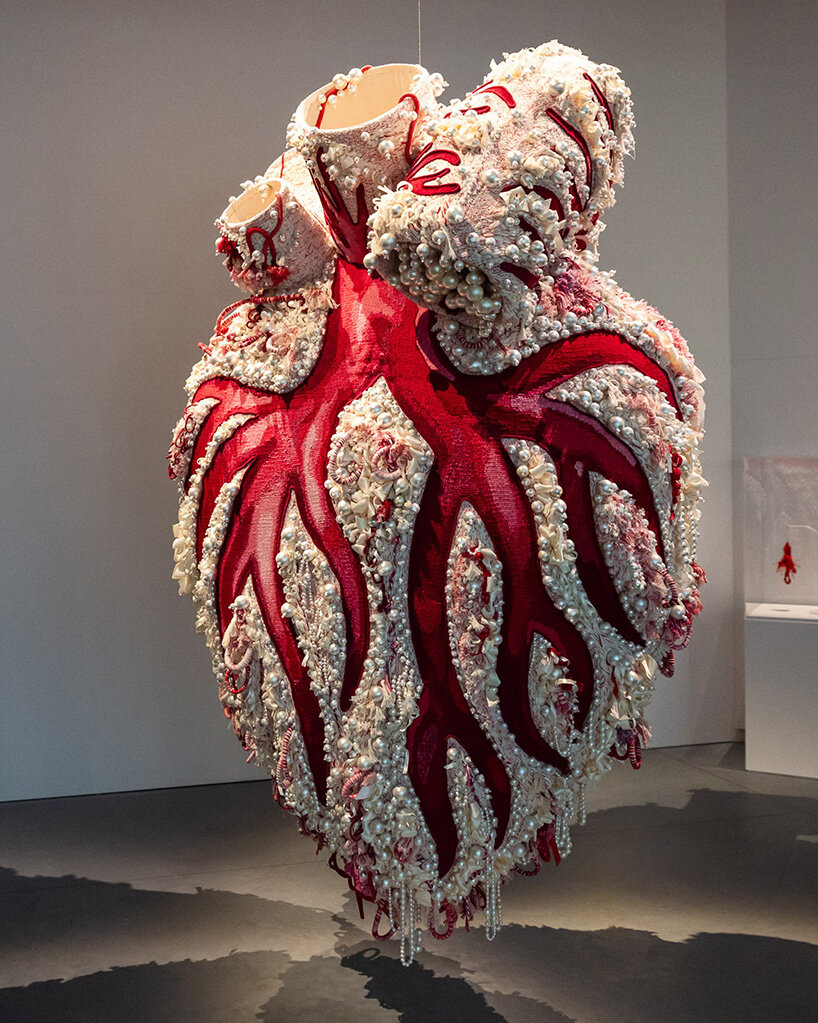
Hearts of Absent Women (Tree of Family), Ema Shin, Biennial of Sydney, image © Daniel Boud
In Ema Shin’s practice, embroidery becomes a method of recording experience through material. Each stitch is built up gradually, allowing the surface of the heart to develop as a multi-layered field of thread. Beads are clustered along certain paths, while other areas remain defined by simple lines of embroidery. The work carries the rhythm of the craft, visible in the subtle variation of the stitches and the slight irregularities of the forms.
The large sculpture on display in Sydney reinforces these qualities. Instead of abandoning the handmade language of her smaller embroidered hearts, Shin expands it to a much larger volume. Thick red embroidery traces major arteries throughout the sculpture’s body, while white textures gather around them in dense clumps. The piece maintains the softness of the fabric while occupying the scale of the installation.
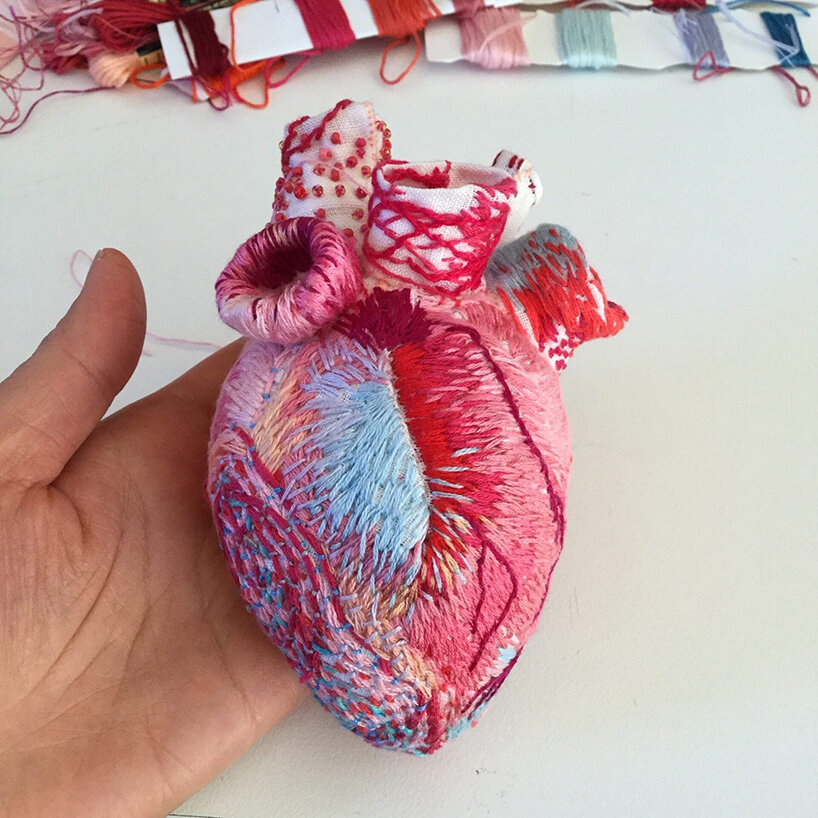
Hearts of Absent Women, process, image by Ema Shin
Installed as part of the Biennale of Sydney, the sculpture situates Shin’s textile practice within a wider discussion of the body and material culture. Visitors move around the work and observe the embroidery from many distances. Shifting scale allows the complex language of yarn to become spatial.
The enlarged heart reflects the same visual vocabulary found in Shin’s smaller pieces. The branching vessels appear as red embroidered paths that spread across the surface. Clusters of beads gather along the edges of these forms, creating a textured topography of threads and embellishments. The project maintains a strong sense of craftsmanship while operating within the scale of the contemporary installation.
Through this extension, Ema Shin shows how embroidered forms can move fluidly between object and environment. Her hearts remain grounded in the language of fabrics, shaped through patient stitching and layered materials. In Sydney, this quiet craft evolves into a sculpture that fills the gallery space while maintaining the intimate gestures that define her work.
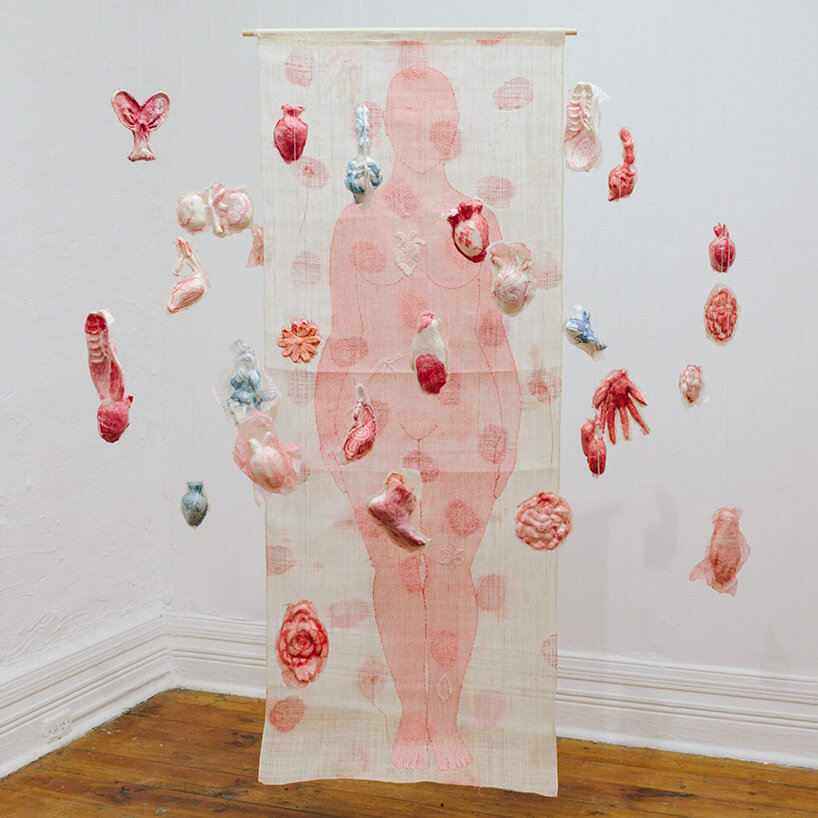
Hearts of Absent Women, image © Oleksandr Pogorily
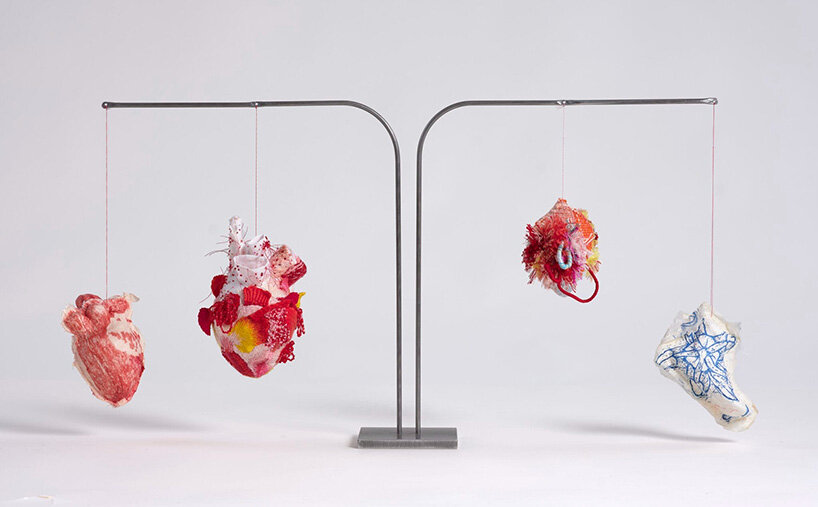
Hearts of Absent Women, image by Narelle Wilson © Ema Shin