

custom portable retro lo-fi cassette player
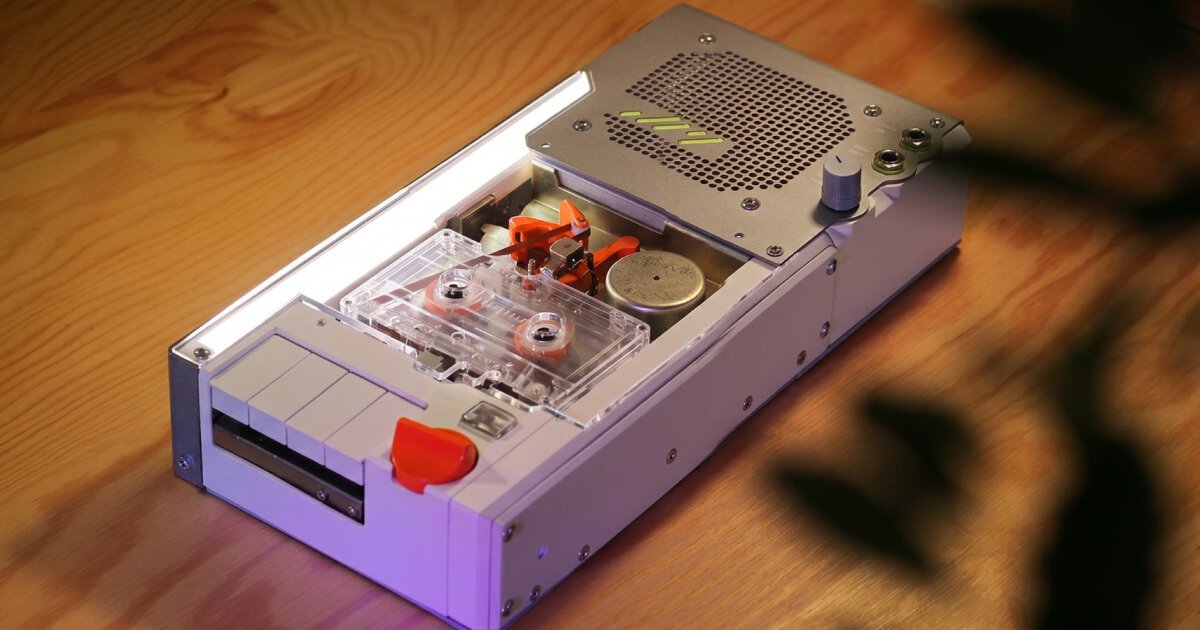
Iulius Curt creates a custom portable retro player with a cassette recording lo-fi songs from streaming apps and smartphones. In a nutshell, the user’s smartphone sends music wirelessly to the machine, which then records it on a moving film loop, the same way a cassette used to work in the 1980s. A second reading head then retrieves the sound a short time later and plays it through a speaker. This machine begins life as the Privileg TC 183, a mid-weight Japanese cassette player. The designer kept the recording circuitry, from the bias oscillator and erase head to the tape equalization, because redesigning these from scratch would have taken months. He then replaced it with a tape loop so it wouldn’t run out like a standard tape.
Using a set of orange 3D brackets, the loop fades, records, travels and plays continuously, without rewinding and without end. On the front of the portable retro lo-fi player is a Bluetooth receiver, the one that converts the incoming digital stream to analog. The charm of the project is that the magnetic tape does not reproduce the sound clearly because the oxide coating introduces a slight instability in the playback speed. But these are the ‘flaws’ that Iulius Curt is after, allowing the resulting sound to have that lo-fi warmth that’s perfect for ambient listening.

all images courtesy of Iulius Curt
Parts made from recycled car stereo parts
A challenge that designer Iulius Curt had to overcome the wiring of the original deck. The Japanese engineers who designed the original chassis he used had connected the electrical circuits by inverting what is usually considered the zero-voltage reference point. It was a cost-saving decision quite common at the time, but the consequence was that the Bluetooth unit and the cassette player could not run off the same power supply without the two circuits effectively arguing with each other electrically. Iulius Curt solved this by placing a small isolation converter between them, giving each side its own electrically separate power supply, and without this correction, the machine produces noise instead of music.
For audio production, designer Iulius Curt also built a way to connect external equipment directly to the portable retro lo-fi player, so he could send a recorded track, run it through the cassette, come back out sounding warmer and rougher. The electronics he built to handle playback are all his own work, with the key component being a small chip originally built for car stereos that conveniently does exactly what a tape machine needs: amplify the signal coming out of the playback head and correct the tonal imbalances that recording naturally creates. This is fed to an amplifier and then to the speaker. The retro lo-fi portable player’s outer casing is bent stainless steel on both sides, wrapped around the original metal cassette body. A clear acrylic panel covers the section where the tape loop runs and users can see the tape moving around the portable retro lo-fi player.

Iulius Curt Creates Custom Portable Retro Cassette Player That Records Lo-Fi Songs

this machine begins life as the Privileg TC 183, a mid-weight Japanese cassette player

the user’s smartphone sends music wirelessly to the machine, which then records it in an animated film loop

a second read head retrieves the sound a little later and plays it through a speaker

the designer kept the recording circuit, from the bias oscillator and erase head to the tape equalization
project information:
name: Stream music from tape
plan: Julius Kurt



