
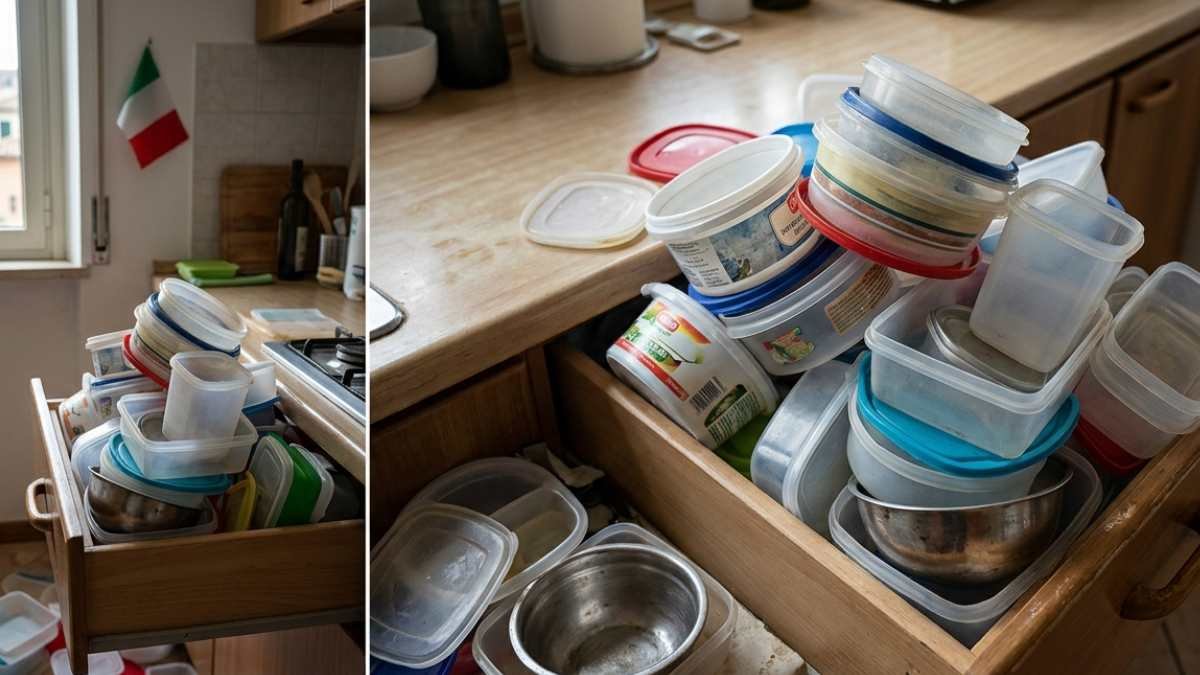

Opening a kitchen cupboard and seeing a rickety pile of plastic containers, all different, often without lids, is an all too common scene. They accumulate over time, one after another, until the available space is no longer enough and each order attempt takes very little. The problem isn’t just aesthetic: it’s practical. When you can’t find the right cover or you can’t fit anything in, the kitchen stops working.
The truth is that these containers are not a solution, but a root cause of clutter. And while they stay there, they continue to take up space without providing any real benefit.
Because containers without lids create more chaos than order
The problem is not having containers, but having too many and no system. When each piece is different in shape, size or brand, there is no logic anymore. They don’t stack well, they don’t combine with each other and above all they don’t have an accurate function.
Containers without lids are the most problematic. They remain there “because they can always be useful”, but in practice they are rarely used. Meanwhile, they take up valuable space and make it harder to use the really useful ones.
The result is one constant feeling of disturbanceeven when the rest of the kitchen is tidied up.
What to actually do: downgrade and restart from one system
The first step is not to organize, but to eliminate. All containers without a lid or without a clean function must leave the kitchen. To keep them “in doubt” is just to keep piling on.
Once you reduce the number, it becomes apparent how much easier it is to manage the space. But the real change comes when you introduces a coherent system.
A set of stackable and compatible containers completely changes the approach. It’s not about having more, it’s about having the right ones. When each container has its own lid and can be stacked without problems, this the space almost organizes itself.
How to choose containers that really work in everyday life
Not all containers are the same. The most effective are those that share dimensions and proportions. This allows you to stack them easily and use them flexibly, without having to search for the right combination every time.
Simple shapes, without recesses or unnecessary details, help maintain visual order. Even the transparency is an advantage: By immediately seeing what’s inside, you avoid opening each container and reduce mental as well as physical clutter.
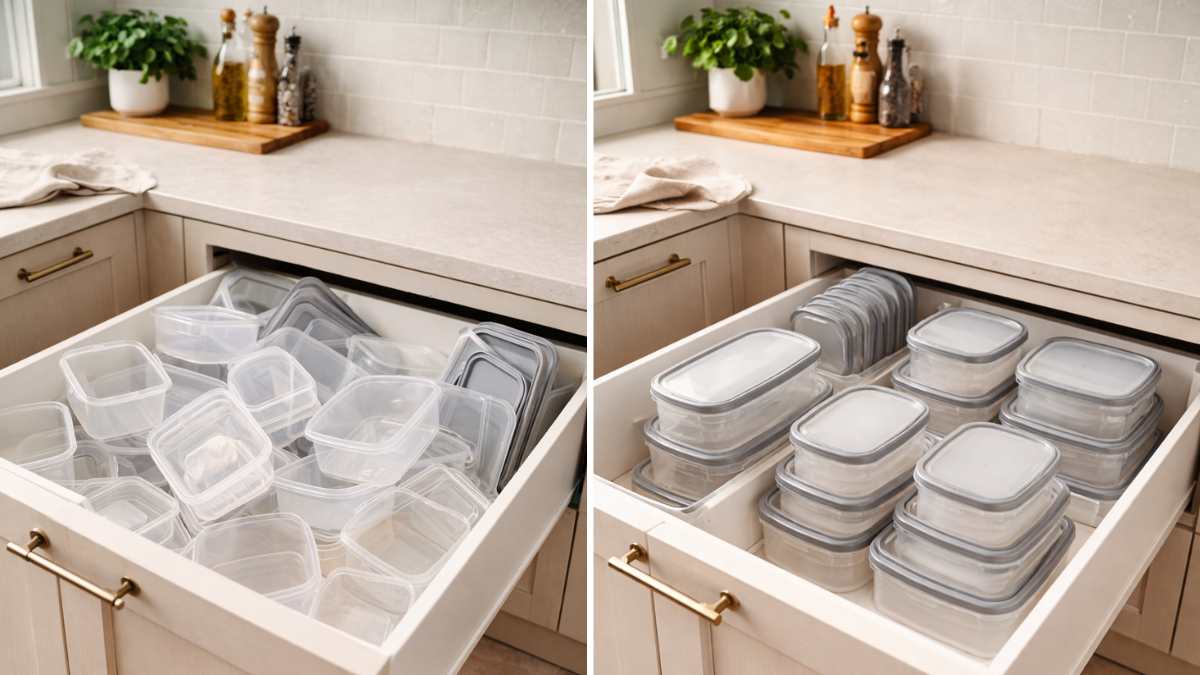
Another important aspect is the compatibility of the caps. The best systems predict few formsso that each lid can hold several containers. This eliminates the build-up problem at its root.
How to organize the space to avoid returning to chaos
After choosing the right containers, it is necessary to give them a specific place. They should not be scattered, but collected in a single, easily accessible space.
Stacking them by size, from largest to smallest, helps keep things organized and quickly find what you need. The caps, however, can be are held verticallyavoiding creating messy piles.
It is also important to leave some free space. When a piece of furniture is too full, it quickly returns to chaos. A minimal “breathing” allows you to maintain order for a longer period of time.
Because fewer containers means a better kitchen
We often think that having more containers means being more organized. In fact, the opposite is the case. The more items there are, the more difficult it becomes to manage them.
Reducing the number and selecting only the truly useful leads to immediate change. The kitchen is done easier to read, more practical, faster to use.
It’s not about giving up something, it’s about eliminating what doesn’t work. And this is exactly what allows you to have a really tidy space.
When the kitchen actually works again
The change is immediately noticeable. Furniture opens without creating a mess, containers are easy to find, everything has a precise place. It’s not a temporary order, but something that is it lasts over time because it is based on simple logic.
At that point, even mundane gestures like storing leftovers or preparing meals become more fluid. And the kitchen stops being a space that needs to be constantly rearranged, it finally becomes a space that works.



