
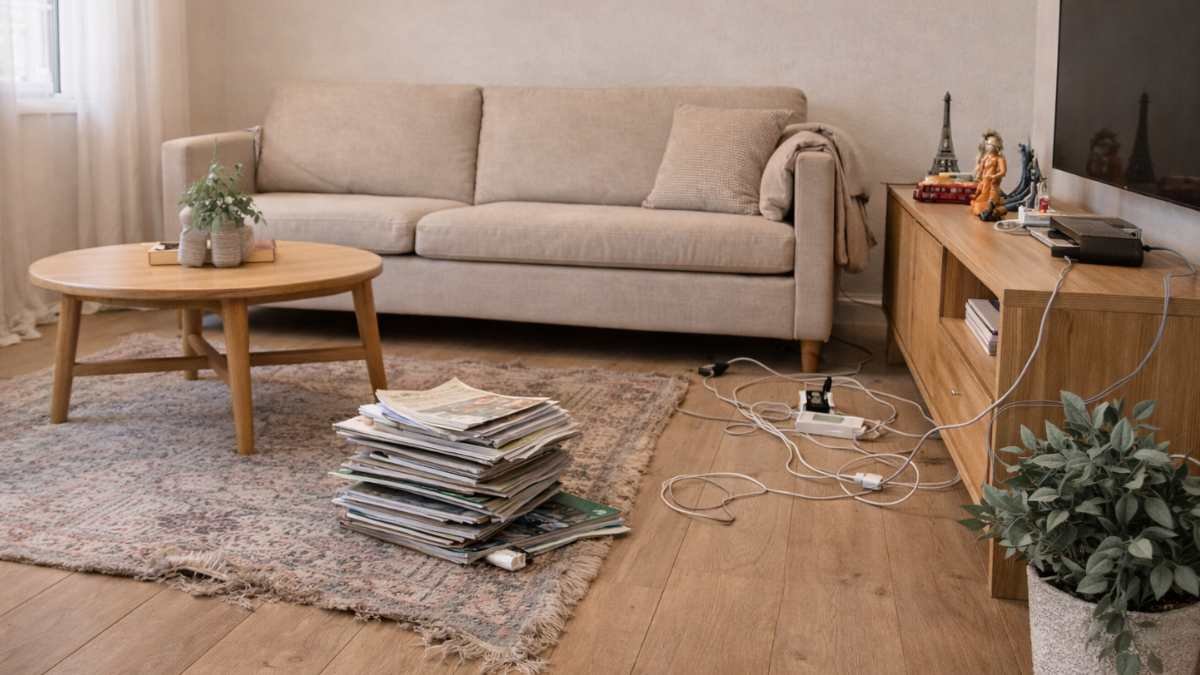

A house can be well furnished, have well designed furniture and solid colors and still convey a feeling of neglect. This is because the problem is almost never the main furniture, but what’s around. Small elements, often ignored, that accumulate over time and affect the overall perception of the space.
The point is not to add new objects, but to understand what to remove. In many cases, just eliminating a few misplaced elements can completely change the look of a room. When the space is illuminated, what remains also acquires value. Often, what ruins the whole thing is much simpler than you think.
Old worn carpets: when the fabrics lower the level
The carpet is one of the most visible elements in an environment, especially in the living room. When worn, discolored or deformed, it immediately becomes a weak point. Even a well-furnished room loses its elegance if the fabric looks worn or out of context.
It is essential that the carpet is in good condition and in harmony with the rest of the environment. A damaged element communicates neglect more than any other furnishing detail.

Stacks of unused magazines: the seemingly harmless clutter
Magazines and catalogs that accumulate over time create a messy and poorly maintained result. It is not a question of quantity, but of perception: a stack left on a table immediately gives the idea something unfinished.
If they are to be preserved, they must be selected and incorporated into the composition. Otherwise, it is better to delete or archive them: the living room should not turn into a paper warehouse.
Exposed cables: the detail that ruins everything
Cables are one of the most underrated items, but also one of the most damaging. Cables visible behind the TV stand or loose chargers have a huge visual impactdespite their technical nature.
A tangle of cables is enough to immediately diminish the perception of a perfect environment. Hiding or organizing them is one of them simpler interventions and effective in improving the appearance of the house.
Plastic memorabilia: when memories become visual noise
Objects brought back from travels have sentimental value, but they don’t always work within a space. When they are made of cheap or colorful materials, they are at risk disturb the visual balance.
It’s not necessary to delete them all, but it’s a good idea choose them carefully. Better to have a few elements that are consistent with each other than a disorganized collection that weighs down the atmosphere.
Damaged fake plants: the immediately noticeable detail
Fake plants can be a practical solution, but only if they are good quality. When they start to discolor or get dusty, they immediately become a sign of neglect.
A damaged fake plant conveys a very strong feeling of neglect. In these cases it is preferable remove it completely rather than keeping it as simple visual filler.
After all, a house looks cared for not because of what it contains, but because of what has been carefully selected. Delete the wrong items it doesn’t mean giving up, but making room for what really matters.



