

A house between a field and a forest
In Hoengseong, South KoreaThe Shin-Dae-Ri House by BRBB Architects sits between a cultivated foreground and a wooded hillside and is a transition from village life to mountain life. Designed for an elderly couple leaving Seoul home it reflects a change in rhythm, where horticulture and seasonal change drive the spatial experience.
The site slopes gently upwards to the rear, with distant ridges forming a multi-layered horizon. The architects place the house close to the edge of the mountain, allowing the open front section to remain available for a garden and small field. This decision creates a clear foreground for the crop while giving the house an elevated vantage point over the valley and stream beyond.

images © Seokgue Hong
BRBB Architects extends the ground
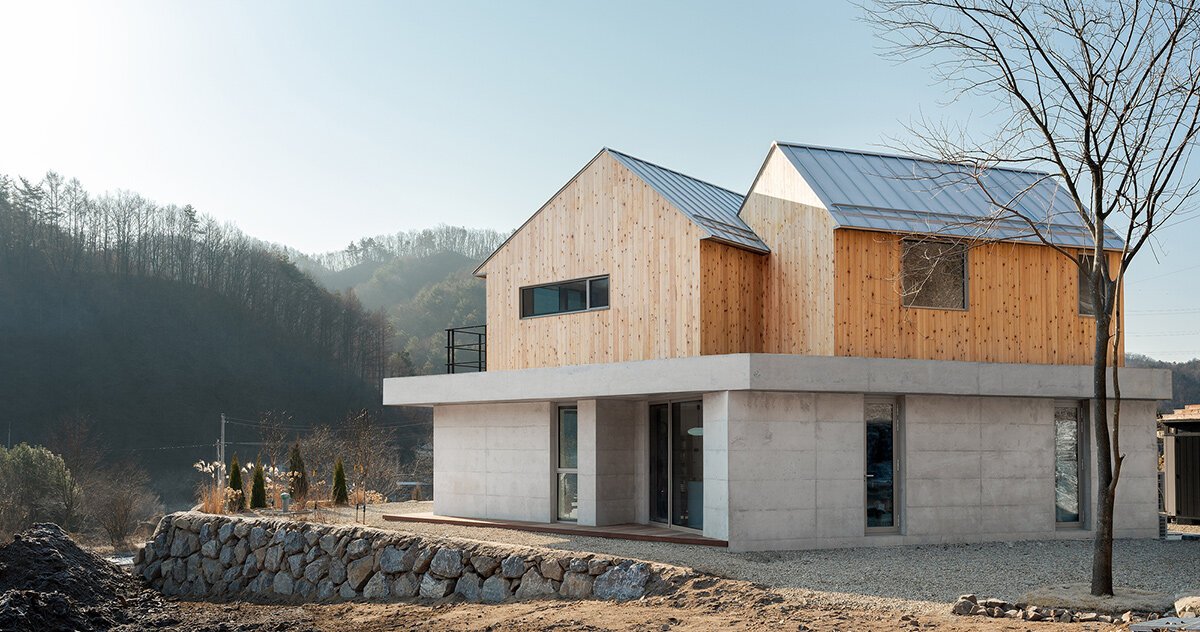
In designing the house, Korea-based BRBB Architects starts with a continuous concrete base that follows the slope of the ground. Cast in place, this lower level reads as a horizontal extension of the ground, grounding the building through its weight and scale. Deep overhangs project outwards, forming shaded exterior zones that moderate sunlight and provide sheltered areas for resting or working.
This base acts as both a structure and a threshold. Its expansive walls define a courtyard along the southern edge, enclosing an outdoor room that maintains privacy while admitting light. The courtyard sits slightly below the upper volumes to create a subtle sense of enclosure that contrasts with the openness of the surrounding fields.

two timber-gabled volumes sit above the slightly pivoted plinth
Timber volumes and orientation shift
Above the concrete plinth, rise two wood-clad volumes with distinct orientations. Each is in the form of a simple gable, yet their slight rotation introduces variation in aspect and light. One volume opens more directly to the valley, while the other engages the slope and trees behind. Together, they create a dialogue between external views and more introspective moments.
The separation between the two forms remains legible both inside and out. Rather than merging into a single mass, the volumes maintain their independence while sharing a common base. This layout allows each interior space to respond to a specific direction.

a concrete footing extends horizontally and engages directly with the ground
inside South Korea’s Shin-Dae-Ri house
Inside, the transition between levels is shaped by BRBB Architects through material continuity. Birch plywood lines the staircase and extends into the upper rooms, bringing a consistent tone that softens the shift from the concrete base to the wood volumes above. The staircase itself becomes a place of gradual adaptation, where light enters through a tall window facing the mountain.
As one moves upwards, the landscape is revealed piecemeal. A glimpse of trees appears along the climb, followed by wider views just inside the upper rooms. This sequence reinforces the relationship between movement and perception, allowing the environment to be registered over time rather than all at once.
The Shin-Dae-Ri House embraces a lifestyle that remains closely connected to its setting. The contrast between the solid base and the lighter volumes above creates a balance between permanence and openness, while the building’s placement supports both cultivation and retreat.

a south-facing courtyard is enclosed by extensive concrete walls

Deep overhangs create shaded outdoor spaces for resting and working



