
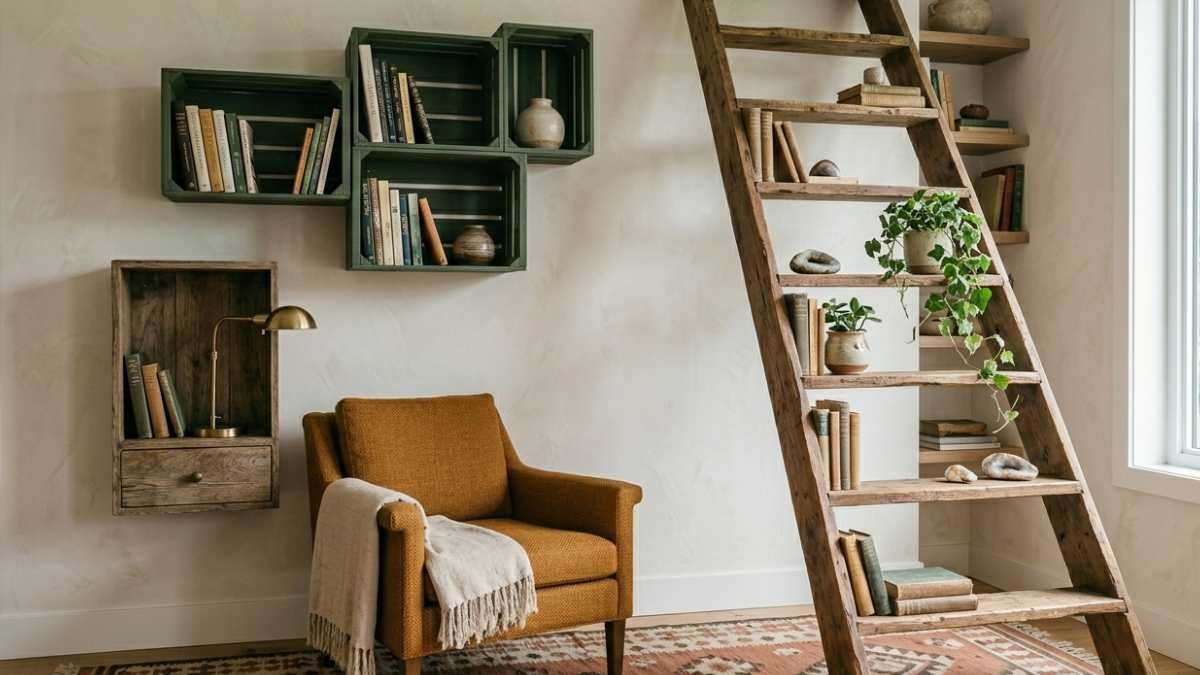

There are items that remain at home for years without real use, relegated to the cellar or forgotten in a corner. However, it is precisely these seemingly useless items that can be transformed into the most interesting pieces of furniture. It’s not just creative recycling, but a more advanced approach to home design: they give new life to objectsinterpreting them in an aesthetic and functional key.
The difference between a shared result and a truly successful one lies in the design perspective. “Reuse” is not enough, it must be they consistently reinventintegrating materials, proportions and style with the rest of the house. When this happens, the result doesn’t look DIY, but a design concept thought out from the ground up.
How to turn common items into designer shelves
One of the most common mistakes is to consider the shelf as a standard element. In fact, it is precisely his reinterpretation that makes the difference.
A old wooden staircasefor example, it can become an extremely impressive vertical shelf. Leaning against the wall or fixed discreetly, it retains its original structure but changes function. The steps become shelves for books, vases and decorative items. If the wood is marked by time, the result will be perfect in a warm and material environment.
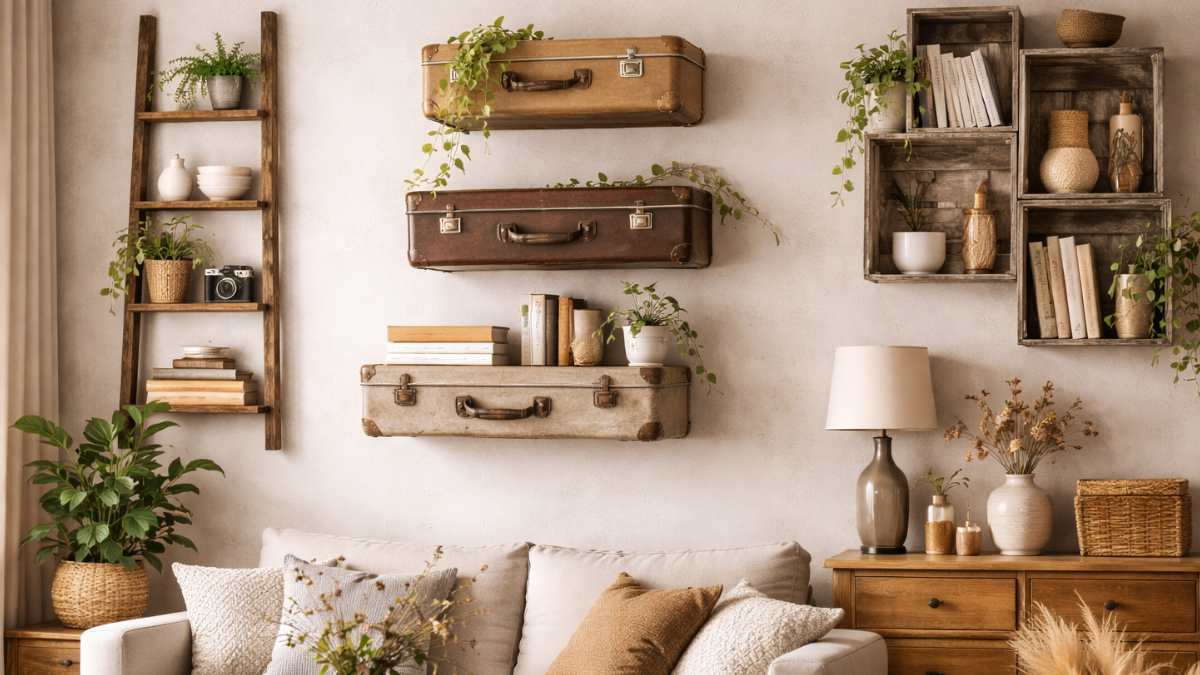
Another not so obvious solution is his old hard suitcases. Mounted on the wall with the base towards the wall, they become storage shelves with a strong visual impact. In a living room or a bedroom, they add depth and tell a story, avoiding the typical effect of industrial solutions.
Even the discarded doors from old furniture they can be transformed into horizontal shelves. A surface that was once vertical completely changes function and becomes a decorative surface. Versions with worked frames are particularly interesting because they add character to the wall.
Creative organizers: when function becomes aesthetic
There are items that lend themselves perfectly to being organizers, but the secret is to use them in unexpected ways.
THE wooden boxesoften seen in an overly rustic way, it can be reinterpreted in a modern key if treated with neutral or dark colors. Placed on the wall in precise rhythm, they create a modular composition. The trick is not to overfill them: leave blank space it is what makes them visually light.
A more complex concept is usage old single drawers. Mounted on the wall, they retain their original structure but become small screen niches. The interior can be left raw or covered with decorative paper, creating a more refined effect.
Even the metal grills or industrial elements can become supports for hanging objects, magazines or accessories. In a modern context, they add an interesting graphic element, especially if combined with warm materials such as wood or fabrics.
Items that become decorative (without looking like recycling)
The real challenge is to avoid the “reclaimed object” effect and turn it into something consistent with the environment.
An elegant solution is to use old wooden cutting boards as wall decorations. Hanging in thoughtful compositions, they create a warm and natural texture. The variety of shapes and sizes adds movement without being chaotic.
THE empty frames is another interesting example. Overlaid or side by side, they create a light visual structure that can be enriched with small objects or mirrors. In this case, the void becomes part of the composition.
Even unexpected items, such as old hardback booksthey can be transformed into small invisible shelves. Fixed to the wall with hidden brackets, they seem to float and create a stunning effect.
How to incorporate these elements into the style of the house
The most important step is integration. A transformed object only really works if it communicates with the rest of the environment. In a modern home, an object that is too “rough” can be lit with a matte paint or with neutral colors.
Quantity is also key. Inserting too many recovery elements risks creating visual confusion. You better choose few pieces, but well placedso as to become focal points. Finally, light is what completes everything: a grazing light or a nearby lamp can enhance textures and materials, making it a star.



