
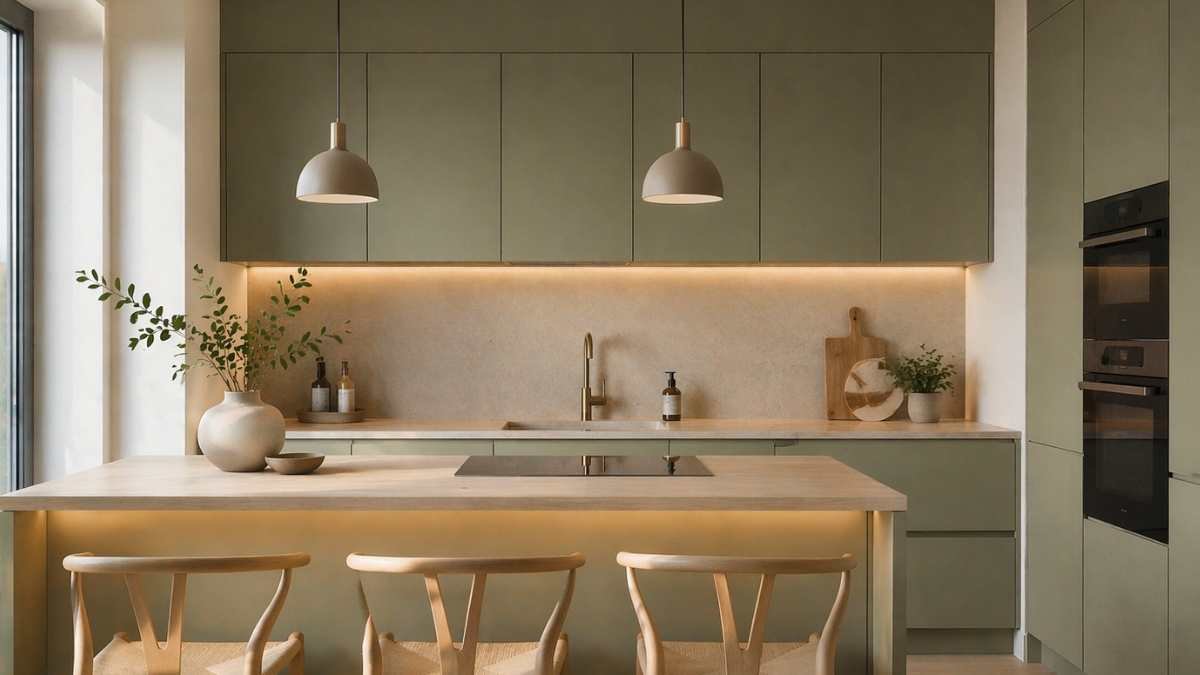

You open a photo of a kitchen and immediately think it’s expensive. Clean lines, elegant materials, everything perfectly in place. Then you look better and understand that it is not a question of furniture or square footage.
There is always one detail that changes everything.
It’s not what everyone thinks, and especially it’s not something that necessarily requires a large investment. It is a precise element, often underestimated, which nevertheless has an immediate effect: it raises the visual level of the entire kitchen and, consequently, the entire house.
The interesting thing is that there isn’t just one. There are some details that work more than others and you just have to choose one in the right way to get a completely different result.
The top: the surface that defines everything
The counter is one of the most visible elements of the kitchen. That’s where the eye falls, that’s where the light is concentrated, that’s where the quality is perceived. A top continuitywith a well-chosen finish, it completely changes the final result.
Materials such as quartz, stone or natural stone have a much more uniform performance than traditional laminates. Even when it comes to technical materials, it’s the visual quality that makes the difference. A well-chosen top makes the kitchen more robust, more refined, more “designed”.
The continuous back: the detail that few consider
It is often underestimated, but the back is one of the most powerful elements from a visual point of view. When prepared in same material as the topwithout interruptions or obvious gaps, it creates a continuity that immediately raises the level of the kitchen.
The result is very different from classic tiles. The surface becomes unique, clean, almost architectural. And this continuity is reflected in the rest of the house. It’s one of those details that you don’t notice right away, but that make a difference.
Grooves instead of handles
Handles are one of those elements that, if not chosen correctly, can reduce the perceived quality of the kitchen. THE councilhowever, completely eliminate this problem. The doors remain clean, linear, without interruptions. The result is more modern, neater, more consistent with a contemporary aesthetic.
It’s a simple option, but extremely effective. And above all, once you see it, it completely changes the way you perceive the most traditional kitchens.
The lighting under the cabinets
It’s one of those details that is often added later, but should be considered from the start. A constant and warm lightplaced under the wall units, it creates depth, reinforces the materials and makes the environment more welcoming. It is not only functional, but scenic. At night, it completely changes the atmosphere of the kitchen and helps the whole space feel more sophisticated.
The faucet: small but decisive
It is one of the most underrated items. However, it is always in the foreground. A faucet with a different finish than classic chromesuch as matte black or brushed steel, can completely transform your sink. It is a detail that is immediately noticeable, because it breaks the monotony and adds character. You don’t need to choose something extravagant. All you need is a well-proportioned model that matches the rest of the kitchen.
The continuum of colors
One of the most common mistakes is to treat the kitchen as a space separate from the rest of the house. However, when colors, materials and finishes interact with each other, the effect changes radically. Walls, furniture, tops and details must speak the same language. It doesn’t mean using everything the same, but creating one consistent palette. This makes the house more harmonious and, consequently, more “expensive” in perception. It’s a delicate job, but it’s what distinguishes a furnished environment from a designed one.
The most impressive detail
Among all these elements, there is one that more than the others has the ability to really change perception: the continuity between top and back. When these two surfaces become one, without interruption, the kitchen stops looking like a set of separate elements and becomes one detached house, clean, almost architectural.
That’s where the jump happens. It’s not just prettier, it’s more cohesive. And this cohesion is reflected throughout the house. After all, you don’t have to do everything. Sometimes you just need to pick the right detail and see it through. Because that’s exactly where the difference between a normal kitchen and a kitchen that really changes the perception of space comes into play.



