

The aesthetics of an interior is not measured only by the quality of the furniture, but by the cleanliness of the lines that define it. Often, the most insidious enemy of home design is not a lack of space or a color mistake, but the “visual noise” created by technology. Electrical cables, necessary but unruly, act as graphic interruptions that fragment the surfaces and flatten the depth of the rooms. Addressing the problem of cable management is not just tidying up, but implementing a real spatial management strategy to restore harmony and architectural continuity to any environment.
The problem is that cables are not designed, but managed after the fact. Appliances are added, furniture is moved, habits change, and the cables stay there, adjusted from time to time. For this reason the result is often improvised. The difference doesn’t completely hide them, though they decide where they should be and how they should accompany the space.
When the cable follows a line, it stops bothering you
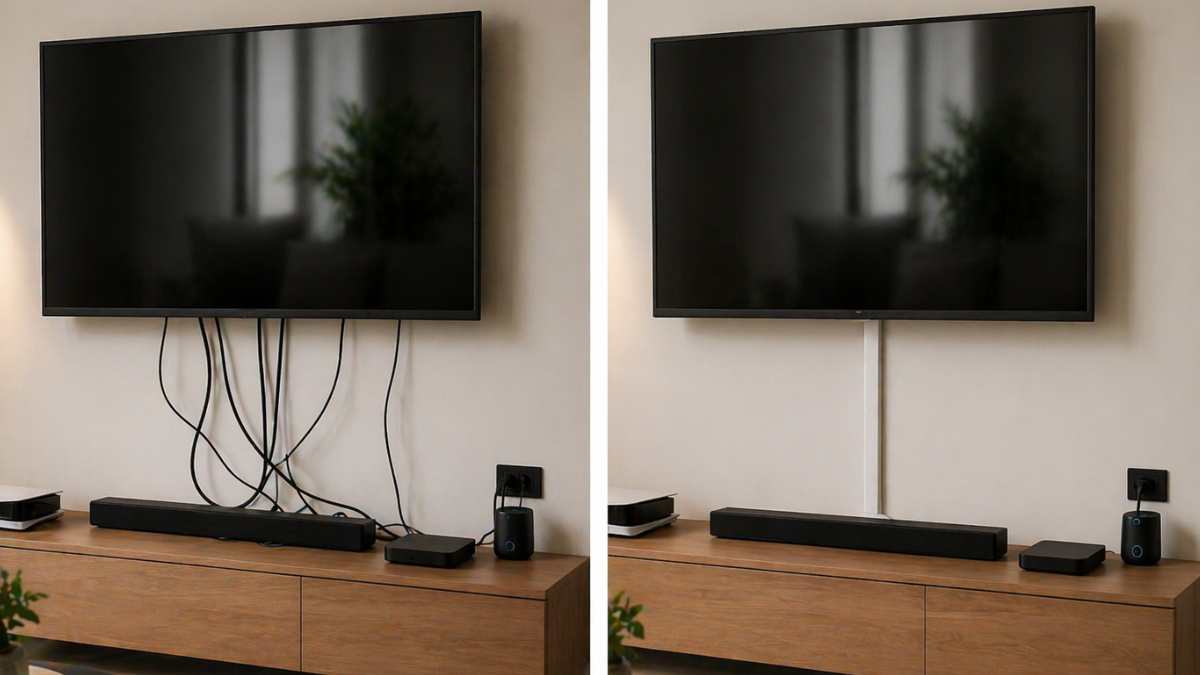
A loose thread creates disorder because it has no direction. It falls randomly, it bends, it piles up. However, when it is made to adhere to a surface, it completely changes the perception. Behind a TV, for example, cables running up the wall are one of the most obvious problems. It doesn’t take much to fix them: bring them in crossbaras close to the wall as possible and keep them solid.
Even without invasive interventions, this simple correction makes them much less visible. If the color of the cable is very different from the wall, it is more noticeable. In these cases, moving it closer to a vertical element, such as the edge of a piece of furniture or an architectural line, helps camouflage it. It doesn’t disappear, but it stops attracting attention.
The office is the most critical point
Everything accumulates here. Chargers, computers, lamps, monitors. The result is often a shadowy mass under the piano or behind the legs. The problem is not the quantity, but the lack of order. When wires overlap without logic, they become visually heavy. In a well-organized desk, however, threads follow a exact route. They are collected, escorted to the back of the floor and brought down to a single point.
This completely changes the look. Even with the same devices, the perception is clearer. The space under the desk becomes legible again and the entire work area looks more refined.
In the room the detail that is immediately noticeable
Next to the bed, there are often chargers, lamps, maybe a poorly hidden multi-socket. Here the problem is not only aesthetic, but also practical. A cable left loose near the nightstand moves, falls, gets tangled. The solution is not to eliminate it, but give it a fixed position.
Passing it behind the bedside table or along the wall, avoiding it to remain hanging or visible from the front, is already enough to improve the whole. The choice of where you will place the socket also has a great influence. When they are too far, extensions and adaptations are created that make everything worse. However, when it is close and well placed, the cable is done almost invisible.
The right furniture solves half the problem
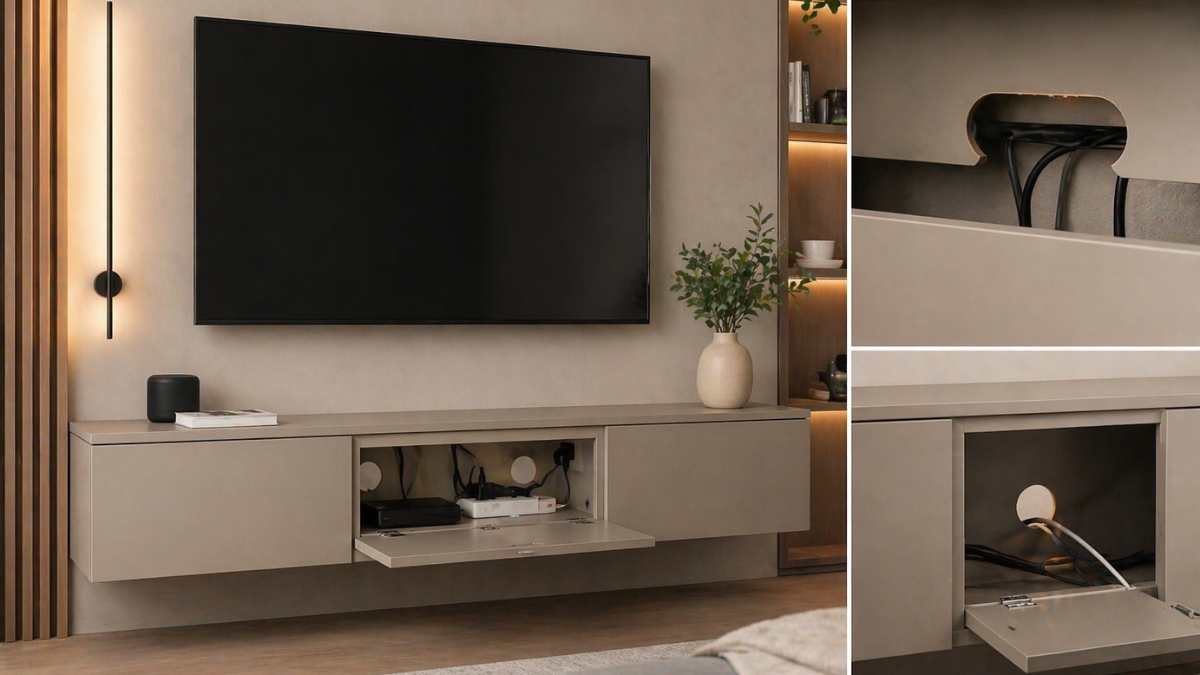
A lot of furniture isn’t designed for cable management, and it shows. Closed furniture without passages, completely full backs, very narrow spaces. In these cases, the cables get strained and end up coming out where they shouldn’t. A piece of furniture with small back passages or with a hidden technical space allows you to manage everything in a cleaner way.
You don’t need anything complex, as long as there is some logic. Even a few centimeters make a difference. In the living room, for example, a TV cabinet with a open pocket at the back allows you to collect cables without leaving them visible. The wall remains clean and the device looks integrated.
Hiding doesn’t mean shutting everything down
One of the most used solutions is to enclose everything in visible containers or channels. It works, but only if done right. If the concealer is more prominent than the problem, the result is not improved. A duct that is too thick or the wrong color becomes a mark on the wall. Better fine-grained solutions, coordinated with the framework or otherwise routes following existing lines.
Even behind furniture you can work well, but without compressing everything. If the wires are crushed or overstretched, they become visible again over time. When cables are managed in the right way, the room changes instantly. Not because they disappeared, but why they no longer interrupt space. Surfaces become clean again, lines are easy to read and even simple furniture acquires more value.



