
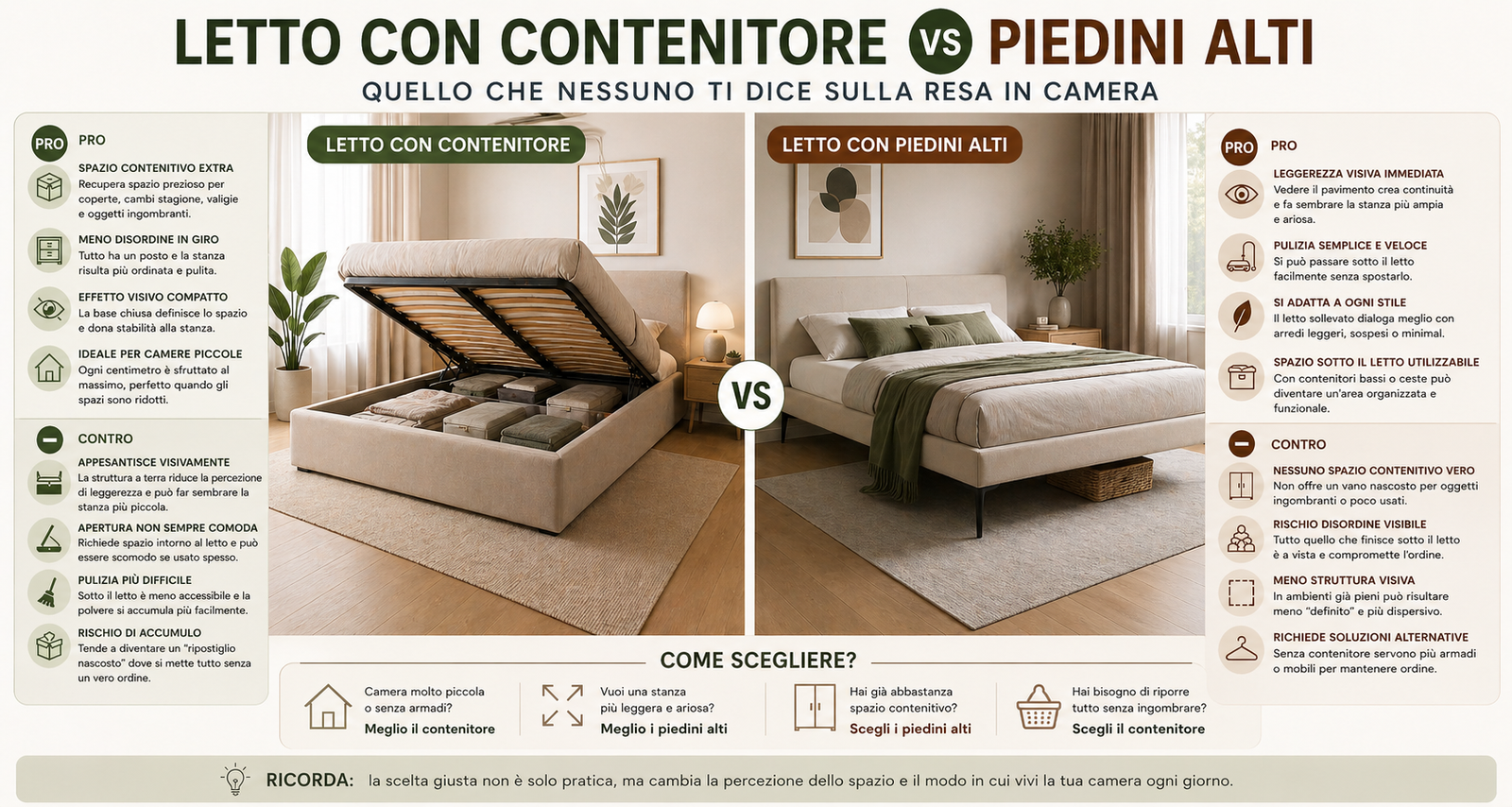

Choosing a bed is one of those decisions that seems simple until you actually look at the room as a whole. The bed with storage space and the one with high legs meet very different needs, but it is not only a matter of space or aesthetics. It’s a choice that changes the way the room is perceived every day, even when you don’t notice it.
The advantages and limitations of the storage bed
Il bed with storage born of a specific need: to exploit every available centimeter. In a home where space is limited, having a hidden compartment under the mattress allows you to reclaim an amount of volume that would otherwise be lost. Blankets, seasonal changes, suitcases or bulky fabrics find an exact location without having to occupy wardrobes or other furniture. This visually brightens the rest of the roombecause it reduces the number of elements around. It is a real advantage, especially in small rooms, where even one less piece of furniture changes the overall balance.
Then there is an aspect connected to ordering. The container forces, in a sense, to group everything into a single space. You no longer have scattered items or improvised solutions, but a precise spot where you can put everything you don’t need every day. This does it cleaner roomeven without special interventions on the furniture.
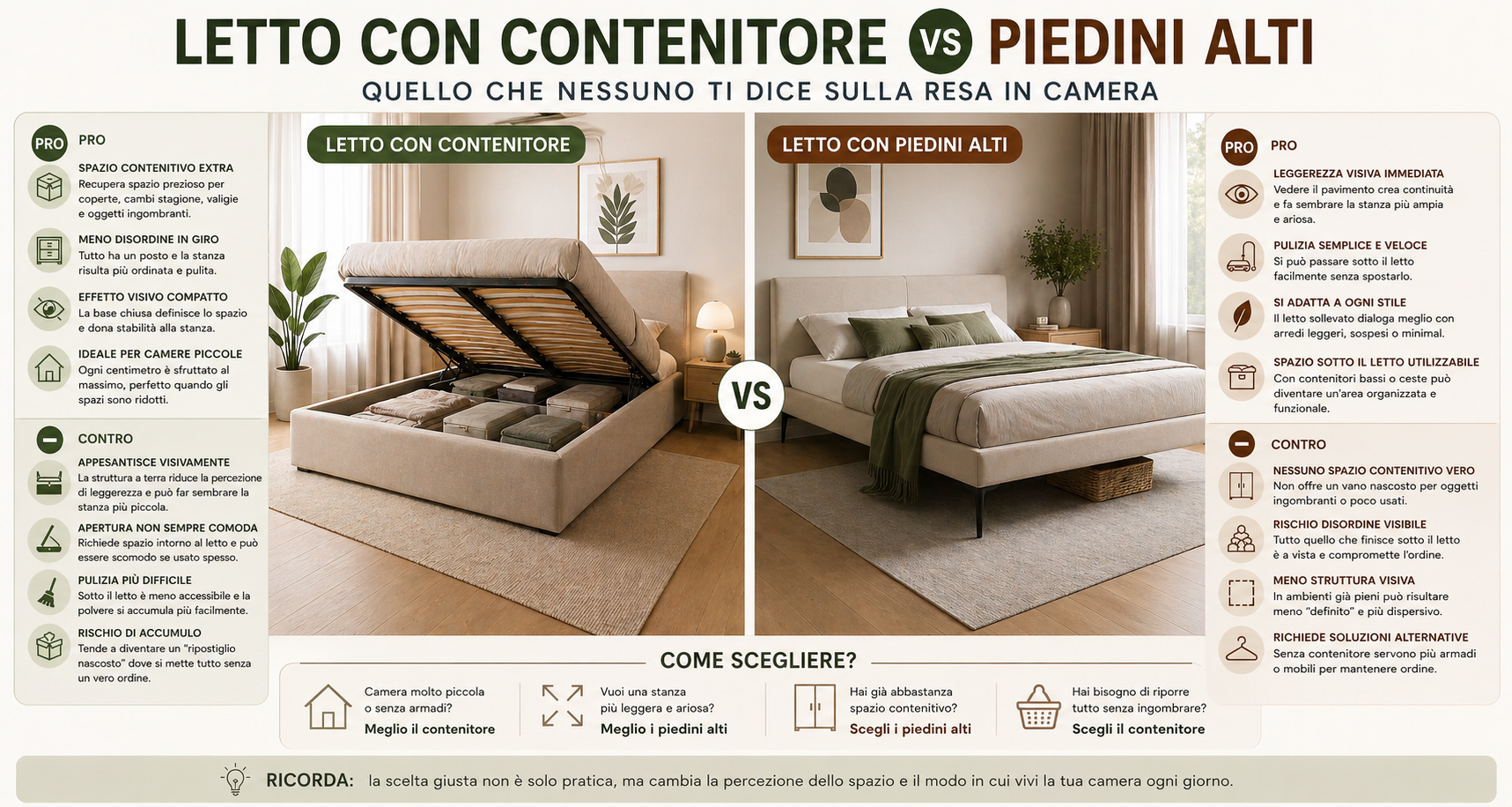
Another point that is often underestimated is the visual continuity. The bed with storage It rests completely on the ground and creates a solid base. In environments that are already full or with a lot of items, this compactness helps to avoid messy “gaps” under the bed, where forgotten items or dust often end up. The room seems more closed, but also more stable.
Finally, in some configurations, it can be more practical for those who don’t want to think too much about space management. Once organized, the container becomes a silent resource that simplifies everyday life.
In addition to these advantages, however, there are also limitations that become apparent over time. The first is directly related to its structure: a bed that completely touches the floor tends to do so fuller roomespecially if the dimensions are not generous. Even with light colors, the compact base reduces the perception of lightness. In a small room, this effect can make everything seem more compressed.
Then there is a question of everyday practicality that is often underestimated. Opening the container is not always straightforward, especially if there are heavy blankets on top or if the space around the bed is limited. This means that, in the long run, it is used less than originally thought.
Even the cleaning becomes more rigid. Not having easy access to the section under the bed creates a less manageable area, especially in homes where dust tends to accumulate quickly. It is a hidden space, but not non-existent.
Finally, the container risks becoming an uncontrolled accumulation point. Just because it doesn’t show, we tend to fill it up more than necessary, losing the ordering function that made it useful in the first place.
The perception of the width of the bed with high legs
Il bed with high legs follows a completely different logic. Here the space is not hidden, but left free. The first result is immediate: the the room seems lighter. Seeing the floor under the bed creates a visual continuity that expands the space, especially in small rooms or with little light. It’s a feeling you get immediately upon entering the room.
This openness also has a practical effect. There cleaning becomes easierbecause it can easily pass under the bed without moving it. There are no areas that are hard to reach and order is easier to maintain over time.
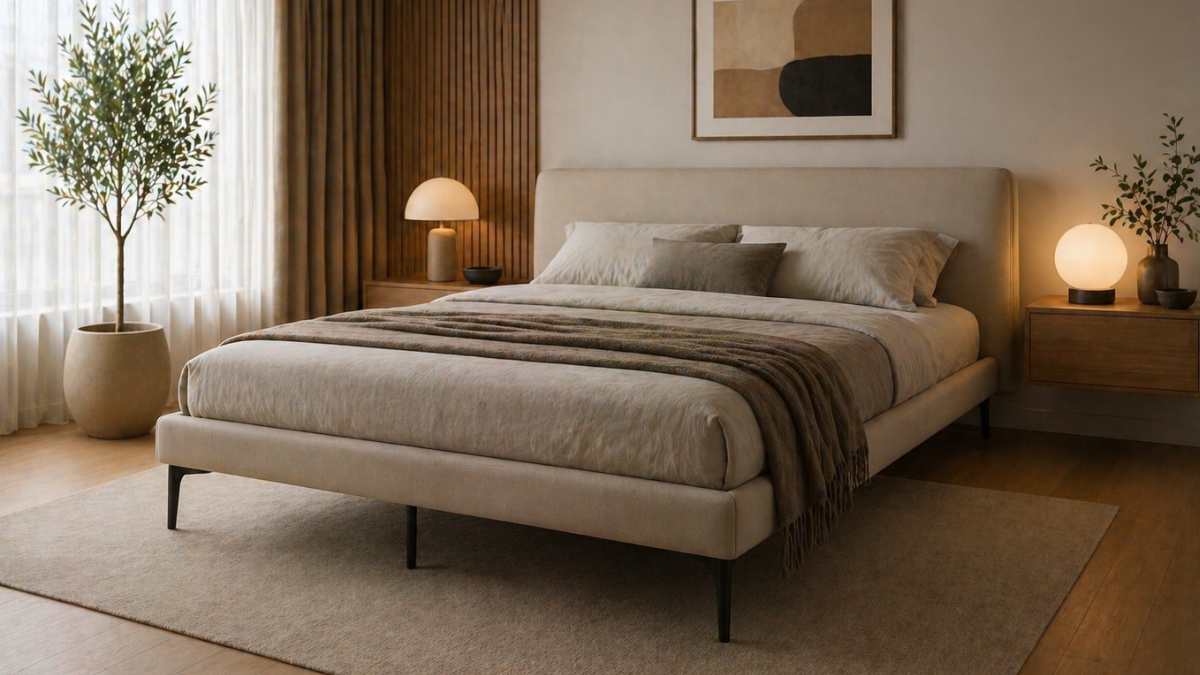
Then there is an aspect connected to the balance of the furniture. A raised bed communicates better with other elements of the room, especially if the bedside tables or furniture are also hanging or light. The whole is more airy, less static.
In some cases, leaving the space under the bed visible also allows you to use it smartly, without closing it off. Shallow containers, baskets or well-organized boxes can be placed without compromising the overall lightness, while maintaining a certain functionality.
Even here, however, there are limits. The most obvious is the lack of real storage space. In homes where every centimeter counts, giving up the pot means we have to find alternatives, often less effective.
The second aspect is precisely about the management of this open space. If left unchecked, it easily becomes a visible accumulation point. Objects hidden under the bed, even temporarily, remain visible and immediately compromise the order of the room.
Then there is an aesthetic question that is very context dependent. In a room that is already full or with a lot of elements, the raised bed can be less “structural”. It lacks that solid base that helps define the space and everything can look a little more scattered.
Finally, the effect of lightness is not always sufficient to compensate for the lack of restriction. In some homes, especially those with few closets, choosing a bed without storage inevitably leads to less tidy solutions elsewhere.
Therefore, the real difference between these two solutions lies not only in the centimeters gained or lost, but in the way the room is experienced. The bed with storage space tends to solve practical problems by concentrating them in a single place, while the one with high legs works in perception of spacemaking it lighter and easier to read.
The right choice is not universal. It depends on how much space you really have, how you use it every day and how willing you are to prefer hidden order over visual lightness. In both cases, the result is immediately visible. And often that’s exactly what makes the difference.



