

When choosing a kitchen or bathroom faucet, the first thing that strikes you is almost always the aesthetics. Lines, finishes, combinations with the rest of the furniture. However, behind a choice that seems purely visual, there is a definite difference regarding daily use, maintenance and above all the cost over time.
Stainless steel and chrome are the two most popular options, but they are not equivalent, even though they may look similar at first glance. Understanding how they actually behave, beyond their appearance, is what allows you to make a more informed and often more convenient choice.
Two similar finishes, but not the same
Visually, especially in modern environments, stainless steel and chrome can appear interchangeable. Both have a metal base, reflect light and are easily integrated into the kitchen and bathroom.
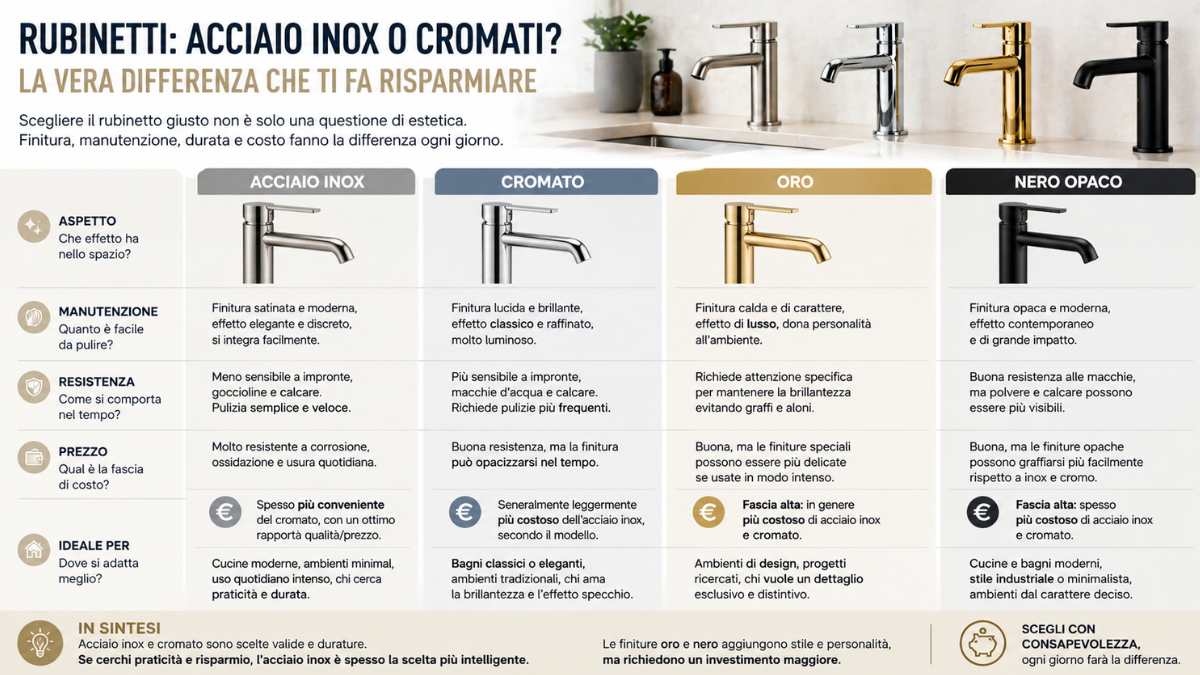
The difference, however, emerges when looking at them more closely. Chrome has a more shiny and reflective almost mirror finish, while stainless steel tends to be more matte or satin. This changes not only the aesthetic effect, but also the way they behave over time.
Chrome is often considered more elegant and shiny, especially in environments with attention to detail. Stainless steel, on the other hand, gives a more technical and modern impression, less “decorative” but very clean.
The difference is visible in daily use
The real distinction between these two materials is not so much in their initial appearance, but in what happens after weeks and months of use.
Chrome, because of its shiny surface, tends to accentuate fingerprints, water drops and calcium salts much more. It is a finish that, to maintain this shiny effect, requires more frequent and careful cleaning. In heavily used environments such as the kitchen, this can become an aspect that needs to be taken seriously.
Stainless steel, on the other hand, is more forgiving. The satin surface better hides the signs of daily use and makes the faucet easier to manage over time. It does not mean that it does not get dirty, but that the visual effect remains more uniform even without constant maintenance.
The point that really makes the difference: the cost
One of the most interesting elements concerns the price. We often tend to think that stainless steel is a more expensive option, but in fact many models are more affordable than chrome-plated ones in a similar range.
This completely changes the perspective. If the choice is not driven solely by very precise aesthetic needs, stainless steel becomes an extremely balanced solutionbecause it offers good visual performance, simpler management and often lower cost.
Chrome remains a valid choice, especially when you’re looking for a brighter effect or want to maintain consistency with other components already in place, but it doesn’t always justify the price difference in practical terms.
When it makes sense to choose chrome
Chrome is still very popular for a specific reason: it easily integrates into classic or elegant environments, where brilliance plays an important role.
In more sophisticated bathrooms or kitchens where every detail is designed to create a coordinated effect, this finish can make sense. Its strong point remains its immediate visual impactespecially when kept perfectly clean.
However, we must be aware that it requires more attention over time and that this aspect can affect the daily experience.
The modern finishes: gold and black
In recent years, variations such as matte black or gold finish have become increasingly common, often present in more contemporary or designer projects.
These are very spectacular solutions, capable of completely changing the character of a kitchen or a bathroom. Black, for example, creates strong and modern contrasts, while gold introduces a more decorative and sophisticated element.
But the limit is the cost. These finishes are almost always in the higher range, often even higher than stainless steel. Additionally, some of these surfaces require special care to avoid marks or wear over time.
For this reason, they work well when they are part of a specific project, but less so when you are looking for a practical and long-term solution without complications.
A more specific choice than it seems
The choice between stainless steel and chrome is not just a matter of taste. It has to do with how you use the space, the time you want to spend on maintenance and your available budget.
If the goal is to have a practical, durable and visually balanced faucet, stainless steel is often the smartest choice. Chrome remains a valid alternative for those looking for a brighter and more refined result, but it requires more careful management.
Ultimately, as is often the case, the difference lies not so much in the product itself, but in how it is used on a daily basis. And that’s exactly where a seemingly simple choice can really make a difference.



