
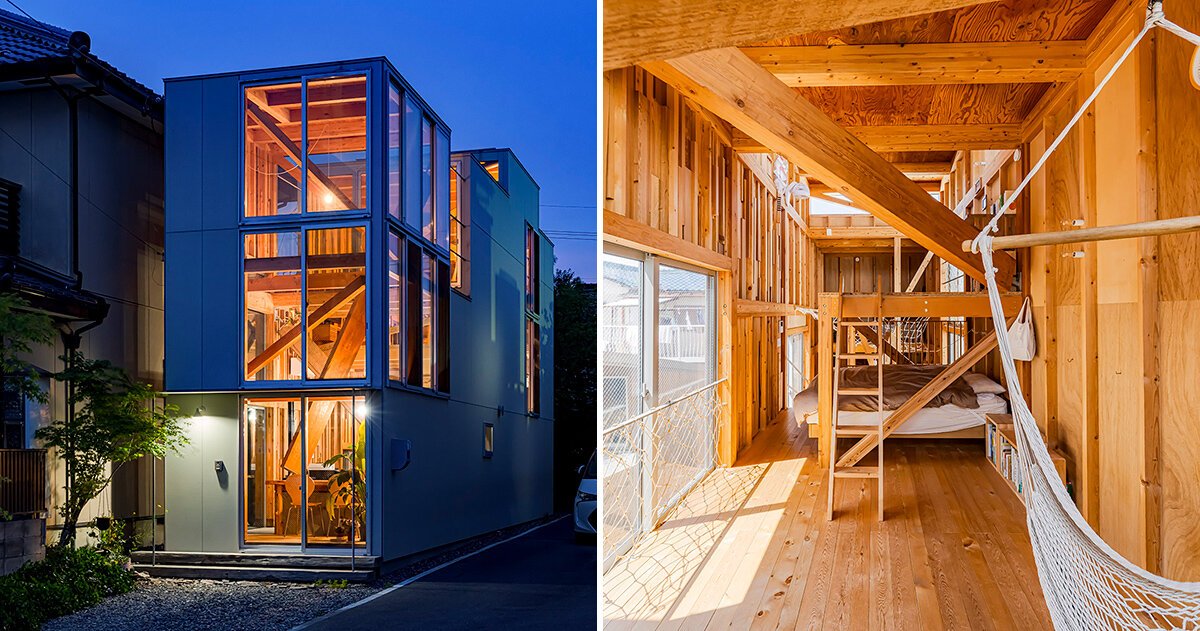

reworking salvaged timber into the structure
Home & Office SH from 1-1 Architects is a combined workplace and residence for a construction company in Nagoya, Japan. Found in a dense, low-lying neighborhood, the home and studio draws directly from materials long held in storage, giving physical form to a local situation that is both practical and cultural.
The customer had accumulated a large quantity timber in two nearby warehouses for decades. Much of it came from bulk orders from a previous generation, along with salvaged pieces collected during demolition. These sections varied in size, type and condition, making them difficult to reuse in conventional constructions. Instead of cutting them into standard elements, 1-1 Architects approached the stock as a set of fixed dimensions that they had to work directly with.

image © Takashi Uemura
a structure shaped by what already exists
THE group at 1-1 Architects shapes House & Office SH through this limitation. Floor heights and spatial volumes shift according to the available lengths of timber, while the structure itself becomes a visible set of beams and supports with distinct geometries. Large diagonal members cut the rooms at unexpected angles, introducing a sense of direction and compression associated with their original form rather than imposed order.
Each connection required a specific response. The custom metal parts were made using 3D measurements, allowing irregular pieces to meet precisely. On site, final adjustments were made by hand to adjust for distortion and subtle deviations. This process leaves traces in the final space, where the alignment is precise in function, but retains the character of the material’s past life.

1-1 Architects combines a workspace and residence in a dense, low-rise neighborhood
opening up the ground level to the neighborhood
The project also responds to a changing urban context. The surrounding area once supported small businesses that combined storefronts or workshops with residences above. Many of these have since closed, leaving the ground floors inactive while the upper levels remain inhabited. This shift has changed the way, replacing active edges with closed facades.
House & Office SH addresses this situation by rethinking the way work and living spaces meet the street. Instead of separating functions vertically or placing them in distinct zones, the building distributes them across the levels in a way that allows for multiple points of contact with the neighborhood. The ground floor remains visible and busy, with the internal activity easily readable from the outside, especially at night when the structure is illuminated from within.

the team reuses decades of salvaged lumber from the client’s warehouses for the main construction
interior as a continuous field of work and living
Inside, the distinction between office and home is deliberately blurred. Workspaces, storage and domestic areas are arranged around a central volume where structure and circulation overlap. The desks are built on thick wooden slabs, the shelves are inside the frame and the stairs run through beams that act as space markers.
Light enters through high openings that span multiple levels, drawing attention to the depth of the section. Diagonal members interrupt the facades while framing them, creating changing relationships between floors. Movement through the building is defined by these encounters, with each step revealing how the structure supports both occupancy and passage.

irregular beams and braces define the form of the building through their original dimensions

custom metal fittings connect each unique timber element in precise coordination



