
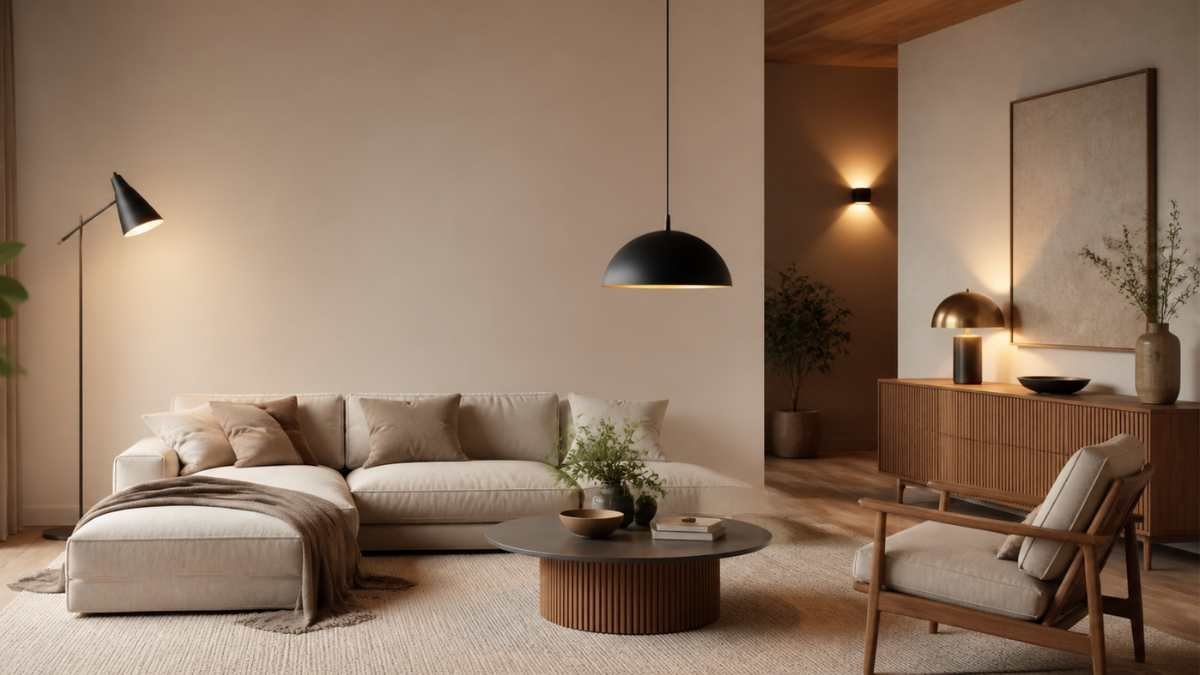

When furnishing a home, light is often the last element you really think about. You choose one main lamp per room, perhaps something aesthetically pleasing, and consider the job done. In fact, this is exactly where one of the most common mistakes occurs: thinking that a single light source is enough.
The truth is that light is not only used to illuminate, but also to construct space. It defines atmospheres, enhances materials, creates depth. And above all, it completely changes the perception of a room, even when the furniture remains identical.
One light is not enough (almost never)
Entering a room lit by a single central light point immediately gives a precise feeling: everything is visible, but nothing is really improved. The environment looks flat, uniform, without variations.
This is because light, when coming from above and from a single point, does not create planes. There are no more familiar territories, no focal points, no visual rhythm. The room works, but it doesn’t ‘live’.
For this reason, the most successful projects are never based on a single bulb, but on a combination of multiple light sources, each with a specific role.
The difference between lighting and creating atmosphere
Not all light bulbs have the same function. Some are used to seeing, others to make a space more welcoming, others to emphasize a detail.
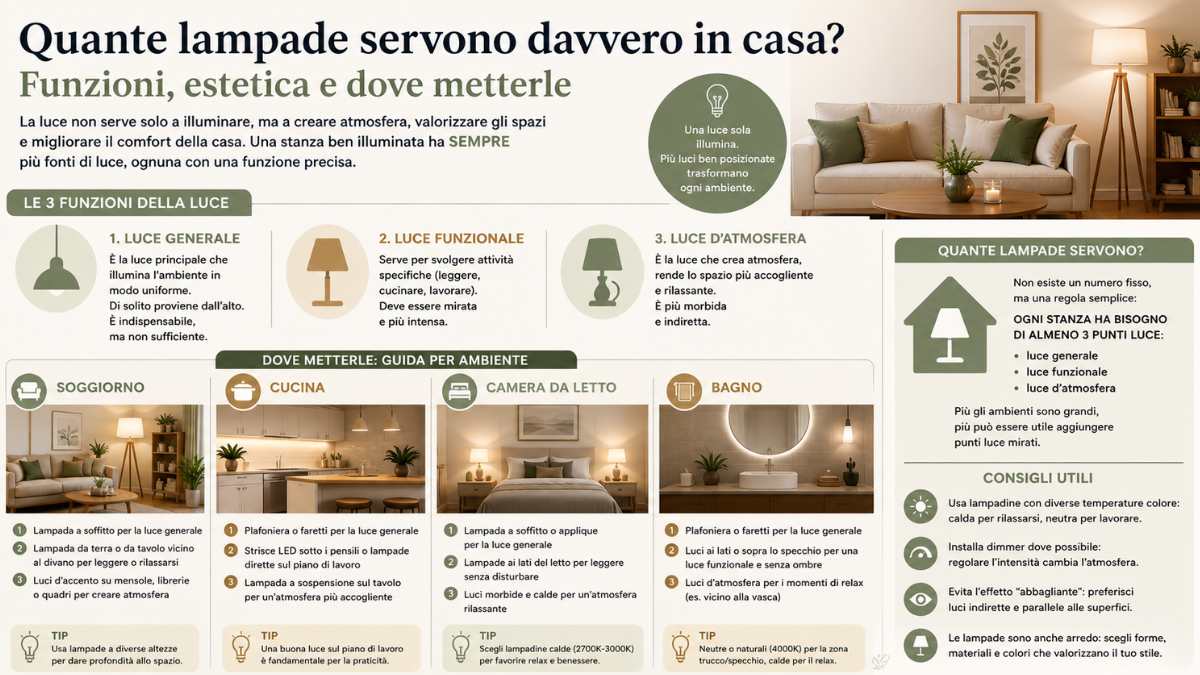
General light is necessary, but it is not enough by itself. At the same time, softer lights are needed, placed at different heights, which accompany the space without dominating it. This layering is what makes the difference.
When the light is intelligently distributed, the room gains depth. Friendlier corners, more lit areas, smoother transitions between one area and another are created.
Where more bulbs are really needed
The living room is the environment where this principle is best seen. Here the light must not only illuminate, but accompany different moments of the day. A floor lamp near the sofa creates a warm spot, while a lower light on a coffee table makes the atmosphere warmer.
Even the bedroom follows a similar logic. The central light may be there, but it’s the lamps on the sides of the bed that really define the space, making it more comfortable and less rigid.
In the kitchen, however, the light becomes more functional. The desktop should be well lit, while the dining room can be softer, more relaxed. Each area requires different light, and this completely changes the experience of the space.
The height of the lights changes everything
One aspect that is often underestimated is the placement of light bulbs. It is not only a matter of number, but also of height.
High lights illuminate, but low lights create atmosphere. A lamp placed close to the floor or on an intermediate surface introduces a more intimate dimension. This balance between different heights is what makes a space more interesting.
When all the lights are at the same height, the environment loses dynamism. However, when they are distributed on multiple levels, the space becomes more structured and welcoming.
How many bulbs do you really need?
There is no fixed number that applies to all homes, but there is a logic. A well-lit room always has at least one general light and one or two secondary lights.
In larger environments, this number increases, but never becomes excessive. The goal is not to fill the room with lamps, but to create a coherent system.
Even a few bright spots, if well placed, can make a big difference. On the contrary, many lamps without logic risk creating confusion.
The aesthetic side (which is not secondary)
Lamps are not just functional tools, but real furnishing elements. The choice of model, materials and shapes helps define the style of the house.
A lamp can become a focal point or be subtly incorporated. In both cases, it must communicate with the rest of the environment. When aesthetics and function coincide, the result is always more balanced.
A house that changes with the light
Ultimately, the question is not how many lamps are needed, but how they are used. Light is one of the most powerful tools for transforming a space without changing its structure.
A well-lit house is not the brightest, but one in which every light has meaning. It’s the one where you can go from a functional atmosphere to a more relaxed one just by turning on an extra bulb.
And often, it’s this very detail that makes the difference between any environment and one that truly feels like home.



