
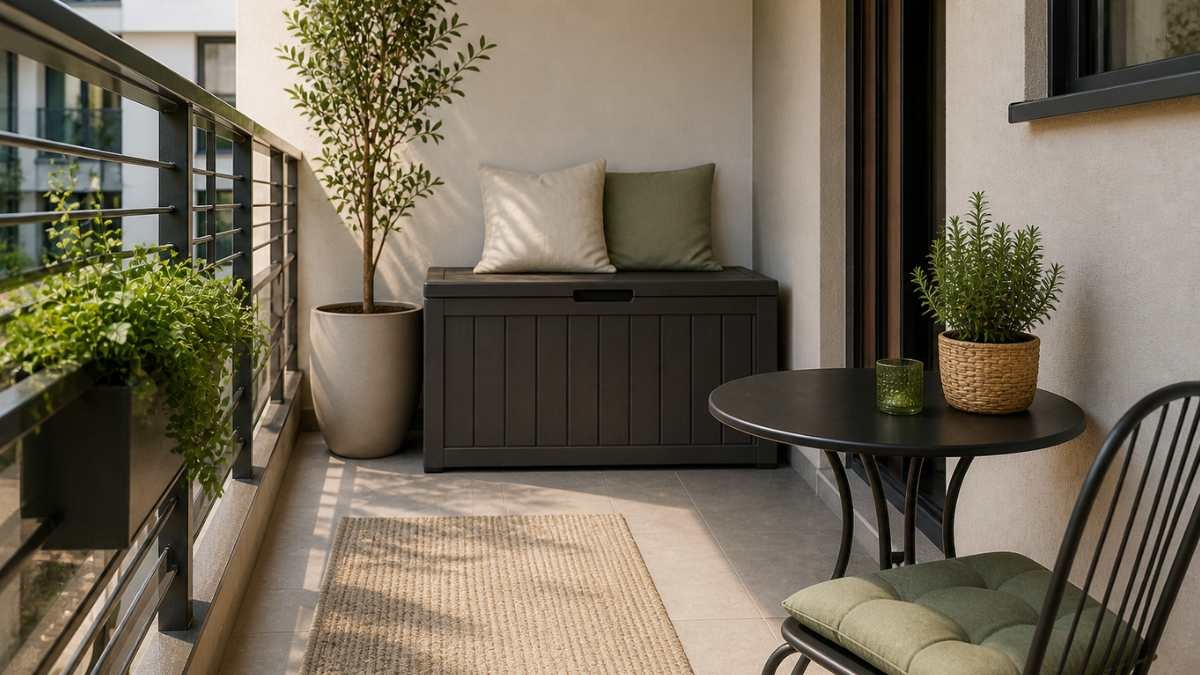

When furnishing a balcony, the chest is one of the most immediate solutions. It allows you to hold pillows, tools, small items and at the same time offers a seat. In small spaces it seems almost inevitable to choose it, because it promises order and functionality without complications.
The most common mistake that changes everything
The most common problem is location. In most small balconies, the chest is placed on the railing or along the most open side. It’s an instinctive choice: the idea is to free up the center and gain space.
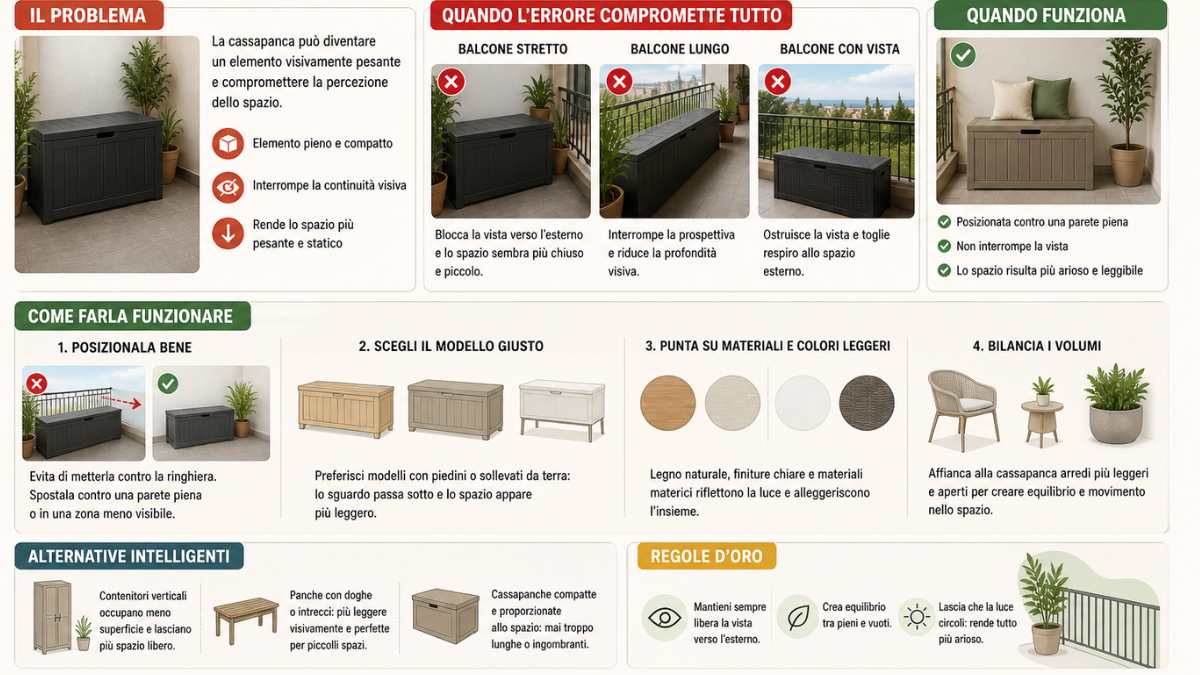
In fact, the opposite is true, at least on a perceptual level. A complete and compact element, placed right at the edge, completely interrupts the visual continuity to the outside. The balcony stops “opening” the view and becomes a closed space, almost a room without a roof.
Imagine a narrow balcony, just over a meter wide. If you place a tall, dark plastic chest without legs along the railing, the space not only naturally decreases, but also looks shorter and lower. The spectacle stops there, it goes no further.
On a long balcony, however, the effect is different but just as punishing. A continuous breast, perhaps the same length as the side, “cuts” the perspective. The space loses depth and becomes visually more static.
The problem of volume (which few consider)
Chest is by nature a block. It does not let the eye pass, does not create transparencies, does not illuminate the space. This is not an absolute flaw, but it does when the frame is small.
Many of the most popular trunks, especially those made of resin or rigid plastic that are easily found at Leroy Merlin, Amazon or outdoor furniture stores, have matte surfaces and dark colors. They absorb light and become visually dominant, even when they shouldn’t be.
When this type of element is introduced without balancing, the balcony loses its lightness. It is no longer a space of passage between inside and outside, but something more closed, more “blocked”.
The cases in which the chest works
If placed against a solid wall, for example, its impact changes completely. It no longer interrupts the view and integrates better with the space. The balcony breathes again, even if the elements remain the same.
Shape also makes a big difference. Models slightly raised from the ground, with legs or a lighter base, allow the eye to pass underneath. It’s a small detail, but it changes the perception.
Versions in natural wood or in lighter materials, perhaps slightly embossed, are less invasive than dark and plastic ones. They do not attract too much attention and are better suited to a domestic context.
The alternative that makes the balcony lighter
In many cases, the problem is not having breasts, but using them for everything. Seat, container, main element. This inevitably makes it mainstream.
A more effective solution is to reduce its role. Using it as a container and placing lighter seating next to it, such as folding chairs or small stools, completely changes the balance. The balcony becomes more dynamic, less rigid, easier to live with.
Even vertical solutions, such as narrow cabinets or tall containers, can work better in some cases. They take up less space and leave more free visual space.
The detail that makes the difference
The balcony, especially if it is small, not only needs order, but also lightness. It is a transitional space, not a closed room. Any element that is too compact, too crowded, risks compromising that quality.
The breast is mistaken when it is treated as a neutral element. Is not. It has a strong visual weight and should be introduced carefully.
Sometimes it is enough to move it, choose a different model or place it next to lighter elements to completely change the perception of the space. And on a balcony, where every centimeter counts, this difference is immediately visible.



