
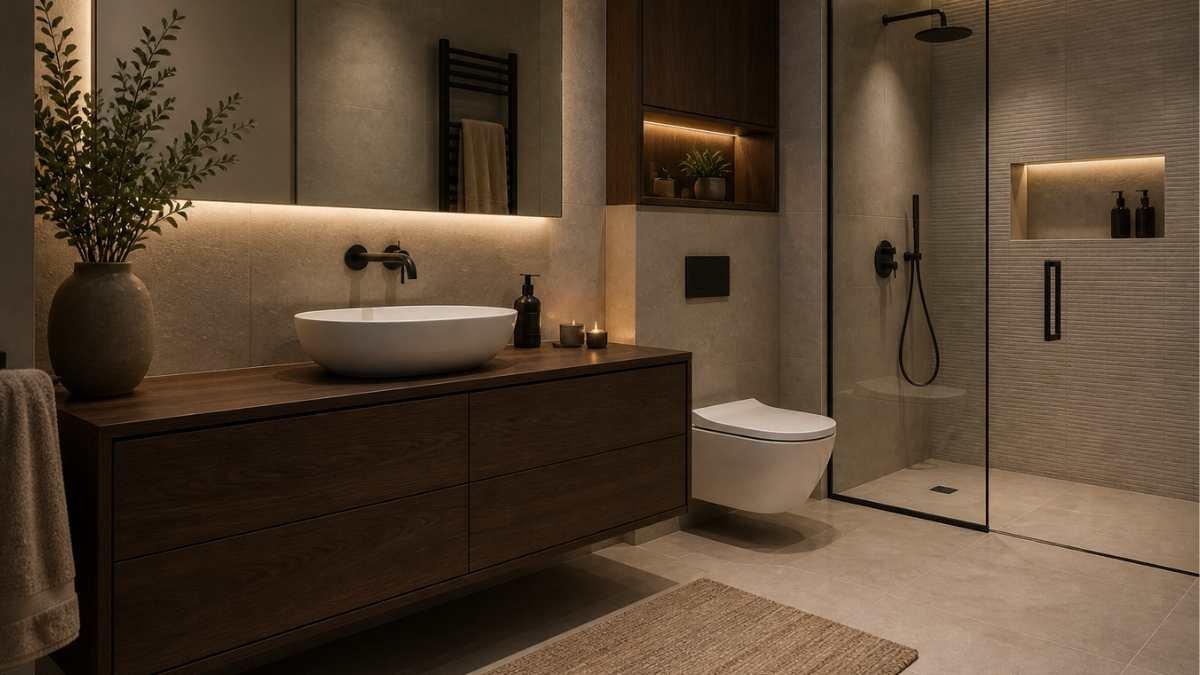

Dark wood in the bathroom has instant appeal. It is reminiscent of elegant environments, design hotels, sophisticated spas, warm and deep surfaces. On paper it seems a safe choice, because it gives character even to a simple bathroom and immediately makes the space more important. The problem is that, in practice, it is not easy to introduce: if combined badly, it can make the bathroom heavier, darker and even less modern than we imagined.
The point is not to avoid dark wood, but to understand what to make him talk. In the bathroom, in fact, each element reinforces the other: tiles, sanitary ware, taps, mirror, light and floor all work together. One wrong combination is enough to turn a refined choice into an outdated or overloaded effect.
When dark wood doesn’t work
The first mistake is combining it with surfaces that are too dark. A bathroom cabinet in rich walnut, wenge or dark oak can be beautiful, but if placed in an environment with charcoal gray tiles, dark floors and little natural light, the effect risks being closed. The bathroom loses depth because everything absorbs the light and even the most beautiful details end up disappearing.
Even the combination with very cold glossy tiles does not work well, especially in shades of ice white or blue gray. In this case the contrast is very rigid: the wood seems almost “rested” in space, without real continuity. The bathroom looks technical, uninviting, as if the materials belong to two different projects.
Even the phenomenon of highly veined marble must be treated with caution. If the wood is already the protagonist and the coating has a strong grain, the risk is creating visual competition. Everything wants to get attention, but nothing really manages to improve. The result may look expensive, but not necessarily elegant.
The combinations that make dark wood more relevant
Dark wood works much better when lit by light but not cold surfaces. The best shades are warm and natural: sand, gray, stone beige, dirty ivory, light dove gray. These colors do not create a violent break, but make the wood emerge more gently.
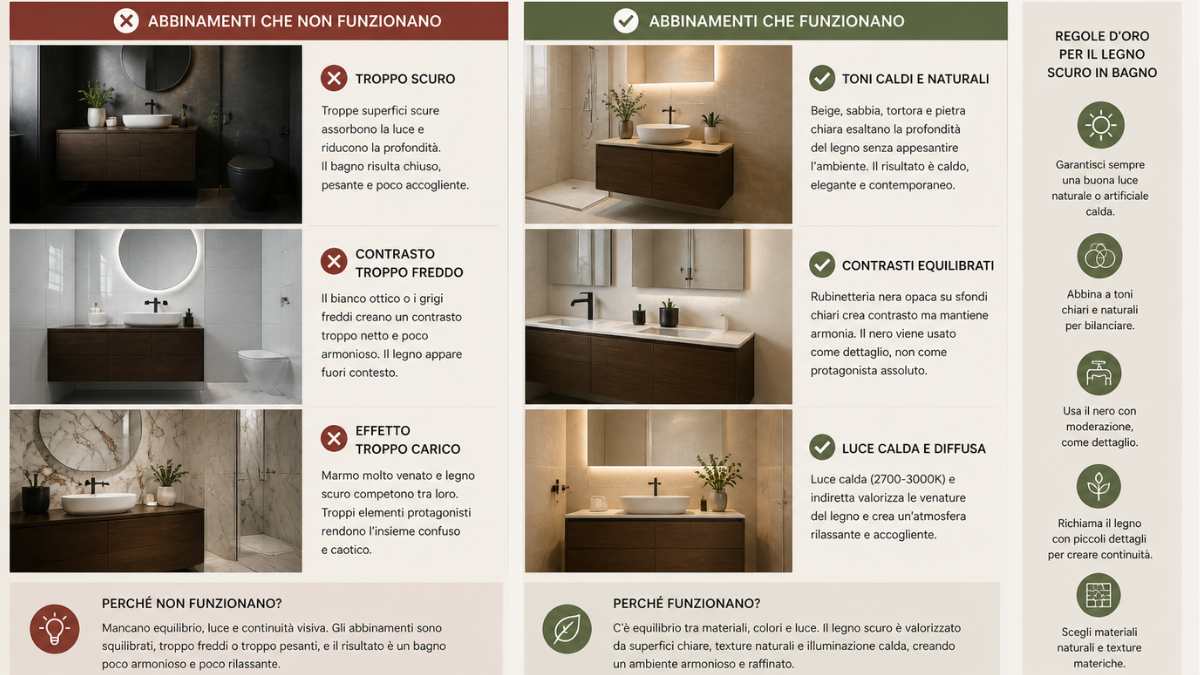
A dark walnut bathroom cabinet, for example, becomes much more elegant when paired with a light stone-effect wall or sand-colored stone. The contrast remains apparent, but not stark. The bathroom looks warmer, more material, more modern.
The combination with matte black faucets also works very well, but only if the rest of the environment remains bright. Black captures the depth of the wood and creates coherence, but it should be used as a detail, not as an absolute second star. However, if you also add black shower profiles, a black mirror, black accessories and dark tiles, the whole thing becomes very heavy.
The decisive role of light
With dark wood, light is not a detail, it is almost a prerequisite. A cold light easily ruins the effect, because it dulls the grain and makes the bath more severe. A warm and diffused light, on the other hand, brings out the depth of the material and makes it much more welcoming.
The best solutions are indirect: light behind the mirror, bright cuts near the furniture, small side appliques. Dark wood should not be aggressively lit, but accompanied. When the light touches it, the bathroom immediately acquires a more sophisticated effect.
Floor, wall and bathroom fittings: where balance is required
If the furniture is dark, the floor should remain more neutral. A light stoneware, warm concrete or modern travertine help keep the bathroom airy. Conversely, a dark floor along with dark furniture only works in large, well-lit and carefully designed environments.
White bathroom fixtures can work, but better if the white is not too visual. A warm white or softer ceramic integrates best with wood. Even countertop washbasins in light stone or matte ceramic can make the whole more sophisticated, because they break up the solidity of the furniture without creating a cold contrast.
The real secret is not to make it work on its own
Dark wood doesn’t have to look like the only “important” element in the bathroom. It needs references, even if they are minimal: a frame, a shelf, a small stool, a tray or a niche with the same substance. This creates continuity and makes the choice seem more deliberate.
But at the same time, you should not overdo it. Very dark wood turns the bathroom into a heavy environment. The best result is achieved when there is wood, recognizable but balanced by light, light surfaces and natural materials.
Dark wood in the bathroom can be a beautiful choice, but only if it is not treated as a shortcut to elegance. It works when it’s calibrated, when it has room to breathe, and when combinations make it lighter. Otherwise, instead of making the bathroom more sophisticated, it just risks making it look smaller, darker and less well-kept.



