
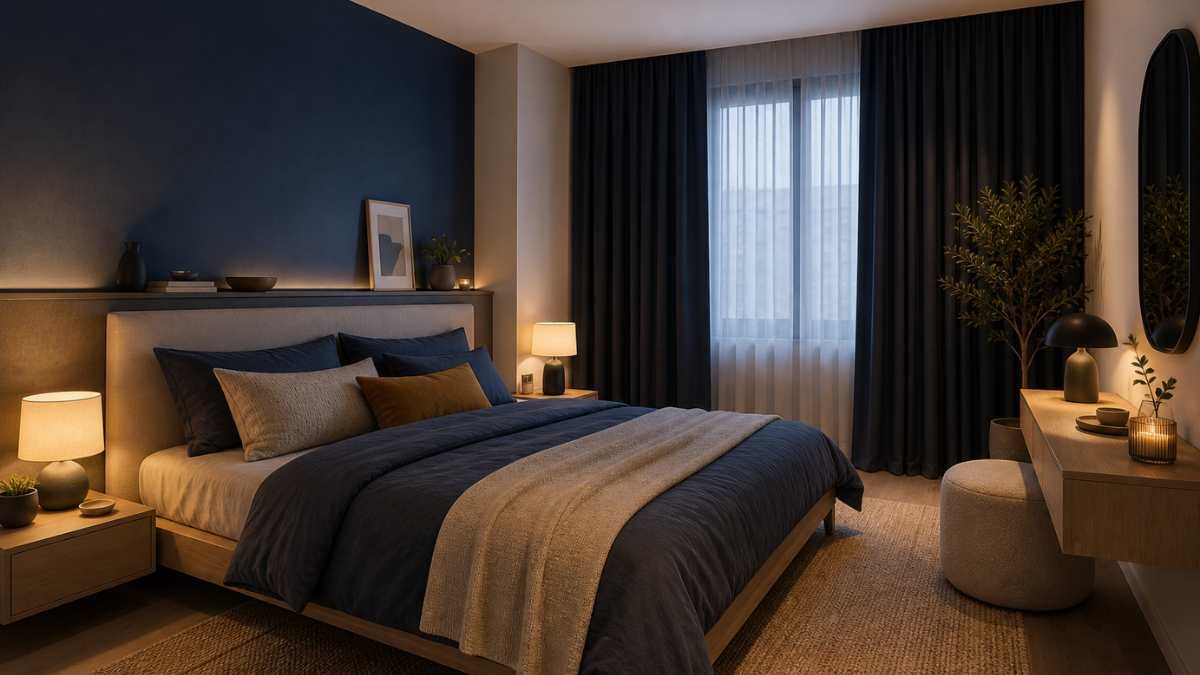

A good night’s sleep is not only a matter of mattress or fatigue. It is above all a matter of environment. The bedroom is a space that works quietly on the body and mind, affecting heart rate, breathing and the ability to relax. And often, without realizing it, it is the furniture itself that sabotages rest.
Wrong light, colors that are too cold, useless objects, unwelcoming materials. All the elements that together make the room less suitable for sleeping than it should be. The good news is that you don’t have to flip everything. A few targeted interventions are enough to completely change the quality of rest.
The color that slows down the body
One of the most underrated interventions concerns the palette. Color is not just aesthetics, but a real sensory stimulation. Shades like Deep Blue or Cloud Dancer, which are very light, slightly dusty neutrals, have a direct effect on spatial perception and the nervous system.
Blue, especially in its darker versions, helps lower the heart rate and promote a state of calm. Cloud Dancer, on the other hand, works on light, making it softer and more diffuse. When these shades are combined with earthy details, such as a warm ocher or a natural beige, the room gains depth without losing its calmness. It’s a balance that’s immediately noticeable, even without knowing how to explain it.
The bed in the right place changes everything
The position of the bed is one of those details that seems minor, but actually has a huge impact on the feeling of security. Resting the headboard against a solid wall creates a sense of stability, while the view of the door, not directly aligned, allows the body to relax.
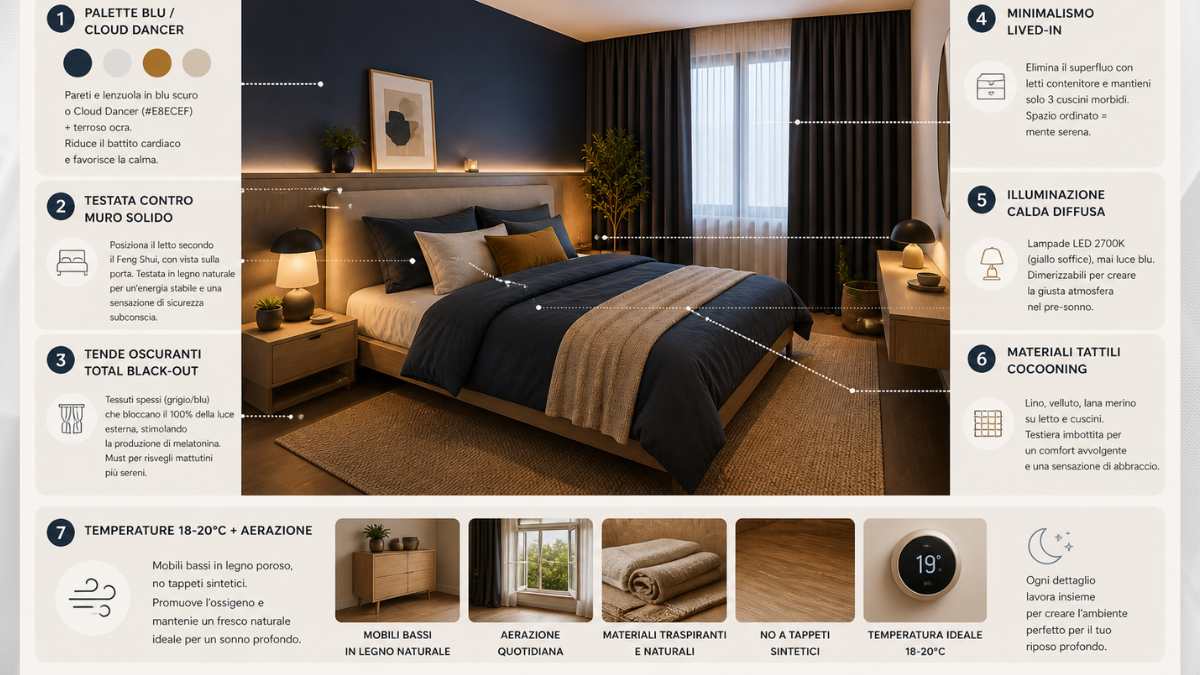
This arrangement, often associated with Feng Shui, is not just a symbolic matter. It’s an instinctive response: knowing what’s going on in space, even unconsciously, helps reduce the state of alertness. If the headboard is made of natural wood, the result is even more balanced, because it introduces a warm and stable component.
The darkness that really makes the difference
Light is one of the main factors affecting sleep. Even a minimal light source can affect melatonin production. For this reason, curtains are not an aesthetic detail, but a fundamental tool.
blackout fabrics, especially in deep shades like gray or blue, they allow you to completely block out the outside light. This creates a more protected environment, more suitable for resting, especially in the early hours of the morning. It is one of those interventions that you notice immediately, from the first night.
Fewer objects, more breathing
Visual clutter is one of the main enemies of relaxation. Even when we don’t realize it, a room full of objects creates a sense of constant tension.
Reducing the unnecessary does not mean emptying the room, but giving it space. Storage beds, a few carefully selected items, pillows limited to the essentials. When everything is in place, the mind automatically becomes lighter. It is a form of minimalism that is not cold, but alive, concrete.
The light that accompanies sleep
Not all lights are the same, especially at night. Cold, blue lights stimulate the brain and make it harder to relax. Instead, warm, diffused light helps the body prepare for sleep.
Lamps with a temperature of around 2700K, perhaps adjustable, allow you to create a gradual transition between activity and rest. Slowly dimming the light becomes a little ritual, a signal that the body recognizes. It’s a simple change, but a very powerful one.
The comfort you feel with the touch
The perception of comfort also goes through the materials. Fabrics such as linen, velvet or merino wool create an immediate, almost natural sense of welcome.
A padded headboard, soft sheets, a slightly heavy blanket. They are elements that transform the bed into a protective space, almost a shelter. It is what is called the “cocoon” effect and it works precisely because it involves the body and not just the vision.
Getting the temperature right is already half the battle
Finally, there is one aspect that is often overlooked: temperature. Sleeping in a room that is too hot or too cold makes rest lighter and less refreshing.
Keeping the environment between 18 and 20 degrees, promoting air exchange and choosing breathable materials make a huge difference. Furniture can also contribute, with low furniture and natural surfaces that don’t retain heat too much. Avoiding synthetic carpets or overly insulating elements helps maintain a more balanced microclimate.
A room that works for you
Good sleep is never accidental. It is the result of a series of conditions that, together, create the right environment. When color, light, materials and layout work in the same direction, the body responds automatically.
You don’t have to revolutionize the bedroom. You just need to intervene in the right places. And often, that’s exactly where the difference lies between an ordinary night and a truly deep rest.



