

Milan Design Week it has become a behemoth — ontologically bursting at the seams and moving away from its original purpose as the world’s premier market for furniture and furnishing innovations. Today’s city-wide phenomenon has expanded not only in scale—folding into every possible palace, church, and abandoned industrial complex—but also in scope, incorporating a series of “entertainment society” installations placed by luxury and mid-market brands in nearly every sector. All spend exorbitant amounts to get into the action.


A daily flurry of flashy showcases—often impressive presentations of real products or ideas—alongside strictly closed cocktail hours, Who’s Who dinners and increasingly exclusive parties tend to culminate with late-night drinks at the legendary Bar Basso, famed as the birthplace of the Negroni Sbagliato, the birthplace of the Negroni Sbagliato, the world’s corner of Milan. confirmed and aspiring elite of the design industry.


Over the course of about five nights, they converge on the relatively compact watering hole, crowding the inside of the time capsule, the awning-covered porch, and the adjacent traffic circle. The required social media post—proof of participation—has become a sign of acceptance, a confirmation of a pilgrimage completed.


For a crowd so attuned to the aesthetic makeup of furniture and furnishings, it’s surprising—almost funny—how rarely anyone looks down to see what they’re actually sitting on, that is, if they can at all. This degree of attention is reserved and often exhausted by the overly organized showrooms and sprawling showrooms found elsewhere in the city, where an avalanche of luxury goods is revealed. At this year’s Milan Design Week, a German designer Tilo Reich set out to tease out this paradox—perhaps also to challenge the growing banality of the event itself and the increasingly detached, occasionally flippant attitude of the industry more generally.


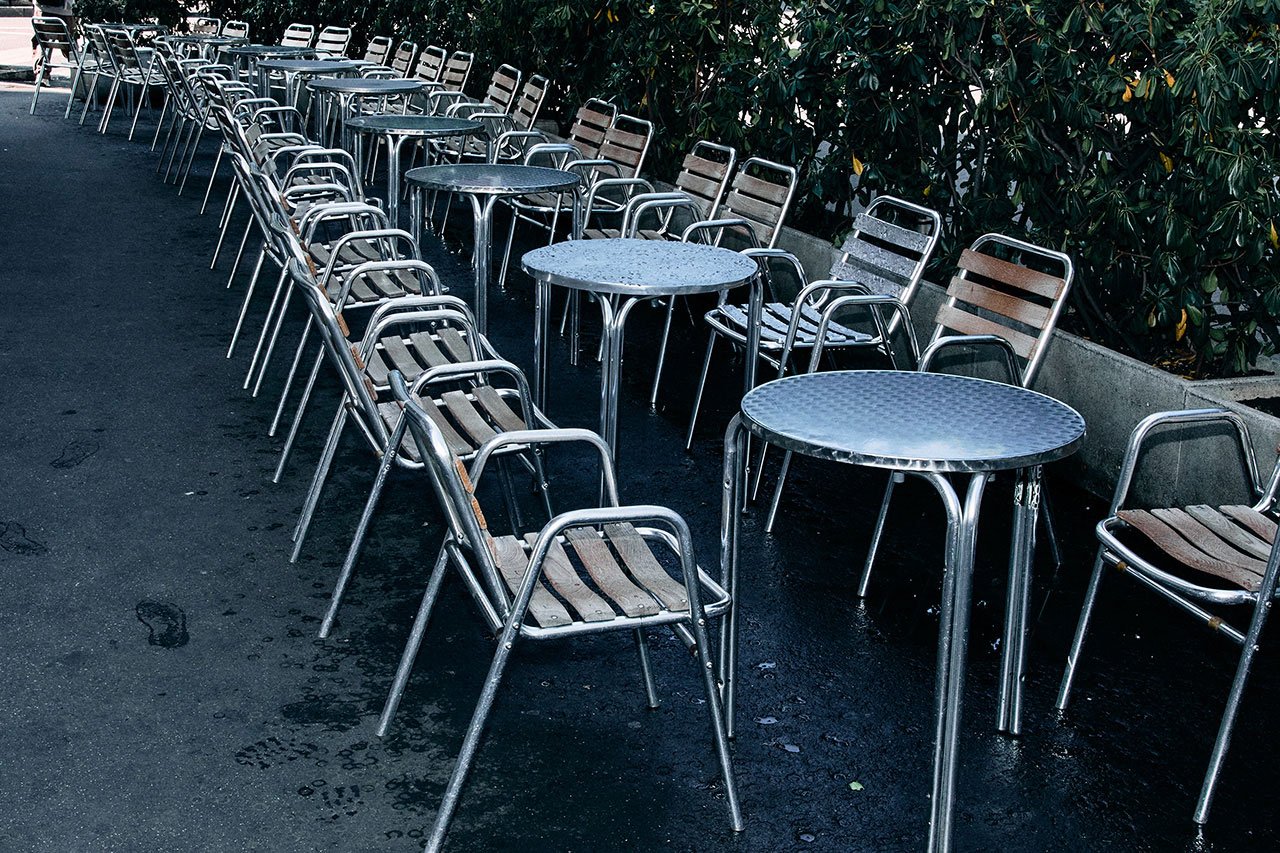
Less an immediate critique than a more transcendent reflection on the cycles of presence and temporality, Reich’s site-responsive tables and chairs bear the recycled cast-aluminum imprint of the worn, weathered pavement beneath them. The ground level itself has been shaped by years of use—the repeated placement, removal, and dragging of furniture leaving its own quiet record.


“The pavement is approached as a form of skin. Cracks, seams, repairs, compressions and transitions appear as inscriptions of time,” the designer explains in an artist statement. “Positive and negative experiences leave equal traces. What has been destroyed does not disappear but becomes part of a new whole.”


Rendered in the same recognizable, mass-produced tubular frames as the furniture commonly found on site, these idiosyncratic surfaces are presented as subtle interventions, subtly subverting expectations of what one might encounter in such a frame.


The challenge – what Reich called the “quietest show at Milan Design Week” – extends from his ongoing project Urban Tissue. “For many years, I have developed an ongoing artistic practice focused on the transformation of urban materials and the exploration of social and spatial structures,” says Reich. “My work focuses on the distinctive surfaces of places and the ways they are shaped by social, cultural and economic influences.”

To know more about the designer visit thiloreich.com.
Photo by Giorgio Garzella.




