

The Rockefeller Apartments occupy a unique place in American architectural history as one of the first International Style residential buildings in New York City, originally designed in 1936 by Wallace Harrison and J. André Fouilheux and commissioned by the Rockefeller family to house tenants displaced by the construction of Rockefeller Center. This project required an interior language able to converse with the building’s modernist pedigree without slipping into nostalgia or era mimicry, a balance Nicholas Potts Studio and Studio Armando Aguirre achieved through extensive archival research and a willingness to let architecture itself dictate the terms of intervention.


The 2,800-square-foot residence combines two former units into a single, large-scale apartment, restoring a sense of spatial clarity that decades of subdivision had eroded. The design is reorganized around a pill-shaped entrance portico, recalling the curvilinear logic embedded in the building’s signature radiused projecting bays.


These bays, which give the Rockefeller Apartments their distinctive street presence, now anchor generously proportioned formal living and dining rooms, restoring a pre-war pace of procession and gathering. Two bedrooms, three bathrooms and a flexible office and guest space complete the scheme, with design decisions guided not only by original plans but also by reference to William Lescaze’s model unit and Nelson Rockefeller’s own 1930s interiors.


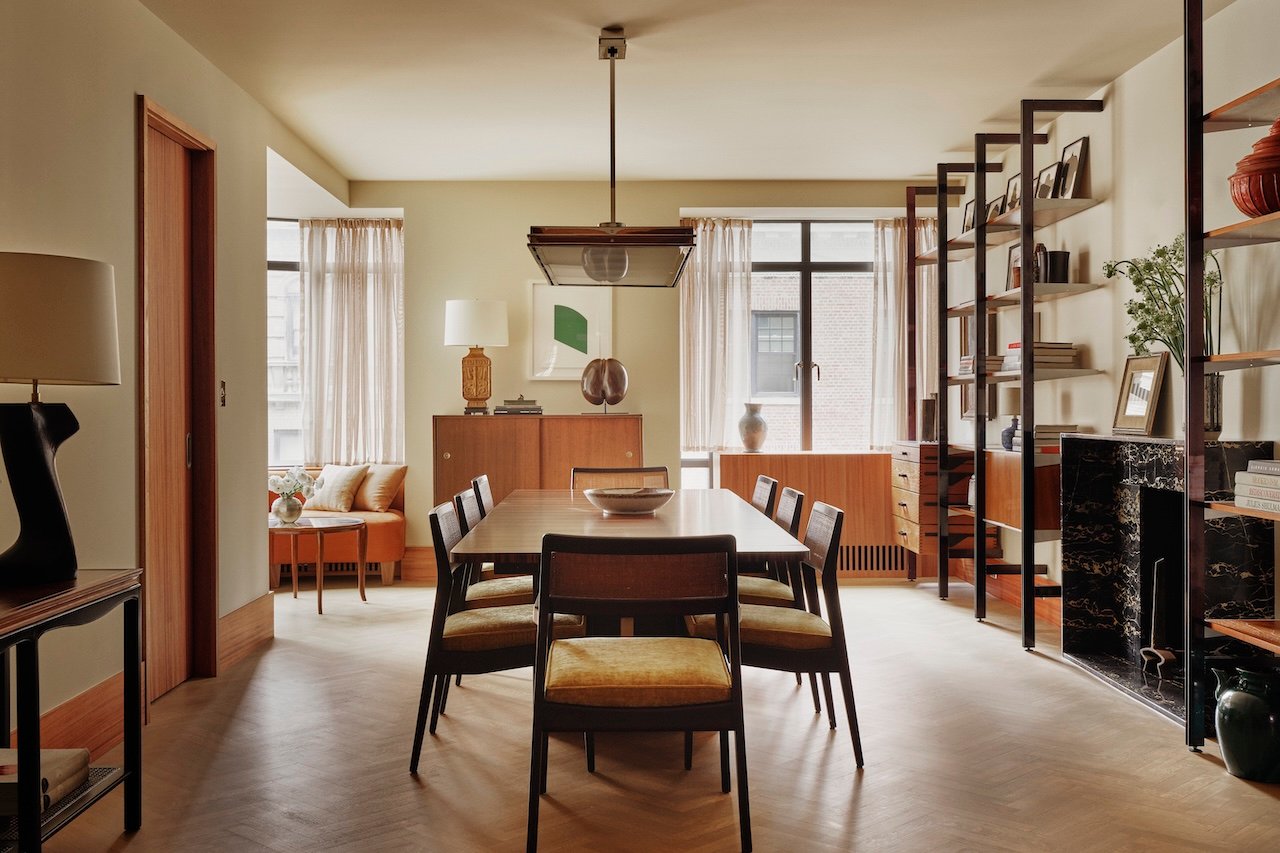
Heavy Khaya mahogany runs through the apartment as a continuous horizontal reference point, becoming a dining table in one room, a cabinet in another and an illuminated art plinth elsewhere. Repetition gives the rooms a quiet rhythm, drawing disparate spaces into a single composition. Mirror-polished Portoro marble introduces moments of reflective depth and visual surprise, with its dramatic gold veins in deep black lending accents that feel both luxurious and architectural. Cork-lined gallery walls reference the foyer’s original hatch, while introducing acoustic warmth and a tactile counterpoint to the apartment’s harder surfaces.


Throughout, custom interventions are accompanied by vintage and vintage furniture drawn from the Bauhaus, International Style and Art Deco traditions, allowing the apartment to feel historically updated without becoming overly referential.


The bathrooms continue this dialogue between restoration and reinterpretation. Original fixtures were retained wherever possible, including a rare historic toilet sourced from New York, then combined with Heath Ceramics handcrafted tile and custom fixtures that quietly bridge past and present.


Elsewhere, custom oak screens, a dinette, daybed and desk, and an illuminated living room shelf made specifically for the architecture reinforce the project’s commitment to continuity between furniture and shell.


The owner’s collection, which includes works by Robert Mangold, Candida Höfer, Ellsworth Kelly, Louise Lawler, Ed Ruscha and Thomas Demand, shaped color and material decisions throughout the project, creating subtle dialogues between art and architecture. The collaboration between Nicholas Potts Studio and Studio Armando Aguirre ultimately demonstrates the value of treating the architectural shell and internal contents as a single design problem, creating a residence in which container and contents speak the same coherent language.
To learn more about the creatives involved, visit npsarch.com and armandoaguirre.com.
Photo by Adrian Gottstyling by Colin King.




