
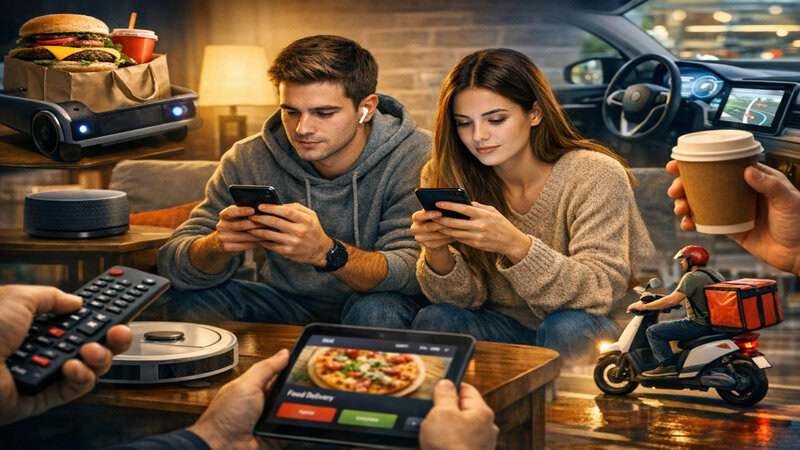

1. GPS navigation

The advent of GPS navigation has greatly simplified travel, reducing the need for traditional map reading and diminishing our innate sense of direction. Over-reliance on these systems can impair spatial awareness and navigation skills, leading to reduced mental resilience and self-sufficiency. Research shows that habitual GPS use can negatively affect spatial memory and hippocampal function. (nih.gov)
2. Food Delivery Apps

The rise of food delivery apps has made eating out more convenient, but that convenience can come at a cost. Over-reliance on these services can lead to a decline in home cooking skills, potentially affecting household diets and budgets. The Centers for Disease Control and Prevention (CDC) reports that cooking less at home is associated with higher rates of obesity and chronic disease. (cdc.gov) While these apps offer convenience, they can also limit cooking skills and foster unhealthy eating habits.
3. Online shopping

The convenience of online shopping has transformed retail, but it also encourages impulse spending and weakens budgeting skills. The rise of buy-now-pay-later (BNPL) services has made it easier for consumers to overspend, leading to an increase in consumer debt. A recent survey found that 41% of BNPL users made a late payment in the past year, up from 34% the year before. (cnbc.com) Additionally, the reduction of personal comparison shopping reduces consumer knowledge, as shoppers lose the tactile experience of evaluating products firsthand.
4. Streaming Services

The rise of streaming services has transformed entertainment, offering on-demand access to a vast array of content. However, this convenience can lead to over-monitoring, eroding impulse control and time management skills. Unlike traditional scheduled TV, streaming allows users to lose track of time, contributing to sleep deprivation. The Sleep Foundation warns that insufficient sleep can impair cognitive functions, including attention and memory, and increase the risk of health problems such as obesity and cardiovascular disease. (sleepfoundation.org)
5. Smart home devices

Voice assistants and automated gadgets like thermostats reduce the need for problem solving and daily chores. THE New York Times highlights concerns about automation making basic domestic skills redundant. This is a growing problem for future generations who are losing the ability to perform basic life skills.
6. Online grocery delivery

The convenience of online grocery delivery has changed shopping habits, but it can also affect meal planning and awareness of food quality. In-store shopping encourages consumers to evaluate prices, nutrition and freshness first-hand, encouraging a more thoughtful approach to food selection. Research shows that online grocery shopping can lead to healthier choices by reducing impulse purchases, but it also has the potential to increase unhealthy choices due to consumers’ reluctance to buy fresh produce online. (cambridge.org) Additionally, a study from Penn State University found that online grocery shopping can lead to healthier purchases, but results vary by community food environment. In areas with limited access to fresh food, online shopping may not improve eating habits. (psu.edu) While online grocery delivery offers convenience, it may reduce the opportunity for consumers to engage in mindful shopping practices that promote better nutrition and food quality information.
7. Ride-Hailing Applications

The convenience of ride-hailing services like Uber and Lyft has transformed urban mobility, but this change can have unintended consequences. Studies show that increased use of these services can lead to reduced physical activity, as people choose rides instead of walking, cycling or public transport. This reduction in active transportation options can negatively impact fitness and navigation skills. Additionally, research from the University of California suggests that the proliferation of ride-hailing services has contributed to increased traffic congestion in urban areas. The study found that traffic services exacerbated traffic congestion, with US traffic congestion increasing by nearly 1 percent and congestion duration increasing by 4.5 percent. (news.mit.edu) Similarly, a study from the Massachusetts Institute of Technology (MIT) found that ride-sharing services like Uber and Lyft have exacerbated urban road congestion. Research shows that these services have contributed to increasing traffic congestion in major US cities, rather than easing it. (news.mit.edu) Additionally, a study from the University of Minnesota found that after the introduction of ride-hailing services, there was a 1.29 percent decrease in city bus use in an average city. This suggests that ride-hailing services may substitute for public transport, potentially leading to reduced use of public transport and increased road congestion. In summary, while driving apps offer convenience, their widespread use can lead to reduced physical activity and increased traffic congestion, underscoring the need for balanced transportation options.
8. Social Media Platforms

Social media platforms have revolutionized communication, enabling global connections and information sharing. However, overuse can lead to shallow interactions and increased stress for online personas. The American Psychological Association emphasizes that excessive use is linked to loneliness, depression and reduced interpersonal skills. (apa.org) Additionally, research shows that reducing social media use can significantly improve body image among teens and young adults.
9. Online Banking & Auto-Pay

Automated bill payments and cashless transactions have streamlined financial management, but they can also reduce financial literacy and the habit of tracking spending. Many consumers set up automatic payment for recurring charges without fully understanding the terms, resulting in unexpected fees or charges. For example, some users may forget about free trials that convert to paid subscriptions, resulting in ongoing charges for services they no longer use. (forbes.com) To mitigate this, it is recommended that you regularly check bank statements and set up recurring transaction alerts to maintain financial awareness.
10. Dating Apps

Digital matchmaking platforms have simplified meeting new people, but some experts warn they can undermine the development of organic social skills. The abundance of options in these apps can make genuine connections more difficult and reinforce superficial interactions. (npr.org)
11. Voice to text & Autocorrect

Predictive texting has made texting faster, but it can encourage laziness and degrade grammar skills. Education Week discussed the decline in spelling and writing skills among students who rely on these tools. (baylor.edu)
12. Self-Checkout kiosks

Self-checkout kiosks have streamlined shopping by reducing waiting times, but they also limit the usual social interactions and cash handling practice. The Washington Post reports that as automation grows, customer service roles and interpersonal skills are shrinking. (washingtonpost.com)
13. Meal Kit Subscription Services

Meal kit subscription services offer convenience by delivering pre-portions of ingredients and recipes to your doorstep, simplifying home cooking. However, this convenience can discourage learning improvisational cooking skills and effective grocery budgeting. The Atlantic notes that relying on these kits can trap users in strict meal planning and higher costs. (time.com)
14. Online Calculators & Math Apps

Online calculators and math apps have made quick calculations more accessible, but overreliance on these tools can erode fundamental numeracy skills. Research shows that over-reliance on calculators can lead to a decline in mental calculation skills and number sense. (ivyleaguecenter.org) This reliance can also reduce persistence and confidence in problem solving, as students may be less inclined to engage in manual calculations and critical thinking.
15. Smart Watches & Fitness Trackers

Wearable devices such as smartwatches and fitness trackers have revolutionized personal health monitoring, offering real-time data on physical activity, heart rate and sleep patterns. While these tools can motivate users to engage in regular exercise, over-reliance can lead to an unhealthy obsession with data, potentially overshadowing the enjoyment of physical activity. (harvard.edu) This fixation can reduce the intrinsic satisfaction derived from movement and can discourage intuitive, mindful exercise routines.



