

Fujiki Studio + FADS Document 16 Years of Seamless Architecture
Seamless Architecture of Fujiki Studio + FADS documents sixteen years of architectural research and design practice developed by Ryumei Fujiki, Yukiko Sato, Fujiki Studio and FADS Published by Beam Editions, the volume examines the concept of “Seamless Architecture” through constructed projectsinstallations, research projects and theoretical studies carried out between 2010 and 2026.
THE publication positions Seamless Architecture as an architectural approach that emerged worldwide in the early 21st century. The term describes buildings in which walls, roofs and sometimes floors are treated as continuous surfaces with minimized joints and transitions. This 21st century architectural concept draws comparisons to biological systems, where the skin functions as a single envelope, and proposes an architectural language informed by living organisms rather than 20th century ‘machines’.
Inside the bookSeamless Architecture is framed as an extension of the studio’s ongoing research into nature-oriented design. Projects explore the continuum between structure, surface and environment through geometries, parametric systems and computational design methods. In documented works, architectural form is approached as a continuous spatial and material condition rather than as a composition of discrete elements.

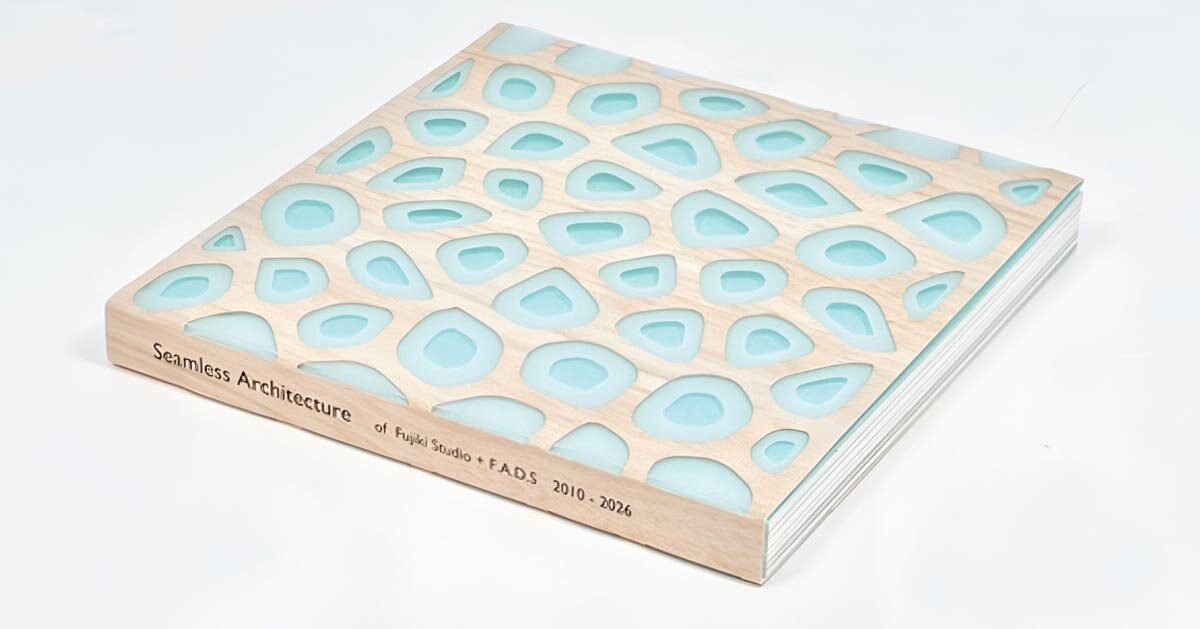
book cover image | all images courtesy of Fujiki Studio + FADS
Origami inspired ‘Wraps Seamless Architecture’ cover version
The post follows of the studio previous book, Aqua-scape: The Nature-oriented Architecture of Ryumei Fujiki, continuing his research into environmental integration and experimental architectural theory. Selected projects include award-winning installations and architectural proposals developed through collaborations between Fujiki Studio at Kogakuin University and FADS
The book’s cover design refers to the Porous Manifold project as a Japanese Tearoom and incorporates folding techniques derived from traditional Japanese origami. This graphic and material approach extends the publication’s broader focus on continuity, surface articulation and spatial transformation.
Published in both English and Japanese, the 164-page paperback addresses topics such as architecture, ecology, facility design, cultural theory, and computational practice. The publication is currently available through Amazon Japan and has been included in architectural libraries at institutions such as ETH Zurich, The Bartlett School of Architecture, Architectural Association School of Architecture, SCI-Arc and Massachusetts Institute of Technology.

chapter 1: Biological

porous manifold as a Japanese teapot

Yeoui-Naru Terminal International Design Competition, Seoul, South Korea

artificial nature: as a park in the topographic field

genetic simulation of Turing patterns

chapter 2: Terrain / Seamless

continuous fluid plate

artificial topography



