


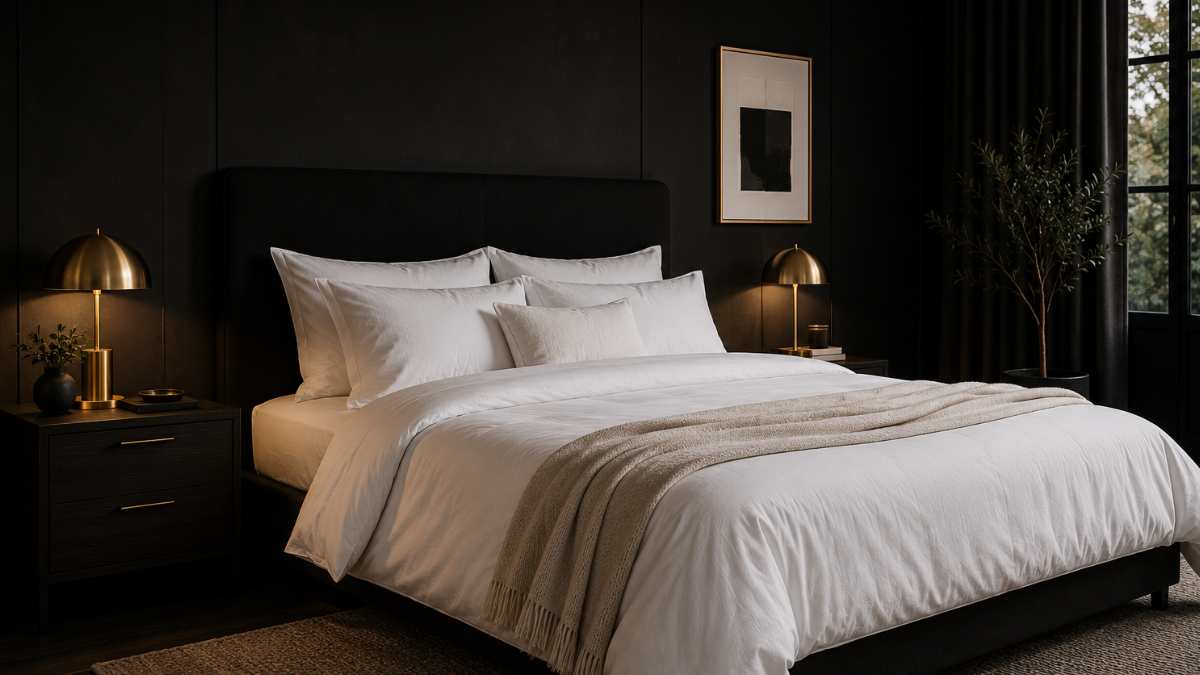
The black headboard, the white sheets, the dark wood bedside table, the geometric wallpaper, the brass lamp. Each of these elements, taken individually, makes sense. Together in a room where you have to sleep, they do a silent job that no one asked them to do: they keep your brain awake.
Sight is the last sense to leave
Before falling asleep, the body lowers its temperature, slows breathing and lowers heart rate. But vision remains active longer than you think. If the visual system remains active, the brain remains active. In the bedroom that means eliminates sharp contrasts, simplifies the field of view, reduces fragmentation.

An environment with many visual contrasts, dark walls against light-colored linens, black frames on light-colored walls, very defined decorative elements, force the eye to continue working even when you have already gone to sleep. It is not a matter of aesthetic preferences. It is physiology: The more visual information the brain has to process, the longer it takes to enter the relaxation phase necessary for sleep.
The tackles that do the most damage
Not all contrasts weigh the same. Some are more problematic than others and almost all are choices that have dominated trendy bedrooms in recent years.
The first is the pure color contrast: very dark walls combined with white linen or vice versa. A room with black or very dark walls can transmit feelings of anxiety and negatively affect sleep. Not because black is the wrong color, but because the nervous system is in a room where you sleep reads dark surfaces as weightnot as elegance.
The second is the contrast pattern: geometric wallpaper or wallpaper with very defined patterns combined with neutral fabrics. THE the brain continues to follow the lines even with half-closed eyes, especially if the headboard or central wall, the one you’re looking at while lying down, is the one full of visual information.
The third, often underestimated, is the light contrast: very bright precision lamps combined with areas of deep darkness in the same room. Cold, blue-rich light inhibits melatonin production. But even warm light, if directed and accurate on a dark surface, creates a contrast that the eye registers as stimulationnot as relaxation.
How Axor and Vibia have changed the way we think about light in the room
It is no coincidence that some of the brands that are more attentive to domestic well-being have developed lighting systems specifically designed for the sleeping area in recent years. Vibia, a Catalan company among the most influential in European lighting design, has been working for years bedside lamps with diffused, indirect light, without points of strong contrast. The lens isn’t decorative, it’s functional: a light that doesn’t create harsh shadows, that doesn’t cast direct beams, that accompany the transition to sleep instead of opposing it.
The same logic applies to textiles. Scandinavian brands such as Tekla, which has become a benchmark for quality bedding, focus on desaturated palettes, shades of sand, warm gray, ivory whiteprecisely because the contrast between pure white and a dark headboard is one of the most visually aggressive in a bedroom.
What to change without upsetting everything
No need to repaint the walls or buy a new bed. Two or three targeted interventions are often sufficient.
The first is to soften the main contrast. If the headboard is dark and the walls are light, enter a interlining fabric, plaid, cushions in shades of terracotta, gray or sagereduces discoloration without changing the furniture.
The second is to work on the wall you are facing while lying down. If it’s the one with the strongest pattern or sharpest contrast, it’s worth reconsidering. A wall with material finish in tone It visually weighs much less than geometric wallpaper, even though it occupies the same space.
The third is to replace point lights with diffused sources. A bedside table with lampshade made of natural fabric it diffuses light instead of projecting it, eliminates harsh shadows and immediately reduces the visual intensity of the room.
The most beautiful bedroom is not the one that looks like an architectural plan. It’s what makes you sleepy the first time.



