
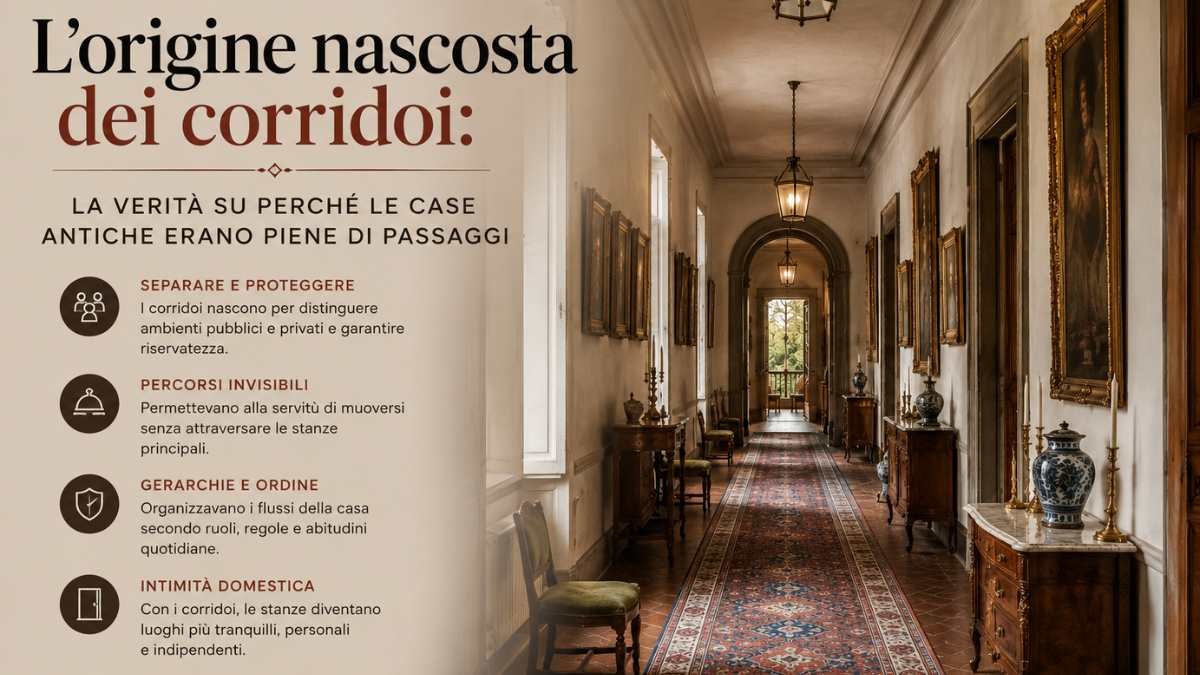

Today the corridor is often experienced as a lost space. In modern homes we try to eliminate it, shorten it, transform it into something invisible. Open spaces, connecting rooms, continuous living spaces: everything seems to go in the opposite direction compared to those long passages found in ancient houses. However, for centuries the hallway has been one of the most important elements of the home.
It was not born for aesthetic reasons. It is not used to “connect rooms” as we think today. Of the origin is much more specific and tells a completely different way of experiencing domestic spaces.
In European aristocratic homes between the seventeenth and nineteenth centuries, rooms did not yet have the rigid function we know today. The rooms were often connected one inside the other. To get to one room you had to pass through two or three others. Privacy almost non-existentconstant movements, servants passing in front of guests, noises passing through the whole house.
The runway was created just for separate the streams. To create invisible paths, reserved passages, social divisions and one new idea of domestic intimacy.
In fact, many historic buildings are beginning to introduce long side corridors to allow servants to move about without interrupting the life of the main rooms. In other cases they served to separate public spaces from private ones. The house slowly stopped being a collection of open rooms and became something more controlled.
And it is interesting to note how this transformation has also completely changed the way we perceive home. For the first time some rooms get really personal. They are closing. They isolate themselves. They are protected from continuous passage.
The corridor was not only used to pass, but also to control domestic life
In stately homes the corridor often had a almost strategic function. It separated hierarchies, protected privacy and organized people’s behavior within the home.
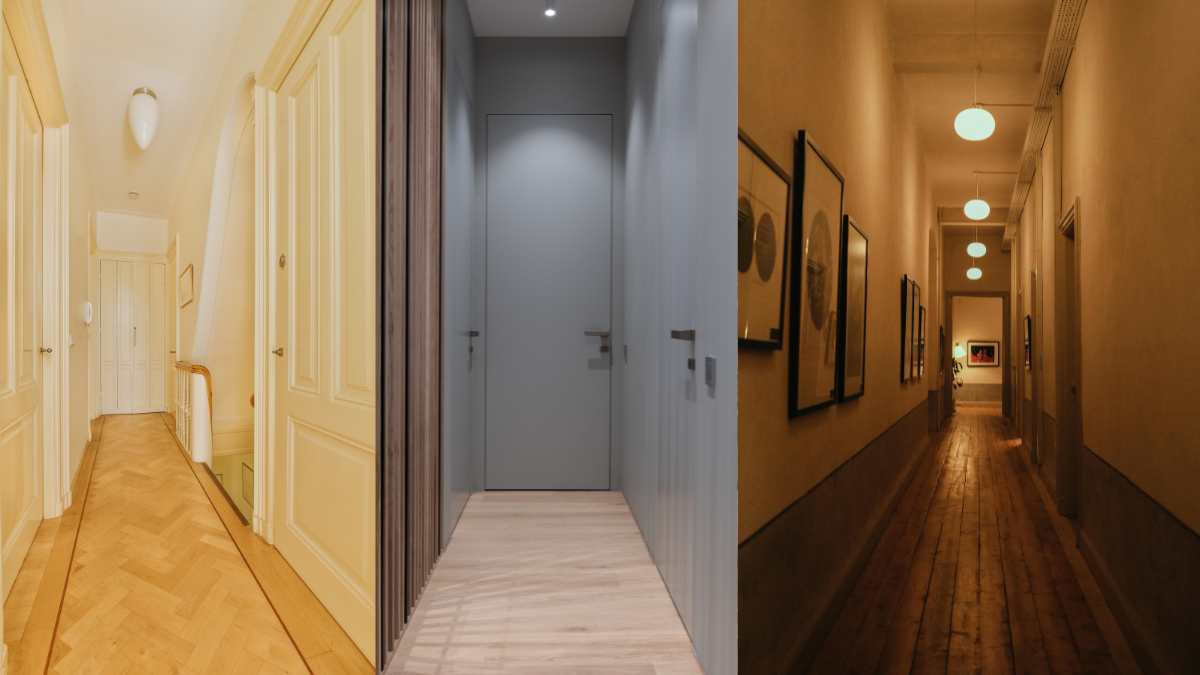
Bedrooms, for example, are gradually becoming less exposed spaces. It used to be normal to walk through private rooms to get to other rooms. With the introduction of corridors everything changes: you only enter where you are invited to enter.
Also the Domestic silence partly arises from this. Without constant passage through the rooms, environments become quieter. More predictable. More familiar.
In large nineteenth-century houses, dual circulation systems even developed: elegant corridors for family and guests, hidden side passages for servants. Some were very narrow, others completely invisible behind walls or panels.
The corridor then becomes a species home organizing machine. It decides who sees what. Who can cross certain spaces. Who remains invisible.
This also explains why many ancient corridors are surprisingly large or seemingly out of proportion to the rooms. They weren’t meant to be pretty. I had to manages movements, separations and space control household.
Before their spread, the home was much more collegial. After that, it gradually becomes more private.
Because modern homes eliminate exactly what was once fundamental
Today it is almost the opposite. Corridor is taken as a cost in square meters. In the new apartments fluid environments are preferred, kitchen open to the living room, bedrooms directly connected to the living room and passageways kept to a minimum.
The modern house seeks visual continuity. He wants light passing through the rooms, fewer doors, fewer clear divisions. In many cases the corridor survives only as a small corridor.
However something is slowly changing. After years of all open spaces, many people are returning to wanting more separate spaces. Areas where you can actually close a door, isolate yourself from the noise, or work without constantly being in the same environment.
It’s strange because the problem is very similar to that of ancient houses, although for completely different reasons. Today there are no servants walking around the rooms, but telephones, televisions, video calls, an open kitchen and constant noise. And so it is the need for domestic separation returns to have value.
Even from a perceptual point of view, the hallway changes the way you experience the house. A narrow passage before the bedroom makes the sleeping area more intimate. A a little disengagement creates a pause between different environments. Even light is perceived differently when not everything is immediately visible from every part of the house.
Many modern works actually recover itfilter ideanot necessarily of the long and closed corridor, but of the spaces in between that separate without being completely isolated.
For centuries, corridors have quietly organized domestic life. Today we often consider them useless simply because we have forgotten why they were born.



