
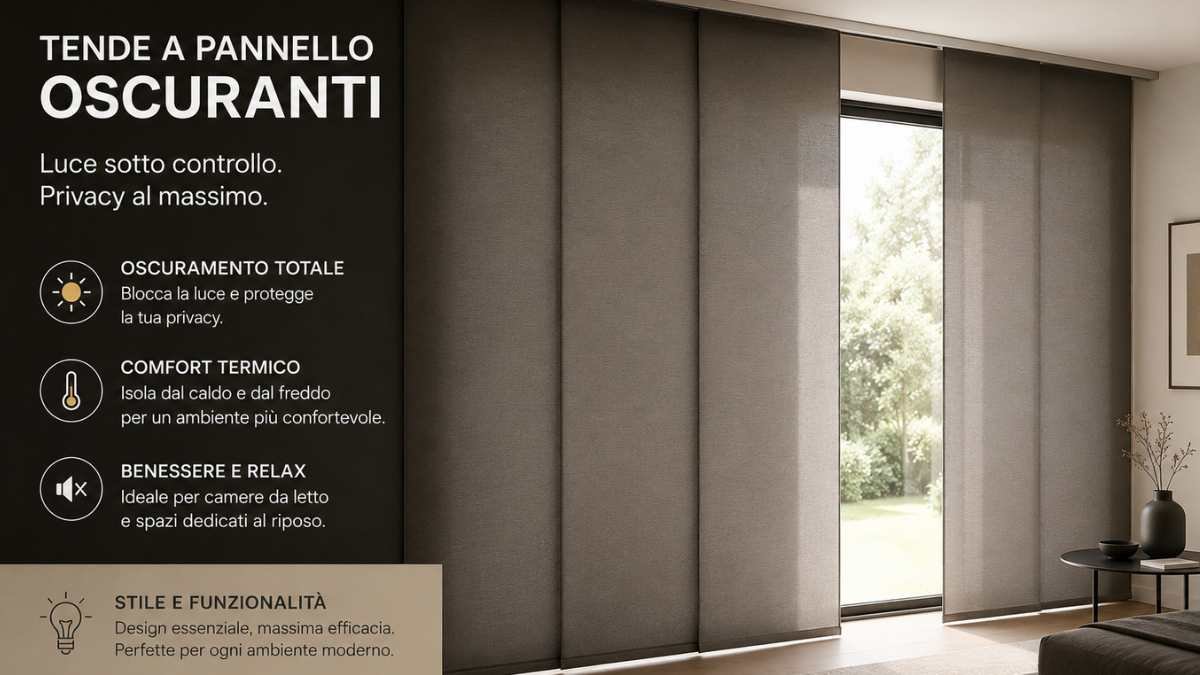

Panel curtains are one of those solutions that seem simple to choose until you sit down in front of a catalog. Track sliding panels, available in dozens of fabrics and colors, easy to assemble, adaptable to any window or glass. Obviously the choice boils down to finding the right color. Actually there is one distinction that completely changes the final result and that many only discover when the curtains are already up and the room behaves differently than they expected.
The distinction is between filter fabric and blackout fabric. It’s not a difference in thickness or material quality: it’s a difference in function, in how the curtain manages the light coming in from the window. A filter cloth lets some sunlight through, softening it and diffusing it into the environment without blocking it. A blackout fabric blocks this almost completely, creating a much darker and controlled environment. They seem like obvious definitions, but the practical consequences of choosing one over the other in the wrong room they understand each other only by experiencing the space.
Complicating the choice is the fact that panel curtains are by definition a modern and minimal solution, widely used in open living rooms, contemporary bedrooms and home offices. In these contexts the mistake clearly pays off: a bedroom with filtering curtains in an east-facing room wakes up at dawn even in summer, while a living room with heavy blackout curtains can look closed and uninviting even at noon with the sun out.
What does filtering actually mean?
A filter curtain is not a transparent curtain. Quality filter fabrics they reduce light transmission between 70 and 90 percentmaintaining privacy and reducing glare without creating darkness. The light that enters is soft, diffused, without direct rays: it is exactly the kind of light that makes a living room or a study pleasant to live in during the day.
The advantage that many underestimate is the thermal one. THE technical filter fabricssuch as those made of PVC-coated fiberglass used in screen curtains, they reduce incoming solar heat by up to 70 percentreducing the perceived temperature in the environment without darkening it. In west-facing rooms where the afternoon sun is hotter and lower, a good filter curtain can make the difference between a livable room and a stuffy one.
For the living room, kitchen, study and environments where you want to maintain visual contact with the outside, the filter is almost always the right choice. Privacy is guaranteed because by day those who are outside cannot see inside, but those who are inside see outside.
What does obfuscation mean?
Blackout curtains block out light almost completely. Quality blackout fabrics reach 99 percent light blockinga performance that brings them closer to the rolls in terms of effective darkening. They are made with multi-layered technical fabrics or with blackout covers applied to the back of the panel, invisible from the front but very effective at blocking light.
The critical point of blackout blinds, unlike roller blinds with side guides, is that i The side edges of the panel always allow a thread of light to pass through when the sun is direct. It is not a manufacturing defect: it is the nature of the sliding panel system, which cannot completely seal the perimeter of the window like a roller shutter. Those looking for total darkness should consider this limit before choosing the panel format.
For the bedroom, especially in eastern exposures or in cities with intense night lighting, theBlackout remains the most effective choice for quality sleep. For a home cinema or studio where you work with screens, blackout eliminates reflections and makes viewing much more comfortable.
Prices and where to find them
Filtering panel curtains start from around 30-50 euros per panel in standard versions of IKEA, Maisons du Monde and Westwingwith fixed sizes and basic fabrics. Customized versions, with quality technical screen fabrics such as Mermet or Sunscreen, start at 80-120 euros per panel and reach 200-300 euros for large windows with a motorized rail.
The blackout shades are similarly priced at the low end, but the versions with 99 percent certified blackout and quality back coating costs an average of 20-30 percent more than equivalent filters.
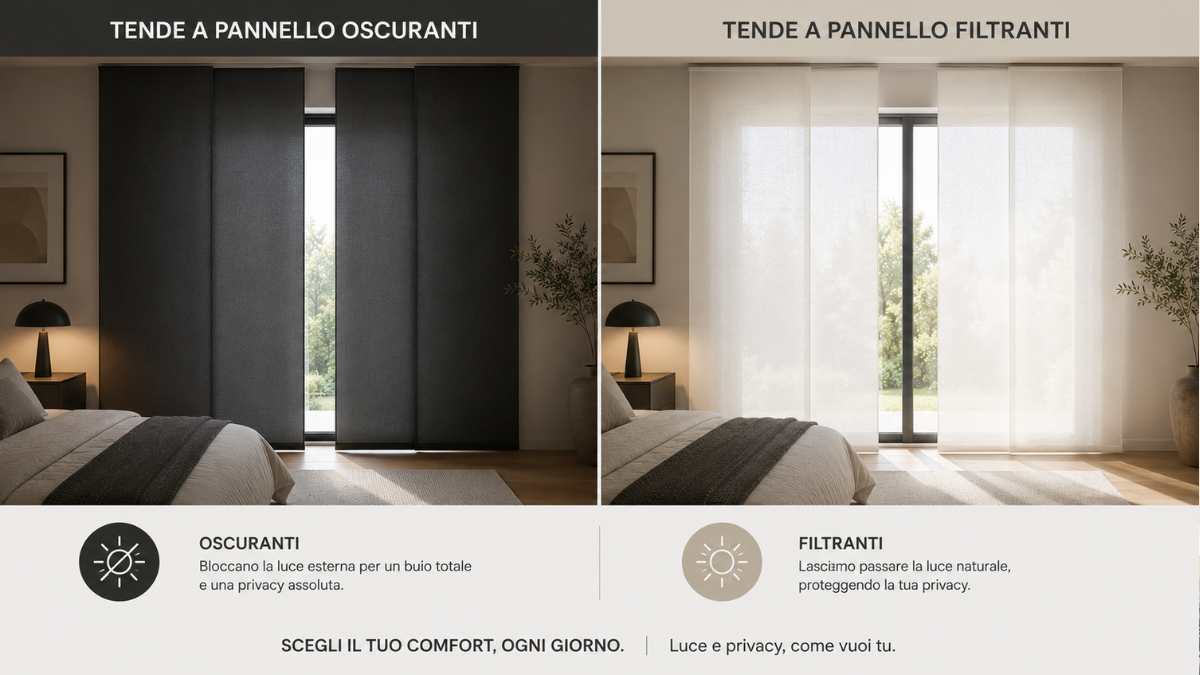
For those who want the best of both worlds without switching systems, the combined solution is the answer: a double piece with a filtering panel on the front and a dark panel on the back. During the day only the filter is used for diffused light and privacy, at night blackout is added. IKEA already offers it as a complete system with the Binario Expansionwhich supports two rows of independent panels.
Panel alternatives worth considering
Those who want absolute darkness without abandoning the minimal aesthetics of curtain panels can evaluate the rollers with side guideswhich seal the perimeter better and are more effective in total blackout. The form is different, but for a bedroom where complete darkness is a priority it is a more reliable solution.
THE custom pleated curtainsavailable in filtering and blackout versions, they take up very little space when open and also adapt to irregularly shaped windows. They cost more than standard panel curtains, but are almost invisible when folded.
For those who rent and do not want to make holes in the walls, e.g systems with pressure tensors Like those from Sunlux or various manufacturers’ tension lines, they install without screws and support both filtering and dark-colored fabrics in panel form. They don’t hold very large windows, but for a standard room they work and can be disassembled in ten minutes.
The choice between filtering and darkening is not an aesthetic preference. It is one functional decision that depends on how the room is usedfrom which direction it is exposed and what relationship you want to have with natural light every day. By knowing this before ordering, you avoid finding out when taking the curtains down a week later.



