
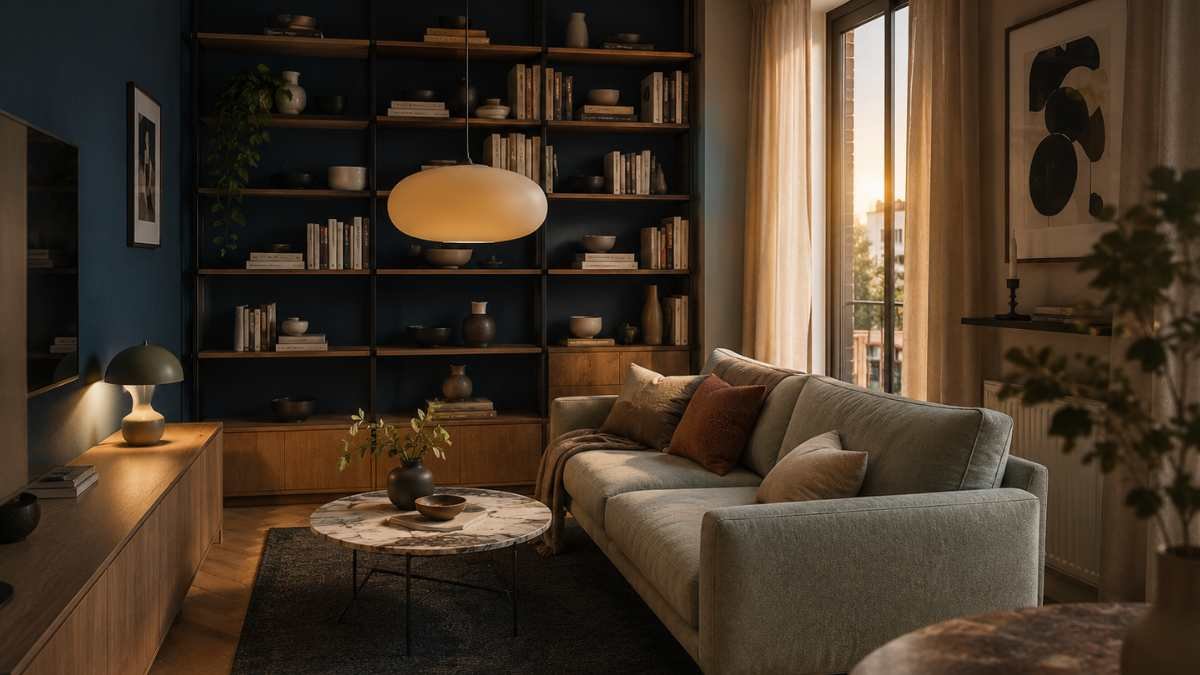

The IKEA 2023 catalog already has a whole section dedicated to it living rooms under twenty square meters. Not out of generosity to those who live in tight spaces, but because this has become the norm in European cities. Milan, Paris, Berlin: the apartment with the generous living room has become the exception rather than the rule. However, the conversation on the web continues to revolve around suggestions designed for rooms that most people don’t have. Large mirrors, huge corner sofas, four by three meter carpets. Technically correct suggestions, but useless for those who work with eight, ten, twelve square meters.
A small living room is not a missing living room. It is a project with precise constraints, and constraints, both in architecture and design, produce more interesting solutions than absolute freedom. The problem is not the space. The problem is we keep treating it as a scaled-down version of something else.
The piece of furniture that does everything and does nothing well
The first pitfall of compact living rooms is multi-functionality at any cost. The idea that each piece should perform three functions simultaneously leads to the selection of items that excel at none. The sofa-bed that transforms into an armchair, coffee table with storage spacethe built-in office library: in theory they are smart solutions, in practice they produce environments that look like catalogs of unrealized ideas.
Hay, the Danish brand founded in 2002has built part of its identity around small objects but with a strong visual presence. The coffee table Neuwith its sloping legs and circular top, it takes up very little physical space, but becomes a focal point when placed next to a two-seater sofa. It doesn’t do anything special. Does not transform, does not fold, does not stack. But it does exactly what it was designed to do, and it shows.
The rule of thumb: choose a smaller number of items than you think you should put in and choose them with stricter aesthetic criteria. Three pieces that have a character hit five neutral pieces at a time.
The wall that works instead of decorating
In small living rooms, the wall is the most underrated resource. Not as a surface on which you can hang pictures, but as a supporting system for the visual organization of the room. A full height bookcase on one wallfrom floor to ceiling, it does two things at once: it contains objects that would otherwise be on the floor and it brings the eye upwards, changing the perception of the room’s proportions.
Muuto, another Scandinavian brand with a poetic approach to Hay but with a different attention to the three-dimensionality of volumes, produces the system Stacked up: modular units that can cover an entire wall without looking like office furniture. The selection of open units alternating with closed ones creates a visual rhythm. Place some books, a ceramic object, a small plant, a Vibia wall lamp with an adjustable arm: it’s not decoration, it’s composition.
The technical point worth remembering: a tall bookcase makes the ceiling appear higher only if it is not completely full. If every shelf is filled to the brim, the effect is reversed and the room looks more chaotic and lower. Make room on the upper shelves.
Color doesn’t save space, it redefines it
White on the walls to make a room look bigger is old and partly wrong advice. White reflects light and visually enlarges environments, but it also produces rooms without an identity that seem to never stop being set up. A small living room painted entirely in a deep sage green, or in a warm terracotta, may seem smaller in absolute terms but more complete, more inhabited, more successful.
Zara Home has brought to its catalogs intense color combinations for solid environments: a bouclé sofa in camel color on a dark parquet floor, with cushions in Kvadrat Remix that mix gray and rust. The result is a forty-centimeter-by-two-meter-by-eighty-meter living room that looks like it was taken from a periodical, not a rental apartment.
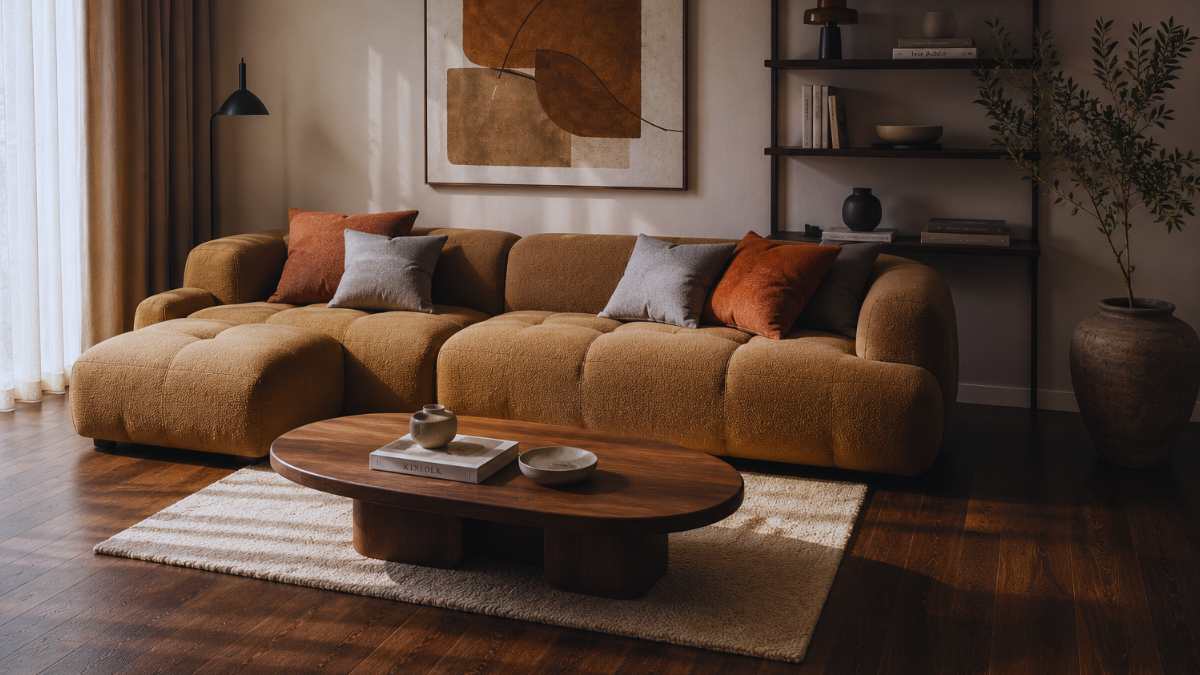
Color acts as the signature of a space. In the big salons you can afford to be shy. In children, Color contraction is paid for with banality. It is not an invitation to exaggeration: it is an invitation to a decision.
Small seats, big presence
The sofa is not mandatory. It has become mandatory by social convention, due to the idea that a living room without a sofa is not a living room. In a space under fifteen square meters, however, a three-seater sofa can occupy up to forty percent of the floor area. And then the living room is no longer an inhabited environment: it is a corridor with a sofa in the middle.
The most convincing alternative is a pair of matching armchairs, possibly swivels, with a low table in the center. Paola Lenti, an Italian company founded in 1994 and famous for its textile surfaces with a particularly tactile character, produces outdoor armchairs that work very well in compact indoor environments as well: light structure, material colors, proportional scale. A Paola Lenti armchair in sugar paper next to one in teal, on a boiled wool carpet in the color of river stone, creates a conversation corner that does not take away the air in a living room of twelve square meters. He gives it.
If the sofa is necessary, choose it without arms or with very low armrests: the solid line lets the environment breathe. IKEA’s Söderhamn, with its modular configuration and slim armrests, is one of the most honest items on the market for this type of space. It costs around four hundred euros in the basic configuration and does not pretend to be anything other than what it is.
The carpet that decides the proportions
The carpet is the element that most of all defines the boundaries of the space. In a small living room, the temptation is to get a small rug so as not to “take up too much”. It is the opposite wrong of what is needed. A rug that is too small isolates the sofait leaves the rest of the room without a visual anchor and makes everything look more disorganized.
The minimum useful size for a compact living room is 160×230 cmwith the front legs of the couch resting on top. This measure unifies the living space and gives the room a readable structure even when it is not in perfect order. Westwing offers low-pile wool rugs in this size starting at around a hundred and twenty euros: enough to see if the format works, before investing in more substantial pieces.
A natural jute rug on a recycled concrete floor, with a low charcoal gray sofa and a tall Muuto floor lamp: it’s a small interior, but it’s unapologetically small.
What is left outside the living room is as much furniture as you put inside
The last consideration is what separates those who know how to furnish from those who buy objects. In a small space, the hardest decision is not what to include, but what to exclude. The coffee table that “could be useful”, la plant too big for the pot you havethe extra table lamp because “maybe you need a little more light”: every item added to a small living room is worth double, for better or worse.
Compact functional living rooms almost always have something in common: a visually free space near the window or entrance, which allows the eye to enter without immediately finding an obstacle. It is not an abstract aesthetic concept. It’s practical: one square meter of visible floor makes a room feel bigger than any mirror placed on the wrong wall. Removal is as difficult as selection. Maybe more.



