
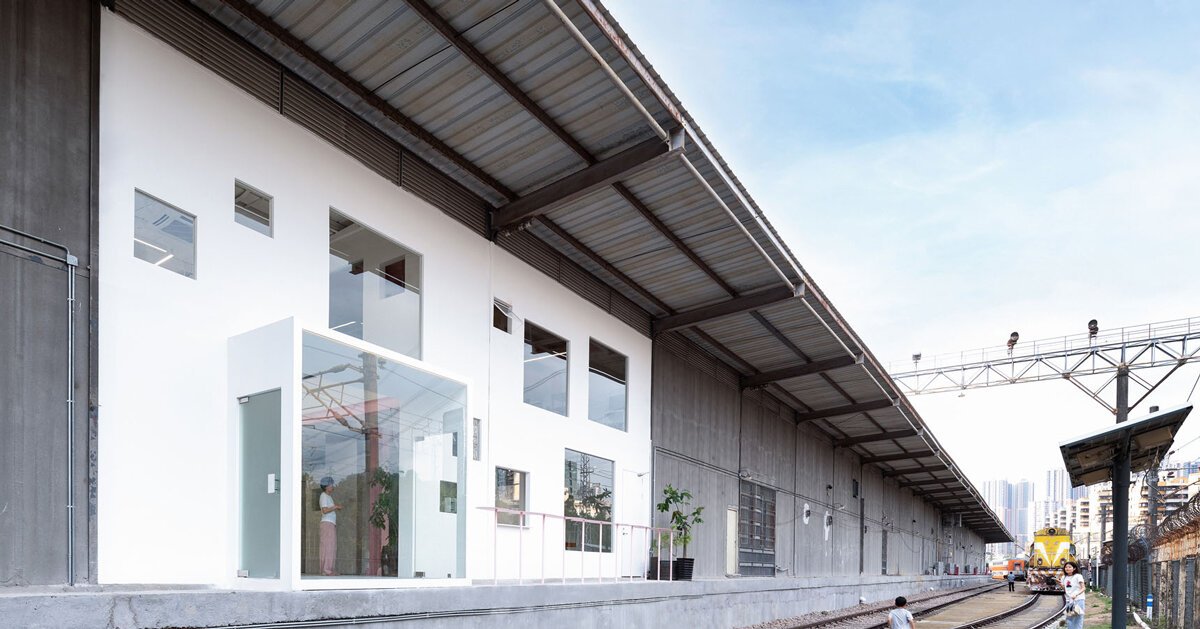

Apelron Contemporary transforms a former railway depot
It is located in the Qingshuihe Railway Relics area ShenzhenApelron Contemporary by Aether Architects and Archigress transforms former railway warehouse in a contemporary report space defined by lightness, transparency and multi-layered spatial relationships. Located between an active railway line and an urban street, the project directly engages with the compressed conditions of the surrounding infrastructure, treating the density and proximity of the site as a defining spatial feature rather than a constraint.
The warehouse’s original structure was designed only to support its existing roof, preventing additional structural loads from being applied to the building. In response, architects have developed what they describe as a “structural cluster” strategy. The new architectural elements, including stairs, walls, rooms and circulation elements, act as independent structures placed under the existing roof rather than connected to it. Each element inserted supports only itself, allowing the intervention to remain structurally separate from the original repository context.
This approach produces a composition of light architectural objects gathered under the industrial shell. Rather than functioning as a single nested volume, the work is organized as a collection of juxtaposed yet independent structural systems that maintain spatial separation while collectively functioning as an exhibition environment.

all images by Zhang Chao
Aether Architects and Archigress redefine the warehouse shell
Transparency plays a central role throughout the project. Openings within the walls are treated less as conventional windows and more as layered surfaces composed of opaque, translucent and transparent materials. The proportion and arrangement of these materials varies according to privacy, daylight, ventilation, viewing conditions and spatial scale. Although natural light enters mainly from the east and west facades, the reconfiguration of the wall systems transforms the previously dark interior of the warehouse into a brighter environment where light and views move through multiple levels of transparency.
Circulation is organized through intersecting horizontal and vertical paths that create changing visual relationships between the interior spaces, the surrounding infrastructure and the framed exteriors. As visitors move through the building, the changing combinations of reflection, transparency, shadow and framed openings produce an ever-changing spatial experience.
The project extends visual connections beyond the boundaries of the building itself. Through layered transparency and carefully placed openings, views of the surrounding railway line, road infrastructure and urban landscape are integrated into the architectural composition. The relationship between solid and void allows the exhibition space to function as part of a wider urban field rather than as an isolated interior. Apelron Contemporary positions architecture as a mechanism for reframing familiar urban conditions through light, perspective and movement. By introducing light independent structures within the former warehouse and reconstructing the building through layered transparency, Studio Aether Architects and Archigress transform an industrial relic into a spatial environment defined by changing aspects, filtered light and evolving perceptions of the surrounding city.

Apelron Contemporary transforms a former railway depot in Shenzhen

the project is placed between railway infrastructure and urban road

The lightweight interposed structures are located below the original industrial roof

Multi-layered transparency reshapes the interior of the former warehouse

independent architectural elements avoid loading the existing framework



