


The mirror in the hall has almost become a dependent reflection of the amateur decorator. You buy it, close it, wait for the magic to happen: more light, more space, more style. And instead, what you get, in most cases, is a faithful reproduction of the disorder you would like to hide. The bag was left on the floor. The coat on the crooked hook. The keys, the files, the son’s helmet. Everything there is multiplied.
The problem is not the mirror itself. It is the idea that the mirror is a neutral intervention, a solution without contraindications. As if contemplation was always an asset. But a mirror does nothing but reflect what is in front of it. And in the average Italian entrée, what you have in front of you is rarely a refined composition.
So it is worth understanding when a mirror works, how it should be placed and above all what alternatives exist for those who really want to manage this space intelligently.
The betraying reflex
There is a fundamental difference between a mirror which wide and one who complaint. An entrance with a mirror placed in front of the main entrance creates a tunnel effect: the visitor enters and immediately sees the entire hallway reflected, including elements that were not intended to be visible. Even worse if the mirror is large, because the width of the reflection increases in proportion to the amount of visual chaos being recorded.
Interior designers are well aware that a mirror placed on a side wall, 90 degrees from the entrance, behaves completely differently. It reflects the opposite wall, often more neutral and orderly, and creates depth without exposing the critical point of the corridor, which is almost always the floor near the door. Aesop, the Australian brand known for its neat storesroutinely uses side mirrors in boutique displays for this very reason: reflection must be managed, not simply positioned.
A 90cm wide entrance with a front mirror looks smaller, not bigger. The brain registers the double image as a confirmation of the reduced space, not as an expansion.
Shape matters as much as position
A round mirror with a diameter of 60 cm and a rectangular one 40×120 cm reflect both, but they act in a radically different way in space. The first isolates a part of the environment, almost a selective window on the wall. The second captures the spine of the entryway: from ceiling to floor, capturing each level of accumulation.
Ikea sells it Hovet mirror (140×40 cm, around 99 euros) as an ideal solution for narrow entrances. And it’s a well-made mirror, with a clean aluminum frame. But in homes with disorganized hallways, it becomes a tool of inadvertent exposure: every shelf of the adjacent shoe rack, every overloaded hook, every bag placed on the floor appears in the reflection with surgical precision. Not because the mirror is wrong, but because the frame was not prepared to accommodate it.
The most manageable forms for difficult entrances are those that cut the visual field cleanly: thick-framed mirrors that define a clean edge, or irregularly shaped mirrors (such as those from Umbra’s Arched line or Gubi’s brass models) that, due to their informal shape, draw the eye to the frame rather than the content of the reflection.
What a mirror can’t solve
The mirror is purchased with the intention of creating visual order without creating real order. It’s an understandable strategy, but it doesn’t work. A mirror does not organize, it does not hide, it does not absorb. It can be distracting at best, and only if the rest of the input cooperates.
An entryway that works aesthetically almost always has an underlying structure: a designated place for keys, a system for shoes that doesn’t accidentally leave anything on the floor, coat racks with fewer hooks than items you need to hang. Only when this structure exists, the mirror can do its decorative work without becoming an instrument of self-complaint.
The New York designer Nate Berkus has devoted a large part of his publishing output to the concept of functional rather than pretty entrances. Its position is simple: every object in the entrance must have a fixed position, and the mirror is hung last, when it is already known what it will reflect. Not as the starting point of the decorative work, but as its completion.
This changes the logical order in which almost everyone buys and hangs mirrors in the home.
Alternatives that don’t cheat
If the entrance is chaotic in structure (small dimensions, multiple doors, unavoidable crowding), there are alternatives to the mirror that perform the same perceptual function without the risk of uncontrolled reflection.
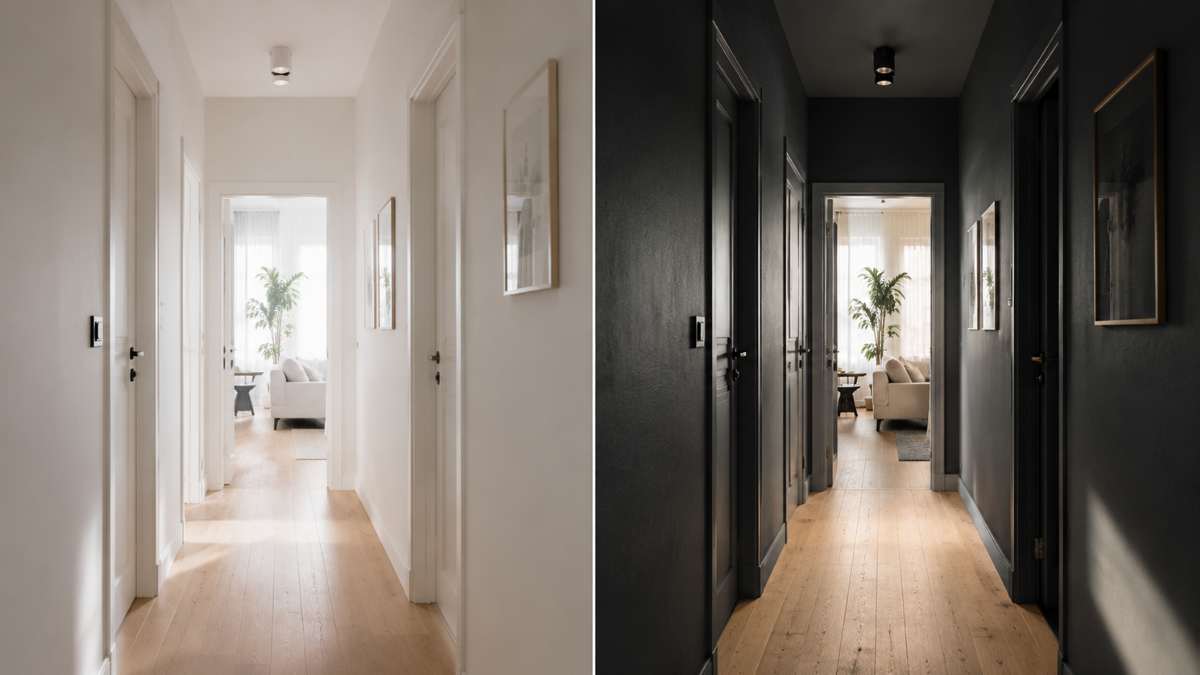
A dark painted wall on a light background it creates depth without sending back images. Color absorbs the eye instead of bouncing it off. Farrow & Ball has built a significant part of its catalog on this concept: color as a spatial tool, not just as an aesthetic one. Colors like Railings (an almost black with blue veins) or Down Pipe (gray slate) were also designed for narrow spaces where a light color flattens and a dark, paradoxically, deepens.
A decorative rattan or woven rope panel on the wall draws the eye without creating images. Same graphical function as the mirror, zero risk of reflection. The brand comes HKliving or Bloomingville distribute panels of this type in Italy at affordable prices, between 60 and 150 euros, with a pure visual impact that does not require an already ordered entry to the work.
Finally, a series of small-format prints, placed vertically on a side wall, creates movement without multiplying reality. It is a solution that does not give light, does not expand the spaces, but does not betray either. And in the most difficult entrances this is already an achievement.
The right mirror, in the right place, with the right frame, It remains one of the best items to hang in your entryway. But the framework must first be built. Otherwise you’re just buying a frame for clutter.



