


A west-facing terrace, in August, can turn into something difficult to live in after four in the afternoon. Anyone who has tried to put an outdoor sofa there knows what we are talking about: the heat reflected from the floor, the still air, the natural feeling of being inside a low temperature oven. However, there are terraces identical in exposure and size that remain habitable even in the hottest hours. The difference, almost always, is the presence of certain plants. Not for aesthetics or romantic microclimate, but for precise and measurable mechanisms that are worth understanding before buying anything in the nursery.
The basic idea is thermal perceptionwhich does not coincide with the actual temperature detected by a thermometer. The relative humidity of the air, the reduction of direct solar radiation and the reduction of the radiating surface around us affect how warm we feel. The right plants work on all three of these fronts, differently depending on the species. Some evaporate at a rapid rate, others create physical barriers to radiation, still others modify the quality of the air around us. Not all rooftop plants do the same job.
Why the plant cools: the physics behind the leaves
Plants lose water through their stomata, those tiny leaf pores that open to allow gas exchange. This process, called evapotranspirationconsumes thermal energy: each gram of evaporated water absorbs about 2,450 joules of heat from the environment. In practice, the plant works as a passive evaporative cooling system, similar to the principle of adiabatic air conditioners, but without electricity consumption. A plant with a large leaf area and a high transpiration rate can reduce the perceived temperature of the immediate surrounding area by 2-4 degrees Celsius, sometimes more in low humidity conditions.
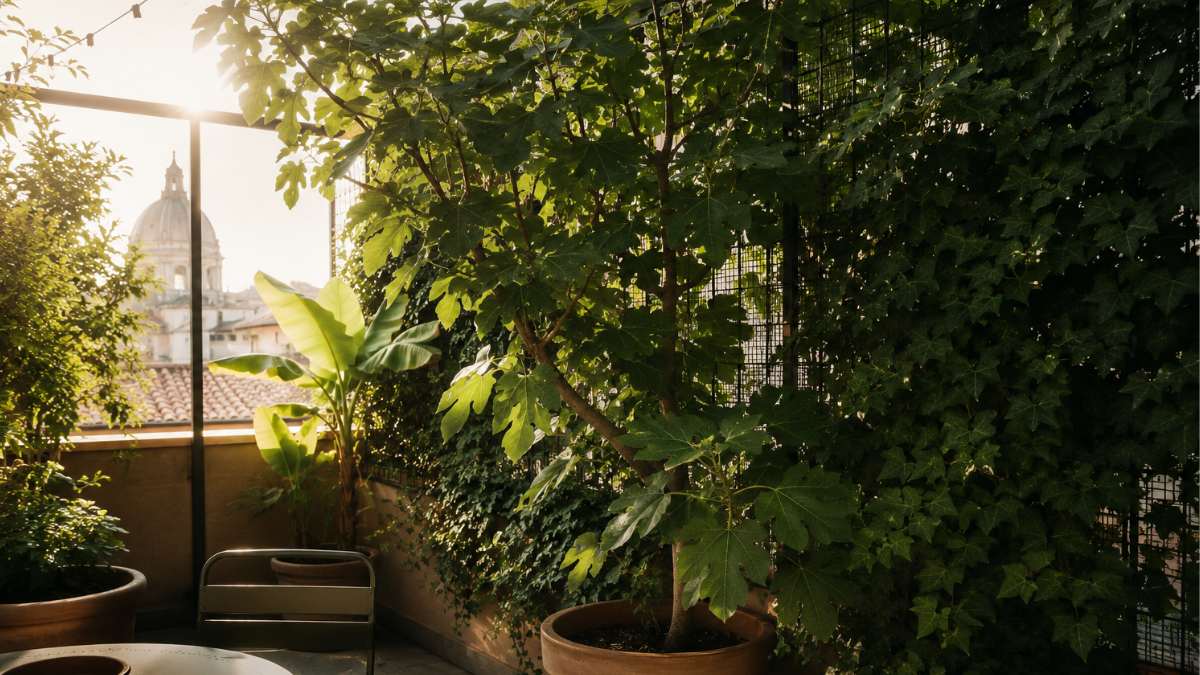
Added to this is the shading effect: a sheet blocks direct solar radiation and reduces the amount of heat absorbed and re-radiated by the floor, walls and furniture. The terrace, in the evening and in the early hours of the morning, returns the heat accumulated during the day. The fewer surfaces heated, the less heat is re-emitted. THE shaded surfaces they remain on average 20-30°C cooler than those exposed to direct sunlight, and this significantly changes the comfort of those sitting a meter away from them.
The five plants that really work
The fig tree (Ficus carica) it is perhaps the most effective plant of all for terraces with sufficient space. Large, lobed leaves with a large surface area evaporate strongly. An adult fig in a large pot, placed northwest of the relaxation area, manages to create a noticeable island of coolness. But it needs a pot of at least 60-80 liters and regular watering in the summer: if the plant suffers from drought, it closes the stomata and stops getting wet.
THE wisteriaif trained on a trellis or on metal wires, it produces a dense leaf cover that blocks direct radiation and, during the growing season, continuously transpires water. Wisteria-covered pergolas are not just a magazine picture: they have a proven thermal function. Tetto Verde Milano, one of the most active Italian companies in green roofs, recorded reductions in radiant temperature under vegetated pergolas of over 40% compared to uncovered structures.
THE Trachycarpus fortuneithe cold-tolerant Chinese palm, is an interesting case in point. It does not have a very high rate of evapotranspiration, but the large foliage and the stem that heats up little (thanks to the fibrous structure) make it useful as a screening element. Withstands down to -15°C, does not need a winter shelter and adapts well to terraces with strong winds. Vivaio Torsanlorenzo, in Lazio, offers samples from 150 cm and up at prices starting from around 80-120 euros.
For those with limited space, the Ivy helix (common ivy) trained on vertical or grilled panels creates a vegetated wall that can reduce the surface temperature behind it by 8-10°C compared to an exposed wall. The University of Reading study, published in 2012 on Building and Environmentquantified this effect in residential buildings with ivy-covered walls. Translated to a terrace scale, the impact is smaller but measurable, especially if the southwest facing wall is the one that heats the floor the most due to reflected radiation.
The last name you need to highlight is Musa basjoothe rustic Japanese banana. The length of the leaves can reach two meters, the leaf area per plant is among the highest that can be obtained in a pot and the rate of evapotranspiration is very high. It requires a lot of water, but returns a noticeably cooler microclimate. Some nurseries offer it in 40-50 liter pots for terraces: it must be protected at the base in winter with mulch, but it survives in Italian climate zones up to the Po Valley.
How to place them to get results
Buying the right plants and placing them incorrectly is a common mistake. The optimal position depends on the orientation of the terrace and the time you use it. If the terrace faces west and is used in the late afternoon, the view should be from the west-southwest side: a tall plant on the opposite side is of no use in hot hours. Plants with high evapotranspiration should be watered in the early hours of the morning and not in the evening: water should be in the stomata during the hot hours, not after.
It’s also worth thinking vertically. A green wall with ivy or passion flower in a metal grate occupies a depth of 30-40 cm, shields the surface that radiates and breathes throughout its entire height. For narrow terraces, it is often more effective than a row of scattered pots. Passionflower (Passiflora caerulea) also has the advantage of growing quickly and can be bought for 6-10 euros at any garden center.
What plants can’t do
No plant replaces structural shading on a terrace without any cover. If the sun shines on the stone floor for six hours a day, the plants reduce the discomfort but do not eliminate it. Their contribution is maximum when integrated with a shade cloth, a pergola or at least an awning: in this case the combined system produces a perceptible microclimate. Alone, on a fully exposed terrace of 30 square meters, plants reduce discomfort but do not turn the terrace into an air-conditioned living room.
A terrace with a fig tree in a large pot, two linear meters of ivy on the trellis and a Musa basjoo in the corner is a different place from one that is the same but bare. Not for a subjective impression: for specific physical reasons. The difference is felt already from the first summer.



