


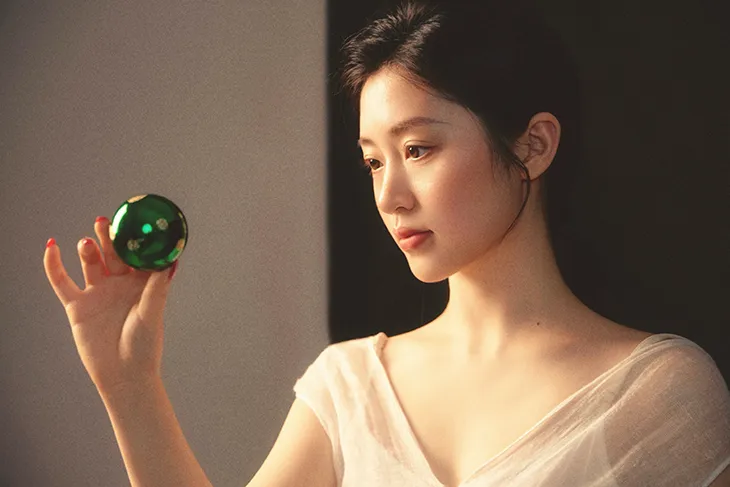
Manlin Zhang is a research-led visual artist working in painting, photography and installation. Her practice comes from a background in optoelectronic engineering, later expanded through studies in Art and Science at Central Saint Martins. Moving between technical systems and visual thinking, her work operates in the gap between art and science, where systems of vision and systems of measurement begin to overlap in their efforts to access configurations of reality that remain partially undefined. Within this space, he traces correspondences between microscopic, bodily, and environmental scales, suggesting that perception itself may function as a changing structure rather than a fixed state.
ART
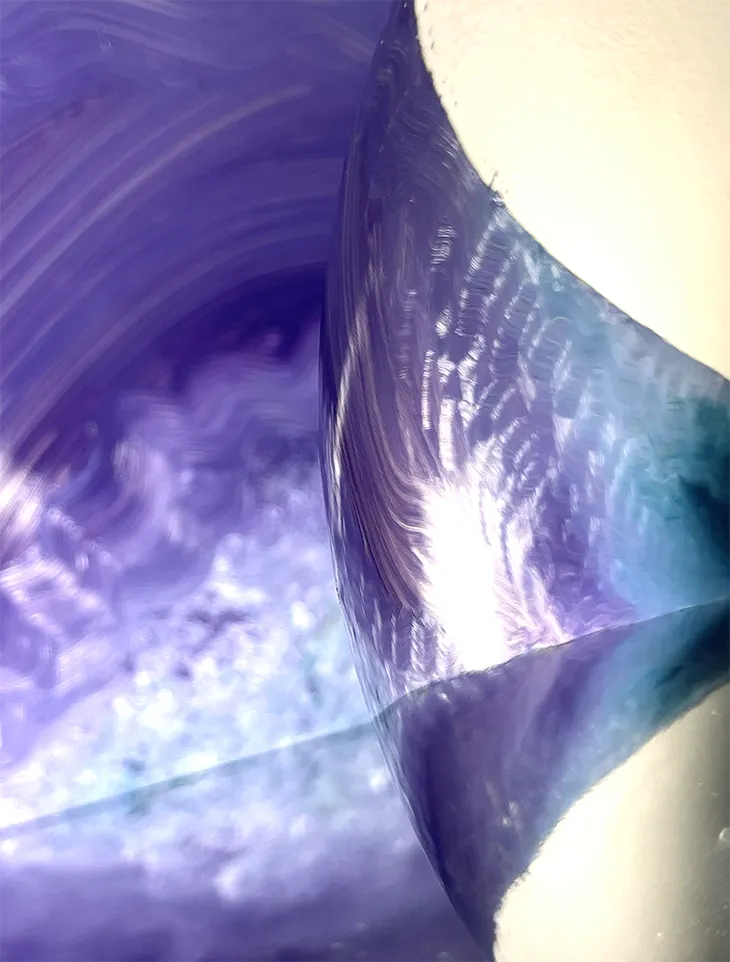
This trajectory is reflected in her individual works, from the miniature photograph “Iridescent Fetching’ (2022) and city light photography “Where light touches time” (2022) in oil painting »Intelligence in Motion – Dreaming Butterfly(2025), where painting functions as a material field of sustained attention.
From visual systems to perceptual construction
Zhang’s early training in optoelectronic engineering involved the development of light-based response systems where light is approached as a measurable and modifiable field. This technical background informs her artistic methodology, particularly her interest in the tension between precision and subtle deviation.
In recent years, Manlin Zhang’s self-directed practice has evolved through engagements with a variety of institutional and cultural contexts, including scientific research environments, cultural institutions and international exhibition platforms in the UK, Europe and the United States. These include group presentations at the London Design Festival (2025),Kairós: Between Choice and Fate” (2025) at The Batsford Gallery in London,dreamscape’ (2025) in Tbilisi and “Stay with Murmura’ (2025) at Aspace Gallery in Brooklyn, New York, among others. Her practice operates within these contexts without disciplinary hierarchy, forming a continuous system of perceptual translation. This places her practice in an evolving interdisciplinary field, demonstrating a distinctive approach to integrating artistic and scientific modes of inquiry.
ORIGIN: Manufactured optical signal
Throughout her practice, images tend to function less as representations of reality and more as a configuration of visibility, where the conditions of seeing are constantly rearranged.
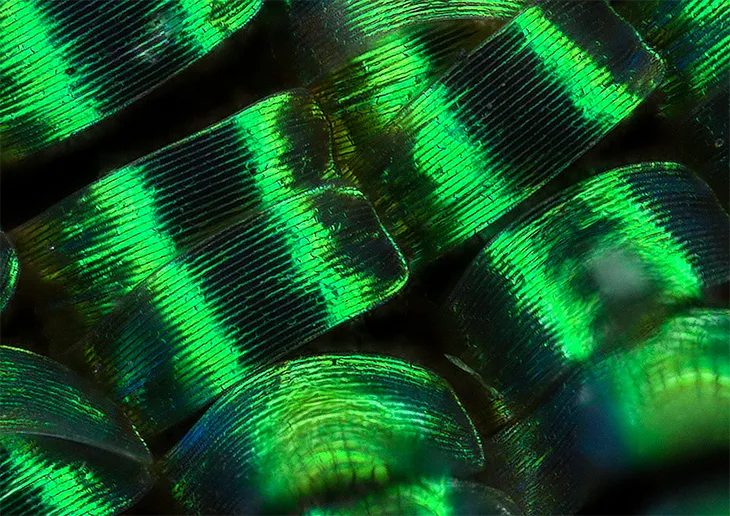
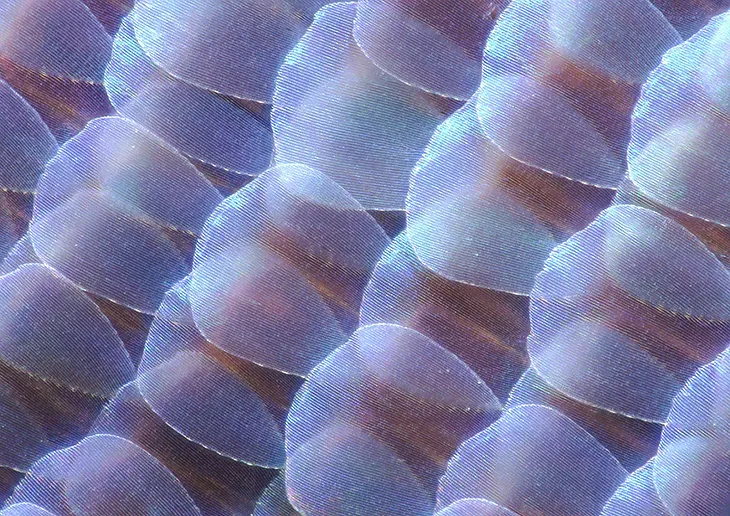
In Iridescent Becoming (2022), microscopic photography reveals the spatial complexity of the butterfly’s scales, where color results from nanoscale structural organization and optical interference. Images operate within a space between documentation and abstraction, where visual information resists fixation and shifts between data and perceptual ambiguity.
The work marks an early moment in Zhang’s practice where biological structures are no longer treated solely as objects of study but begin to function as perceptual stimuli. In this sense, the series establishes the conditions from which her later painting systems emerge.
REFLECTION: Optical Field
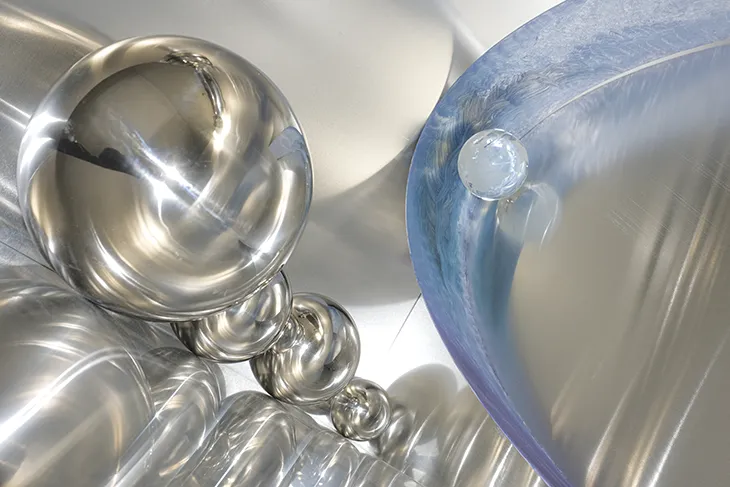
Volatility is established in Delicate Future (2023)where Zhang constructs a self-contained reflective environment, consisting of reflective aluminum forms and painterly color fields. The work initially suggests a planetary configuration, however this reading quickly collapses. Mirrored surfaces fragment perspective, displacing any fixed point of view and embedding the viewer in a network of reflections. The painted elements introduce a contrast: fluid, temporal and resistant to the stability of reflective structures.
What does he do? Fine Future the transformation of the material into a mechanism is imperative. The reflection is not used to depict the space but to reorganize it. Vision folds in on itself, creating a situation in which vision is distributed rather than centered. In this way, he reconstructs his visual conditions, displacing the position of external observation.
INTERRUPTION: Unstable under environmental conditions
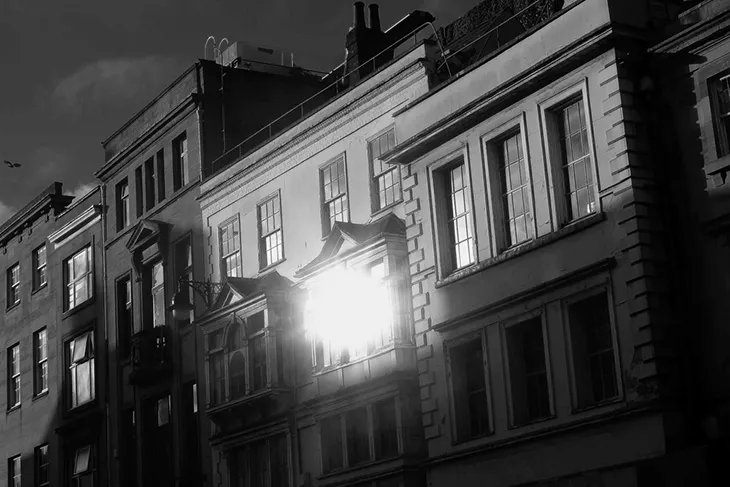
Her photographic series on urban light captures transient alignments between architecture, movement and sunlight. These moments function as ephemeral spatial configurations in which visibility emerges through the interplay between environmental conditions and visual experience.
In the image, a strong reflection of sunlight disrupts the clarity of the architectural surface. The overexposed center collapses detail and depth, creating a zone where visibility is inhibited. While the surrounding structures remain sharply rendered, the central glow interrupts spatial continuity, drawing the eye while simultaneously denying access. The work succeeds in transforming a fleeting visual condition into a perceptual instability, where light actively reshapes the act of seeing.
Material Continuity
Her painting practice extends these concerns into material form. In ‘Intelligence in Motion – Dreaming Butterfly’ (2025), multi-layered oil surfaces unfold through fields of highly luminescent color, oscillating between computational precision and organic growth.
Rather than functioning as a representation, the painting functions as a dense color environment in which color behaves as both structure and flow. Greens, teal and deep tonal blacks form multi-layered conditions of emergence, where surface and depth constantly interact with each other. The work has a sense of suspended movement, in which visual elements appear neither fixed nor resolved, but are kept in a state of continuous configuration.
Throughout painting, photography and installation, Zhang constructs transitory systems in which light, reflection and scale remain in states of instability. Her work moves between microscopic structures and urban environments, tracing the conditions through which images, perception and reality are constantly reorganized. At the core of her practice is an ongoing inquiry into perception itself: how reality is constructed through observation and how intelligence, human or otherwise, can emerge through processes of sensing, interpreting and feedback.
Working in these mediums, Zhang adopts a restrained, non-expressive mode of production in which creative decisions are shaped through visual logic. It develops a practice in which research, material experimentation and imaging technologies are intertwined, positioning visual practice as a way of knowing that actively produces and reshapes knowledge structures rather than simply representing them.
Words from DSCENE Editor Maya Lane.



