


In the catalog of almost every brand of modern furniture, the table with a central base occupies a privileged position. Tolix, Calligaris, Kartell, Pedrali: each has its own version of the monolithic pedestal, the painted metal cone, the synthetic marble column. The aesthetic message is coherent and recognizable: formal cleanliness, no legs interfering with the seat, a furniture architecture that looks more to sculpture than to function.
On Instagram profiles dedicated to interior design, these paintings appear in airy environments, photographed from above or in perspective, where space is never really an issue, because space, in these homes, is never really an issue. In medium-sized Italian houses, with living rooms from 20 to 28 square meters and open kitchens that eat another two meters deep, the situation changes quite radically.
This is not an aesthetic judgment. These tables can be well-designed objects, with quality materials, considered proportions. The problem is structural and concerns a principle that has an accurate name in interior design: the optical sanitary vacuum. It’s worth understanding what this means and why ignoring it has real consequences for living space.
Under the table there is a space that works even when you don’t see it
A table with four perimeter legs, what our grandparents would simply call a “table”, leaves all the space free under the top. This empty area does three things at once. It allows light to pass through the environment without interruption, perceptually lightening the mass of the furniture. It allows the chairs to slide completely under the top when not in use, reducing side bulk to zero. And it visually maintains a continuity between the floor and the ceiling that makes the room appear larger than it is.
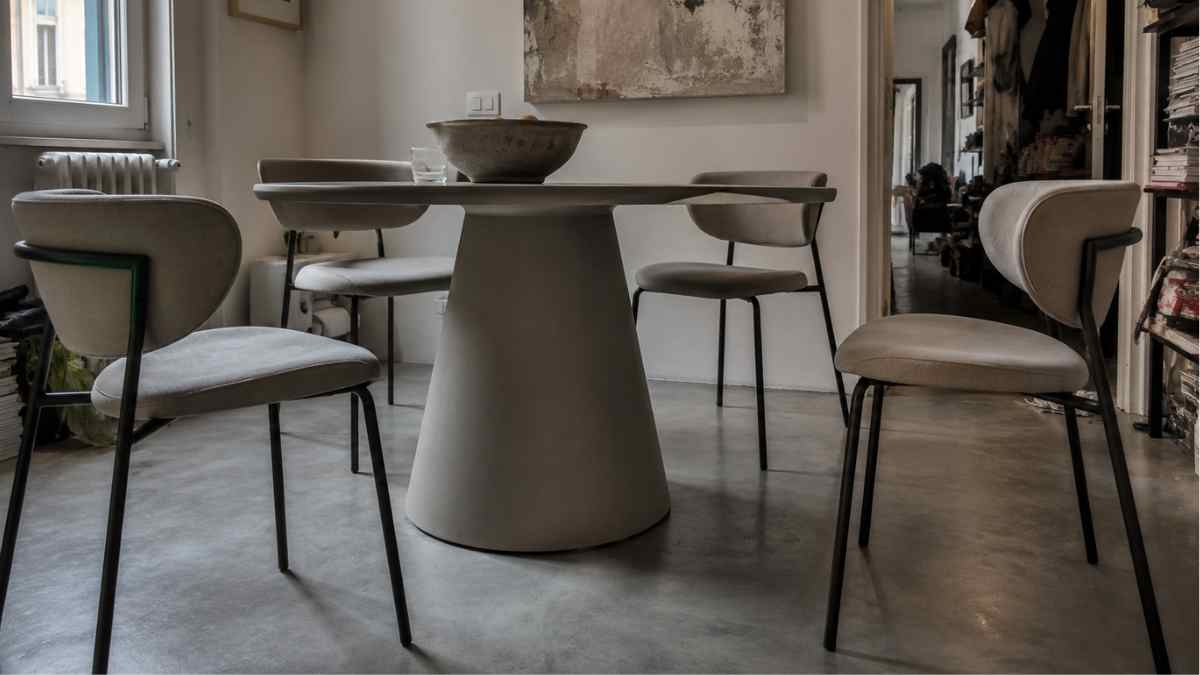
The tables with central basewhether it’s a cone, a cylinder, a star pedestal or a tulip base like Eero Saarinen’s famous Pedestal Table for Knoll from 1956, they work according to an opposing logic. They naturally occupy the lowest volume. Not the perimeter area, where the traditional legs would be, but the central one: exactly where the sitters would want to put their feet and where the front legs of the chairs naturally look for support.
Because chairs become the real problem
When you push a chair towards the table and the central structure prevents the movement, the chair remains suspended at the waist. The front legs remain outside the perimeter of the top, protruding towards the corridor or sofa. In an apartment with 80-90 cm corridors, this means that this space is halved every time someone gets up from the table and does not pick up their chair. In practice, for the entire duration of the meal or dinner, each chair removes from 25 to 40 cm of width in the surrounding environment.
Calligaris, to name an affordable and widespread brand in Italy, offers a table with a central metal tray base in the Orbital series. Aesthetically compatible with the catalog, price around 700-900 euros in the standard version. But the base, with a diameter at the base of about 60 cm, makes it impossible to fully bring any chair with front legs that are not very thin and stuck back. With standard design chairs, the side dimensions in use exceed 30cm per side compared to the perimeter of the top.
Saarinen’s tulip and the misunderstanding of open space
It is worth returning to Saarinen, because his Table Table from 1956 is the aesthetic ancestor of this entire family of tables. Saarinen designed it to resolve what he called “the slum of legs” under American furniture from the 1950s: the visual overlap of four table legs with eight or twelve chair legs around them. The solution was radical: eliminate the table legs to reduce visual clutter. The idea worked in the original context, which was a special, spacious dining room with matching Tulip chairs by the same designer. Tulip chairs have a pedestal identical to the table, which slides out naturally and does not create the blocking effect that occurs with four-legged chairs.
The problem arises when this aesthetic principle is applied to tables sold as independent objects, to be combined with any chair, in medium-sized apartments where there is no dedicated dining area. The context it was designed for no longer existsbut the shape remained.
What do good small space designers see?
Designers who work in compact apartments know that managing the space under the table top is one of the most important parameters when choosing furniture. Muuto, a Danish brand that has made strict functionality an aesthetic value, offers the Linear Steel Dining Table series ultra-thin perimeter legs in painted steel that completely free up the lower area while maintaining a contemporary profile. Price around 800-1000 euros for 140 cm. IKEA, for its part, has built an important part of the success of the Lisabo table precisely on this principle: four legs in solid ash, a shape that allows the chairs to slide completely under the top, a structure that visually weighs very little.
It’s not nostalgia for grandma’s table. It’s geometry. In a space where every centimeter is real and non-negotiable, the difference between a table that gives space when not in use and one that takes it away even when resting is a difference you feel every day, every time you pass the dining room to reach the sofa or the window.
The table with a central base makes sense in some specific contexts: environments dedicated to the dining room, open spaces with generous sizes, combinations with chairs designed for this type of structure. In everything else it is an object that solves an aesthetic problem by creating a practical one. And the practical problem, unlike the aesthetic one, is not solved by changing the carpet.



