


Wood has had its day, at least as an automatic answer for those who want a home that doesn’t look like an airport. Between parquet flooring throughout, exposed beams and rough bleached oak shelves, the warmth effect has become a prepackaged package that can be recognized at a glance. The result? Houses that all communicate the same message, with the same grain, the same knots, the same promise of industrially reproduced authenticity.
But domestic warmth is not a texture: it is a matter of how the materials absorb light, how the colors behave during the day, the visual and tactile mass that the forest does not need to mention to be felt. There are surfaces, colors and combinations that restore the same perceptual density, without showing even a centimeter of wood. Some come from vernacular architecture, others from contemporary Scandinavian and Mediterranean design. They all have one thing in common: they require more precise choices than a simple “lay the floor and go”.
Terracotta is not nostalgia
In recent years the glazed terracotta and no has returned with a force that goes far beyond the country kitchen. We are not talking about worn and irregular Tuscan terracotta, but geometric tiles with matte finishes, reduced thicknesses and unusual shapes. The Spanish brand Cevica produces a range of natural terracotta with smooth surfaces and colors ranging from ocher to burnt copper: placed on an entrance floor or on a bathroom wall, they return a visual temperature that no laminate parquet could imitate.
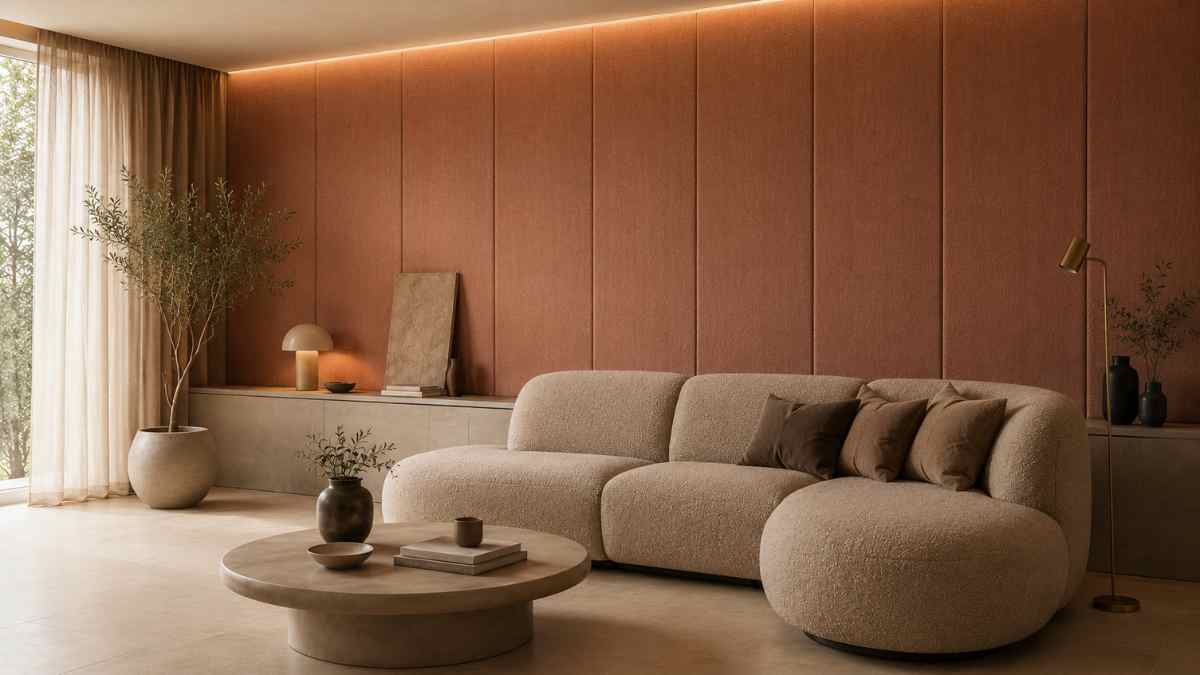
Terracotta has real thermal mass: it absorbs heat and releases it slowly, which means it’s not just an aesthetic effect. Combined with white lime plaster or a greige tadelakt wall, it creates a color layering that ranges from pinkish beige to dull orange, without ever looking like pizzeria decor. The trick is not to combine it with light wooden objects, which immediately push it towards the rustic: dark metal, raw linen, charcoal-colored porcelain are better.
Color does heavy lifting
One of the most underrated ways to introduce heat into a room is to act accordingly color temperature of the wallsnot in materials. Colors with yellow, orange or red tones, even if they are expressed in neutral and desaturated tones, modify the perception of space in a certain way. Benjamin Moore has color in his catalog Pale Oak (OC-20): is a beige that turns into an antique pink depending on the exposure, and on an entire wall it radically transforms the character of a room, giving the same ambient feeling that is sought in wood without using a gram of it.
The same result is achieved with i Color of the Year 2024 at Farrow & Ball, where you like the shades Preference Red the Dead salmon working in the warm series of pink terracotta. A single wall painted in a warm, textured color, paired with brass or shiny metal furniture, does more work than an oak floor. Tone on tone in a warm range, from cream to rust, is one of the few approaches in which monochrome does not cool but warms.
The concrete that does not cool
Concrete has a bad thermal reputation, and in part it deserves it: poorly used, in the shiny pearlescent versions of minimalist showrooms, it’s the most uninviting material around. But the microcement in a warm tone it’s a different animal. Applied in shades in sand, caramel or light chocolate versions, with a satin rather than glossy finish, it is not reminiscent of Mies van der Rohe’s garage but something closer to the cocciopesto plaster of the Ottoman baths.
Companies such as Ideal Work or Concrete LCDA offer decorative systems in microcement with blades specially designed for warm residential environments: theirs Hot Sand or similar shades work on floors, kitchen surfaces and bathroom covers, creating a material continuity that does not visually interrupt the space. Combined with heavy fabrics, such as a burgundy velvet curtain or an ivory bouclé wool rug, microcement stops being cold and becomes a neutral and warm base at the same time.
Fabric as a structure, not as an accessory
The amount of soft fabric in a room is perhaps the most overlooked factor in calculating perceived warmth. It’s not about adding cushions – it’s about using the fabric as architectural material. Floor-to-ceiling curtains, even in low rooms, add vertical visual mass and absorb sound so the space stops feeling empty. The Danish brand Square produces technical and furnishing fabrics in wool and wool combined with colors in a warm range, used by designers such as Ilse Crawford to cover entire walls in private homes.
The effect isn’t overwhelming if you’re working with just one dominant hue: a clay-colored fabric panel on a long wall, combined with a bouclé hazelnut sofa and a sand-colored porcelain floor, creates a tactile and color layering that needs no explanation. Raw, loosely woven linen, used as a blackout curtain, filters the light and gives it an amber quality that no rigid material can replicate.
The metal that heats instead of cools
Brass, copper and polished iron have entered the vocabulary of home design as details, but used in more significant quantities they completely change the thermal perception of a room. Brushed brass kitchen counterunvarnished and therefore destined to oxidize and darken over time, it brings with it an aged quality that wood does not have: it does not scratch in the same way, it is not afraid of water and with time it acquires a patina that makes it richer, it no longer wears.
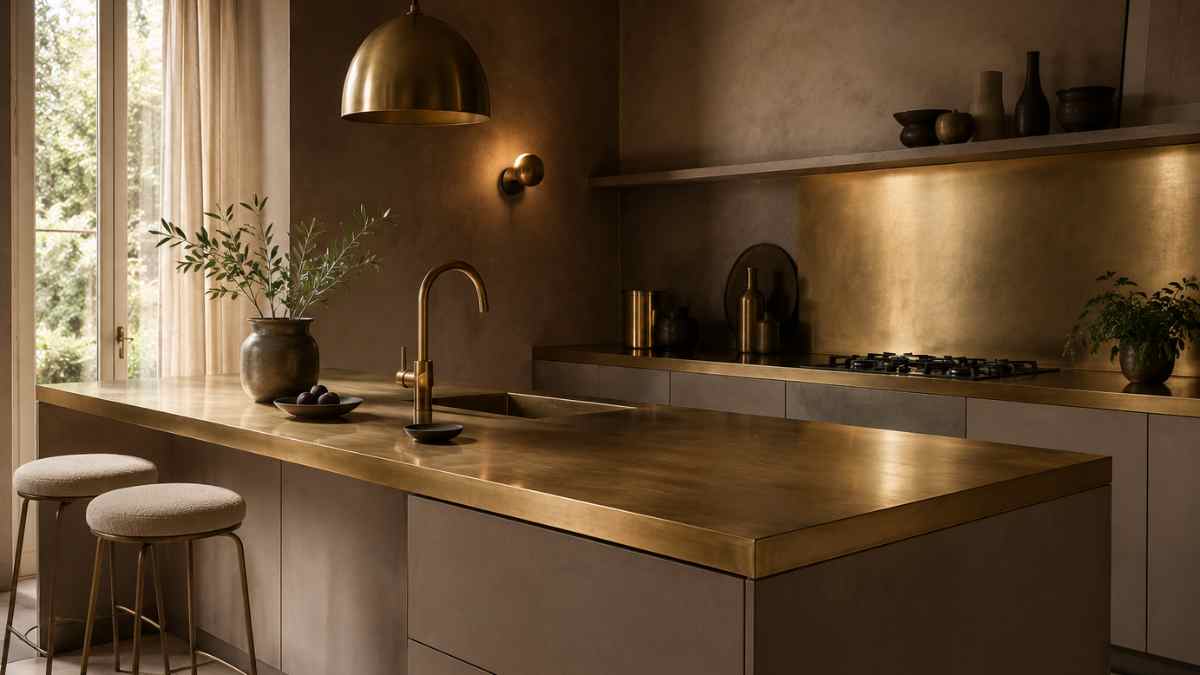
London-based brand Devol Kitchens systematically uses brass and raw copper in its designs, often combining them with colored plasters in its sage green or light blue ranges. The combination works because copper and brass have an inherent warm optical temperature, regardless of the environment. Even just antique brass handles, faucets and frames on neutral surfaces are enough to shift the perceived thermal balance of a room without touching floors or walls.
A house that warms does not have to justify itself with nature. The best materials for doing this are those that keep the look close, that change over time without degrading, and that don’t impose a single lifestyle as the only possible answer. Wood will stay everywhere. But it is not the only language in which the same thing can be said.



