


Lust has a mixed reputation. On the one hand, it is recommended to anyone approaching plants for the first time, almost as if it is an alternative for those who do not want to commit. On the other hand, on the Instagram profiles of interior designers such as e.g Hilton Carterits author Wild at homeappears systematically in the most sought-after setups, combined with light wood shelves and handmade ceramics.
It’s not a contradiction: it’s that Pothos, well used, has a rare ability to visually connect different elements together, descending, dressing, filling empty spaces with an almost architectural logic. The problem is not the plant. The problem is that it is usually placed in a single container in a low cabinet, left to grow without direction, and then you wonder why the corner still looks messy.
Three samples on a shelf completely change the perspective. Not for reasons of abundance, but because they allow you to build a composition with different heights, densities and growth speeds.
Why three and not one (or five)
A single Lust on a shelf takes up a slot. Five risk transforming the shelf into a solid jungle where objects disappear. But three samples create rhythm. It works for the same reason photographers talk about rule of thirds: the odd number creates dynamic balance, not static symmetry. On a five-tier shelf, for example, placing one Pothos in the top right, one in the center left, and one in the bottom center creates a natural visual path that leads the eye without getting in the way.
There is also a practical question. Pothos is a species with varieties with quite different characteristics. Epipremnum aureum in its classic form it has large leaves and tends to fall heavily. THE Marble Queen of Lustwith its white marbling, it grows more slowly and has a lighter habit. THE Neon Pothosthe almost fluorescent bright green, acts as a contrasting color note. Using three different varieties on the same shelf isn’t botanical showmanship: it’s color and volume management.
The shelf as a structure, not as a background
Almost all shelves used in Italian home environments are either too deep or too shallow to support hanging plants. IKEA’s KALLAX shelves, with their 39 cm depth, tend to trap Lust, which struggles to fall freely. The most effective solutions are open shelves between 20 and 28 cm deep: the plant can go down the wall or down without obstacles. Brand like String furniturethe classic Swedish system from the 1950s offers exactly this configuration, with the ability to change the depth of the shelves within the same structure.
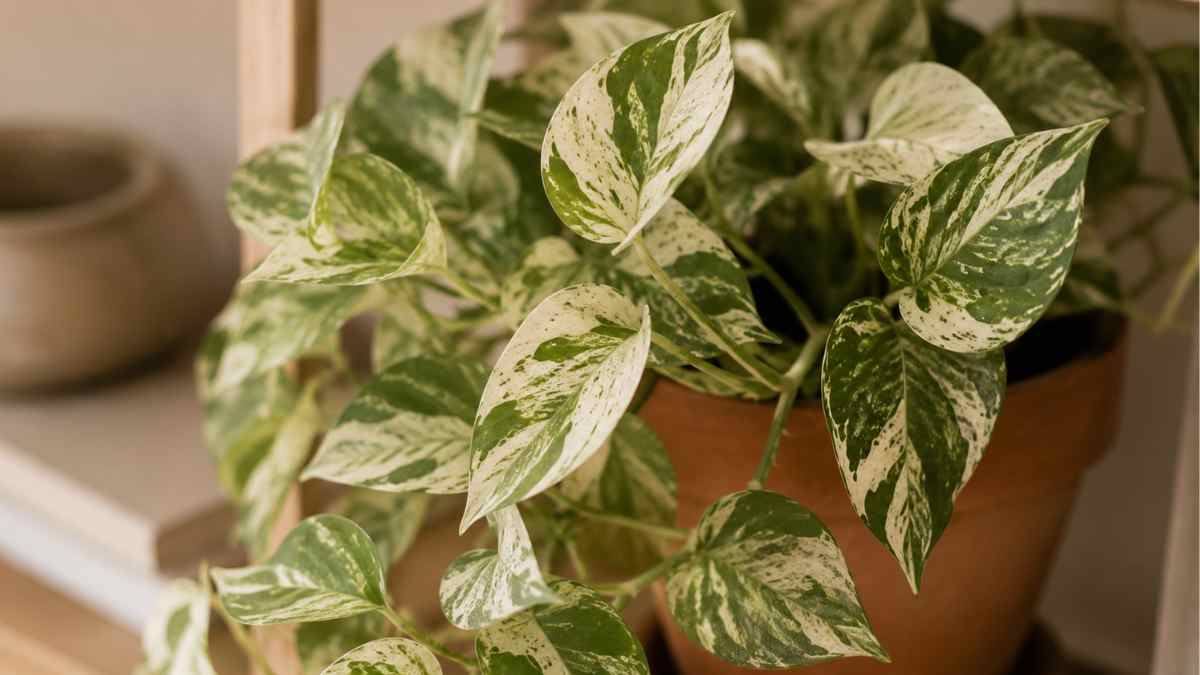
Material issues. Light wood, ash or birch, tends to enhance the contrasting green of the leaves. Dark wood, walnut or stained oak, goes well with Marble Queen because the white variation of the leaves breaks up the gravity of the background. The black matte metal, found in products such as HAY’s Путь shelves or modular systems from Firm Livingit is probably the most neutral and photographically cleanest frame.
Pots, substrate and that error in proportion that is immediately noticeable
The wrong jar ruins everything. A Pothos in a 14 cm white plastic pot on an oak shelf 180 euros has exactly the effect you expect. Proportions matter as much as the choice of plant: for shelves up to 25 cm deep, pots with a diameter between 12 and 18 cm are the right size. Concrete materials: raw terracottaraw ceramic or porcelain stone. Natural terracotta also has a functional advantage: it breathes, reducing the risk of root rot which is the only real threat to a Pothos in poorly ventilated environments.
In the substrate: Pothos is not demanding, but in pots it tends to suffer in compact soils from a large distribution that retain too much moisture. A mixture with 20-30% perlite improves drainage without disturbing anything. Approximate prices: perlite can be found in any garden center for around 4-6 euros for a 5 liter bag, which lasts for years for home use.
The Layout That Doesn’t Look Well Thought Out (But It Is)
The danger with arranging plants on the shelf is the shop-like effect, that feeling of a nursery display that doesn’t belong to anyone. To avoid this, plants should never be isolated on special shelves: they should coexist with books, objects and frames. The rule of thumb is that each Lust takes up no more than a third of the horizontal space of the shelf it’s on, leaving the rest for the other items.
A specific example: high shelf with Neon Pothos in a 14 cm terracotta pot, flanked by two or three vertical books and a low object (a candle, a stone, a small sculpture). central shelf with 16 cm white matte ceramic Marble Queen, is left freer so that the leaves hang visibly. low shelf with classic Epipremnum in 18cm pot, with leaves running down to the floor. The overall verticality created is what transforms the shelf into something that looks curated without looking staged.
The only adjustment needed over time is to rotate the containers every two weeks: Lust grows towards the light and without rotation the leaves will all tend in the same direction, losing the three-dimensional distribution that is the starting point of it all.



