


There is one class of appliances that no interior design manual has ever been able to truly tame. The refrigerator is hidden behind a panel. The oven disappears into the recess. The dishwasher is disguised as a piece of furniture. The washing machine, no. The washing machine remains there, round, white or concrete, with an open porthole and wet drum, reminding everyone that someone lives in this room doing laundry.
In large bathrooms, the problem does not arise. But in studio apartments, in cramped bathrooms, in improvised laundry rooms created in a closet, the machine takes up a disproportionate amount of visual and mental space.
Brick is not an option for those who rent or don’t want to redo the plumbing. Buying a built-in means spending between 600 and 1,200 euros just for the model, not including installation. However, there are solutions and some cost less than a weekend away.
Curtains and curtains: the most underrated solution
A scene is not a tradition. In Scandinavian and Japanese design culture, fabric concealment is a precise architectural gesture: it reduces visual noise without creating permanent obstructions. A raw linen panel curtain mounted on a ceiling track can hide a washing machine, a boiler and three shelves of cleaning products in one go. The ceiling track is the detail that changes everything: eliminates the problem of bar vibration during the spin cycle and allows the fabric belt to extend to the floor, also covering the base of the machine.
IKEA sells the KVARTAL system with double and single pieces, compatible with curtains up to 150 cm high, starting from around €25 for the track. Combined with cotton or linen panels from the AINA series, the result is neutral and domestic in the best sense of the term. For those who prefer something more structured, micro-textured fabrics from Bemz, the Swedish brand that produces special covers for IKEA furniture, offer velvet and bouclé variations that withstand everyday use and won’t warp from moisture.
One caveat: avoid fabrics that are too light or translucent. With the washer on, the movement of the drum shows through the fabric like a Chinese shadow and the effect is worse than the exposed porthole.
Sliding doors: when space is limited but the intention is clear
Sliding doors work better than hinged doors in almost any environment where the washing machine is in a hallway or tight space. They require no opening space, can rest against an existing wall and, if chosen correctly, become part of the furniture rather than revealing its absence.
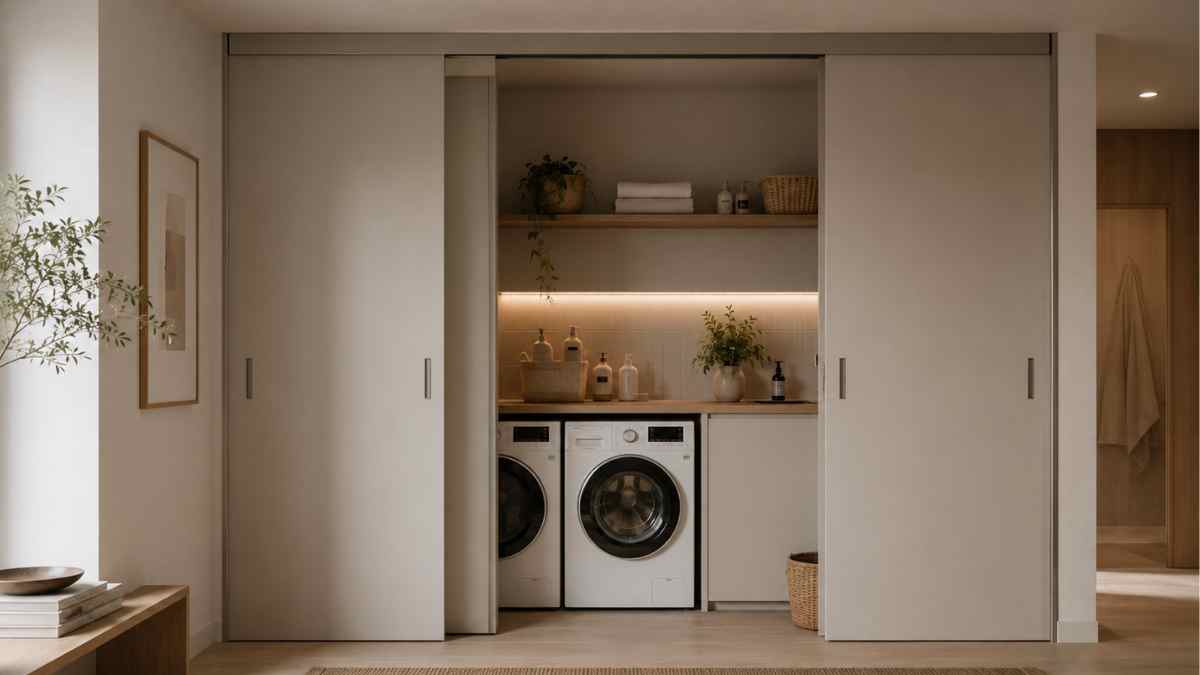
The material makes the difference. A white lacquered MDF door solves the technical problem but adds nothing to the frame. A panel of raw pine wood with a matte wax finish or a sheet of smoked glass with a black iron frame, turns an alternative into an option. The Italian brand Anyway Doors produces sliding systems with ultra-thin painted aluminum frames, compatible with wooden, glass or even mirror panels, with prices starting from around 180 euros for a single bespoke door.
A less expensive but effective solution: applied track systems, such as the Barn Door stylemounted directly on the wall with iron supports. In this case the panel slides in front of the machine rather than being contained in a structure. The industrial aesthetic doesn’t suit every space, but in a bathroom with white subway tiles and black faucets, it works with precise consistency.
The fake bookstore and the double deception
This is the trick that requires the most planning but produces the most convincing results. The basic idea: build or buy an open shelf structure that occupies the entire wall, placing the washing machine inside as if it were a special compartment. The top and side shelves are used for booksplants, baskets or anything else that makes sense in this space. The machine ceases to be an isolated household appliance and becomes part of a composition.
The key is the height of the structure: it should reach the ceiling, or almost. A bookcase that stops in the middle of the wall reveals its function. One that takes up the entire height suggests that the washing machine has always been there, part of a project.
IKEA KALLAX is the most obvious starting point, but it has a limitation: standard units are 42 cm deep, insufficient for most washing machines (average depth between 54 and 60 cm). BILLY, on the other hand, comes in a 40cm version, but can be customized by adding side panels. An artisan solution, made by a carpenter with poplar plywood, costs from 300 to 600 euros per measurement and allows you to manage the necessary depth without compromise.
The washing machine compartment can be left open or closed by a door. If you choose the door, it is better to choose one with the same finish as the rest of the structure: handleless, pressure opening or with a push-to-open system.
Beautify: when the washer remains visible but changes skin
Hiding isn’t always the right answer. In some contexts, especially in small bathrooms where every additional solution takes up space that doesn’t exist, the alternative is to work on the aesthetics of the machine itself.
The market for decorative self-adhesive films for household appliances has experienced growth in recent years that no one had predicted. Brands such as Wrappz, Hexis and WrapStyle produce premium vinyls in marble, concrete, wood and monochrome finishes, tailored to cut for specific models. A washing film costs from 40 to 90 euros, lasts three or four years and is removed without leaving any residue. A machine covered in white Carrara marble or matte charcoal gray is no longer a device to be hidden: it becomes an object with a different presence, not decorative in the conventional sense, but at least consistent with a color project.
The washing machine lid is often the most overlooked detail. Placing a solid wood or teak cutting board over the top of the washing machine lid (attached with removable double-sided tape) turns the surface into a functional shelf. Some manufacturers such as Magi Laundry and several artisans on Etsy make custom lids from oak, walnut and bamboo, with prices ranging from €50 to €130.
The details around the machine complete the picture: a rattan basket for clothes, a shelf with detergents poured into uniform containers, a washable mat on the floor. This is not about surface decoration, but about creating a context in which the washing machine is part of something rather than an isolated object waiting to be removed.
Ultimately, the question worth asking isn’t how to hide the washing machine, but how much mental space you’re willing to devote to it. Some do very well with the door open and the detergent in the lid. Others don’t. The solutions described here do not change the operation of the machine, but change the way the space around it is inhabited, which is something different and perhaps more important.



