


Anyone who has chosen a dark floor knows what it means to look at it two days after washing and find it worse than before. The white marks, the milky streaks, the fingerprints that seem to be etched into the wood or the stonework: they are not a defect in the material, not even the fault of those who clean it badly. It’s the fault of the missing information at the time of purchase, when the seller happily talks about impact resistance and a ten-year warranty, but is silent about what happens every time you wipe it. Dark floors are demanding, and this need has a precise logic worth understanding before you resign yourself to living with a floor that never looks clean.
The dark surface is unforgiving of residue. Any trace of scale, unwashed soap, minerals dissolved in the tap water becomes visible on a black or charcoal background with a clarity not seen on light colored floors. It is not paradoxical: it is natural. And the solution lies not in miracle products found in supermarkets, but in a basic understanding of how these surfaces react to what we put on them.
The problem isn’t the dirt, it’s the water
The first thing no one says is this the water itself is the main enemy dark floors. Italian tap water has an average hardness that varies between 15 and 40 French degrees depending on the region: in Milan it is around 28, in Rome it exceeds 30, in Naples it can reach 35. Whenever the floor is wet and then dries less than perfectly, calcium and magnesium salts remain on the surface. Invisible in light colors, clear in dark.
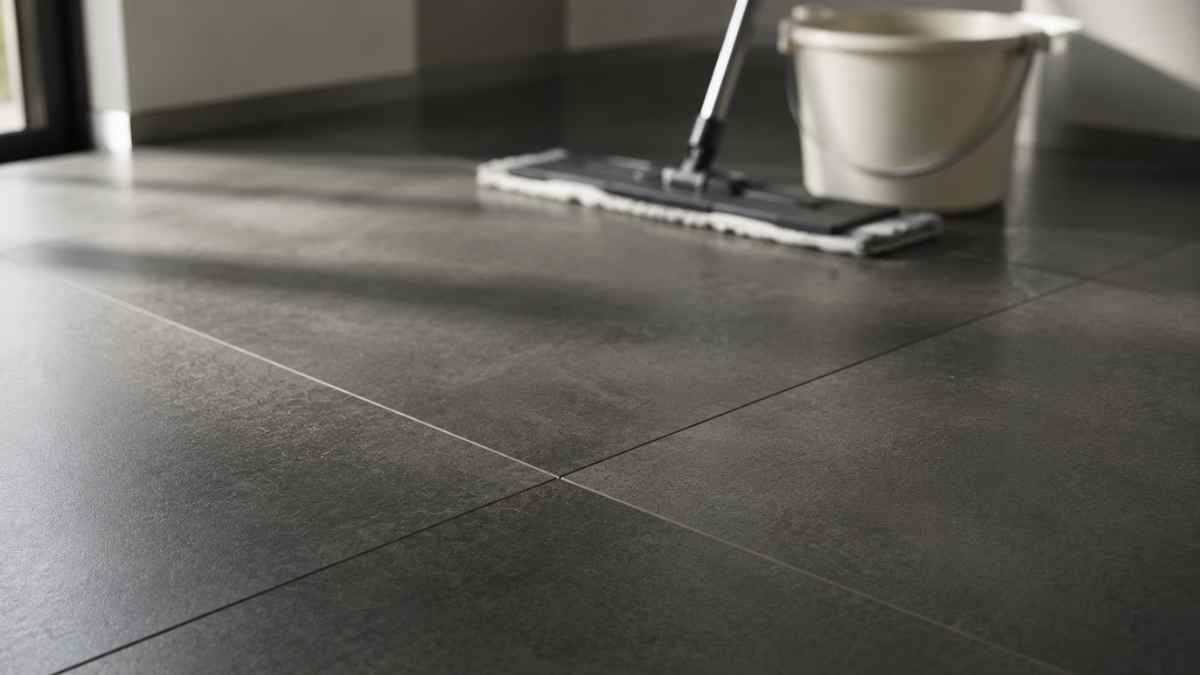
The most effective treatment is not a different cleaning product, but changing the drying method. The cloth should be wiped twice: once to clean it, the second with a nearly dry cloth to remove any residual moisture. Who uses a motion in microfibers like Leifheit’s Clean Twist or Disc Mop model, it performs better precisely because the microfibers hold water instead of redistributing it. The difference between a wash done this way and one done with a traditional mop is visible after the first use.
For those who live in hard water areas, it’s worth investing in a scale filter for the water tank or, even better, using distilled water for the final rinse. It costs little and solves the root problem of stretch marks without having to resort to specific products.
Detergents: what is written on the package is not enough
Dark porcelain floors, which represent the majority of installations in the residential sector, have practically zero porosity. This means that they absorb very little, but it also means that whatever is deposited remains on the surface. Using a detergent with surfactants that don’t fully rinse away creates an invisible layer that builds up over time and becomes the base on which all kinds of residue sticks.
Products with a neutral pH such as Fila Cleaner or Kerakoll Fugabella Eco Clean are specifically designed to prevent this build-up. But here again, concentration matters: many use them in very high doses thinking they will clean better. The result is the opposite. One teaspoon per liter of hot water is sufficient for regular maintenance. Exceeding this dosage means leaving behind detergent residue that attracts dust and creates exactly the type of milky film you want to avoid.
For dark parquet, graphite painted oak or matt lacquered canaletto walnut, the logic is different. The matte finish, much in demand in recent years thanks to collections such as Listone Giordano’s smoke-coloured Roverella range, is particularly subtle. Oil or wax based products should be used sparingly and only if the floor is oil treated and not varnished. Confusion of the two finishes is a mistake not easily rectified.
Invisible scratches that whiten
On dark surfaces, micro-scratches that would go unnoticed on a light-colored floor become visible because the scratched material exposes a lighter color than the background. This applies to stoneware that gets scratched by sand dragged under shoes, but also to parquet floors that get scratched by furniture legs.
Sand is the most common abrasive and the most underrated. A handful of grains creeping in from the outside, rubbed even by daily passage, scratch the surface in a widespread and uniform manner. The most effective solution is not technological: it is entrance mats, placed both outside and inside the door. Those with a rubber bottom and dense fibers, such as the natural coconut models from Ikea or the more durable versions from Emco, stop the sand before it reaches the clean surface.
For furniture legs, self-adhesive felts work, but they wear and tear. A more durable solution is silicone caps, which adapt better to uneven surfaces and last for years. Solid wood chairs with metal basessteel chairs, bar stools: on a dark floor every repeated contact leaves a mark and its prevention costs less than its restoration.
Restore an already degraded floor
If the floor already has a layer of accumulated residue or is full of age marks, the first step is a deep clean with an alkaline pH degreaser such as Fila Deterdek diluted in warm water. It should be brushed on with a soft-bristled brush, left on for five minutes and then rinsed off carefully, preferably twice. This type of emergency cleaning should not be done more than two or three times a year, because alkaline products, even if effective, stress finishes in the long run.
For dark parquet with surface scratches in the lacquer, there are specific polishes that temporarily fill microcracks and restore visual uniformity to the surface. Bona, a Swedish company specializing in parquet finishes, has a range of maintenance products including Bona Polish for matt finishes, which is applied without rinsing and is compatible with dark colours. It is not a permanent repair, but postpones the time when sanding is necessary.
A dark floor that is consistently cared for does not require extraordinary efforts. It requires method and some information that should have arrived at the time of purchase and is instead distributed on industry forums, manufacturers’ technical data sheets, and sometimes after a mistake has already been made.



