


The hallway is the space where no one takes photos for Instagram. No Pinterest mood board devotes a section to it, no interior design TV show makes special episodes about it. However, it is the first square meter you touch when you enter your home and the last one you see before you leave. For years the standard answer to lighting this space was a central, round, white ceiling light, costing seventy-nine euros, installed by a hurried electrician and never touched again. Then something changed the collective logic: not a sudden trend, but the progressive awareness that the poorly lit corridor makes everything else in the apartment worse. Not for an abstract aesthetic reason. To be very specific: it is the perceptual filter through which you read every other environment. You arrive in a dark, narrow corridor, with a yellowish light on the ceiling, and the living room that follows already starts at a disadvantage.
The home lighting market has responded with a range of solutions previously reserved for high-end projects. Prices have fallen, formats have multiplied and today orientation requires a precise criterion.
The central ceiling light has a structural problem
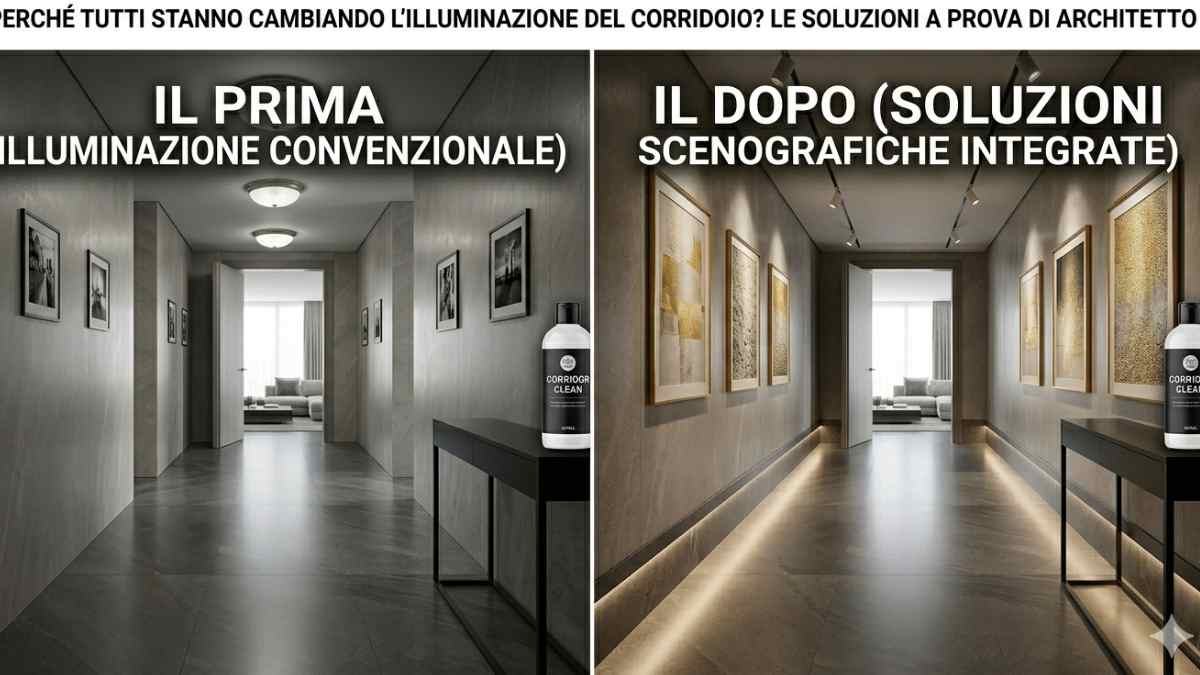
It’s not a matter of taste. A single light source placed in the center of the ceiling casts shadows down, right where the face of the person walking is. The result is a light which ages the features and flattens the space. It works well in the kitchen, where you need direct lighting on the worktops. In a corridor three meters long it produces the effect of a hospital corridor.
The principle that guides the designers is different: they work on multiple levels of light, avoiding the ceiling being the only point of emission. Wall washer on the walls, LED strips along the skirting board, medium height asymmetrical wall lights. It is not necessary to use them all together. Even just adding a secondary source to the wall radically changes the perception of depth.
Flos has been working on this principle for a long time with the line Paleindirect light wall lamps designed for transitional environments. The emission goes up and down, avoiding direct reflection. The price is around 280-320 euros per piece, an affordable figure considering that two units are enough for a typical corridor.
Color temperature: the detail no one reads on the label
Most bulbs sold in department stores range between 3000K and 6500K without anyone really explaining what that means. 6500K is the light of a cloudy day, white and slightly anxiety-inducing. 2700K is warm, orange, similar to old incandescent bulbs. For a residential corridor, the ideal range is between 2700K and 3000K.
Above 4000K the space takes a aseptic character that can work in an office or shopbut in a private house it causes a nuisance without the person living there being able to trace the cause. It is one of those details that distinguish a designed project from an assembled one.
Philips Hue LEDs allow you to adjust the color temperature dynamically, with values ranging from 2200K to 6500K via an app. They cost more than a general LED strip, but for a corridor where a light change from morning to night is needed it is a solution that makes sense. A basic kit with two bulbs and a bridge costs around 90-110 euros.
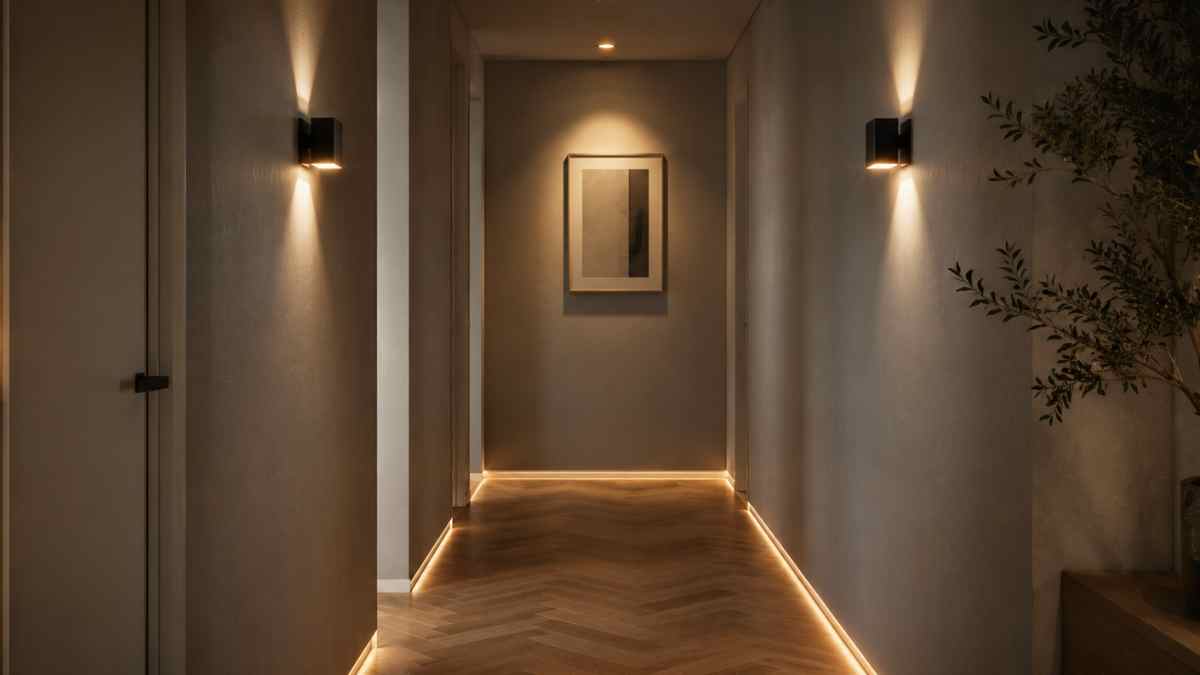
An eighty-centimeter-wide corridor is not made wider by an optical trick. But it can feel less oppressive if the lighting works in depth rather than width. The most effective strategy is to light the back wall and not the sides.
A small wall lamp or an adjustable spotlight aimed at the end wall of the hallway visually shifts the vanishing pointelongating the perception of space. If this wall has a painting, an object, a certain texture, the effect is multiplied. If it’s white and empty, it still works.
IKEA introduced a series of adjustable LED recessed spotlights with a constant color temperature of 2700K in the SILVERGLANS series. They cost less than twenty euros each and are installed with an eighty millimeter hole in the suspended ceiling. It is not a luxury project option, but it is a right choice for those who want a professional result on a limited budget.
For those who already have an existing plasterboard false ceiling and want to avoid structural interventions, LED strips integrated into the skirting board are the solution with the most favorable installation-performance ratio. A medium-quality three-meter strip, with an aluminum profile and an opal diffuser, costs from 40 to 70 euros. The grazing light on the floor visually lengthens the corridor without the need for an electrician.
Switches and dimmers: where the electrician becomes a consultant
A corridor with beautiful lighting and a standard switch is a missed opportunity. The dimmer turns the same system into something configurable. Early in the morning, with twenty percent light, the corridor is not aggressive. At night, with someone arriving late, you don’t have to choose between total darkness and full light.
Not all LED-compatible dimmers are the same. Many cheap models produce flicker at low volume levels, a problem you don’t see but strains your eyes over time. The Legrand Valena Life models and the Vimar Arké series have good compatibility with most LEDs on the market and cost between 25 and 50 euros each, excluding installation.
The other option is the motion sensor with time setting. In a corridor used in the passage it has a precise logic: the light turns on when needed and turns off by itself. Schneider Electric has a range of aesthetically neutral switch plate integrated sensors that fit most existing installations. You don’t need to redo the system.
When the hallway becomes a project
There is a point beyond which corridor lighting ceases to be a technical solution and becomes a compositional choice. It happens when you decide to use light not to see better, but to say something about the space.
Patricia Urquiola worked on this concept in the project Mandarin Oriental Hotel in Milanusing the corridor as a sequence of light boundaries, each with a different temperature and intensity. It’s not a direct domestic approach, but the principle can be carried over to scale: treat each corridor meter as a change of register, not as a neutral connection between rooms.
At the residential level it means, for example, alternating an area with warmer light near the entrance to a slightly cooler and more intense area near the service rooms. Not a clear contrast, a shade. Enough to make the space look more complicated than it is.
A dark hallway is never just a wattage problem. It’s a problem of intention.



