


For years the lighting design of living rooms has revolved around the same axis: the ceiling lighting point, the chandelier as an identification element, the ceiling light as an improvised solution. Then something began to move, little by little, in the homes of those who look at the premises more closely. Not above, but below and to the side.
THE floor lamp it has ceased to be a secondary accessory, that floor lamp that fell into the corner next to grandma’s armchair, and has mastered a role that no other piece of furniture can fulfill with the same efficiency: it dominates the space, defines areas, creates visual depth. At a time when living rooms have become hybrid, multifunctional, often without dividing walls, the floor lamp solves problems that the ceiling can’t even touch. No need to add electrical system, no need to drill holes in the wall. Just move it fifty centimeters and the whole room reading changes.
Vertical geometry in an age of flat surfaces
Screens are everywhere, horizontal, flat, two-dimensional. The eye of those who inhabit these spaces is used to moving in continuous levels without interruption. The floor lamp introduces a defining verticality which breaks this habit in a natural, unadorned way. A one-hundred-eighty-centimeter-tall trunk with an adjustable diffuser leads the eye on trajectories that a television or sofa cannot construct.
Flos, a Brescia company founded in 1962, has built part of its identity precisely on this principle. Arco, designed by the Castiglioni brothersremains the school case: Carrara marble base, polished steel arm extending up to two meters and forty two centimeters, brushed aluminum diffuser. It’s not a lamp, it’s an architectural statement. The starting price is around 2,500 euros, but the principle it incorporates, the light falling from above without touching the ceiling, can be reproduced with much smaller budgets.
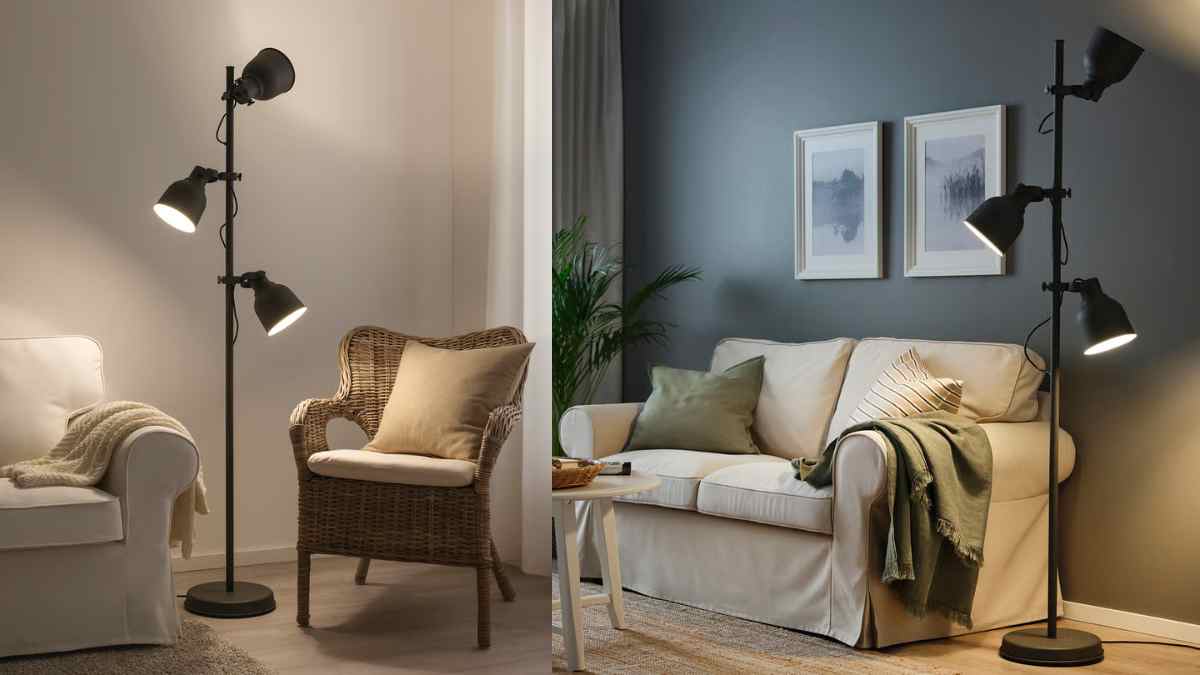
IKEA, in the current catalog, offers the Hectare in dark gray painted metal, with adjustable head and fabric thread: about 69 euros. He does not impersonate Flos, but does his job honestly. For those looking for something more structured without reaching the Made in Italy signature, Maisons du Monde has included in its permanent line satin brass floor lamps with natural linen shades around 120-150 euros, with more considered proportions relative to the price level.
Where to place the floor lamp almost everyone makes a mistake
The normal position, corner behind the single armchair, works. But it reduces the base to a tool. The most interesting option is to mount it between the sofa and the dining roomwhen these two elements coexist in open space. In this transition area, the floor lamp creates an informal threshold of light that doesn’t need a wall to exist. At night, with the lights low, this column of light separates the two environments more clearly than any carpet or bookcase.
Another underrated position: next to the TV, not in front. The side light reduces the contrast between the illuminated screen and the dark wall, a real problem for those who use the living room as a home cinema room. In this case the floor lamp does not decorate, it solves a normal vision problem.
Luceplan, a Milanese brand with a solid history in lighting design, has over the years produced floor lamps designed precisely for these environments. Costanza Terra, with its flat lampshade made of iridescent polyethylene, diffuses an even and ambient light, particularly suitable for mixed environments. At around 800 euros it is an investment that lasts decades.
The return of the lampshade, but different than before
After years of bare trunks, metal diffusers and exposed light bulbs, the the lampshade returns. Not eighties florals, obviously. This one on raw linen, on thick cotton, on Japanese washi paper. The difference is not only aesthetic: a lampshade made of natural fabric modifies the perceived temperature of the light, softening it, making it less surgical. In a salon that has to work until late at night, this difference is noticeable.
Artemide, another excellence from Lombardy, has in recent years proposed reinterpretations of the classic lampshade with modern materials. The Tolomeo Paralume floor, with its hinged arm and lacquered aluminum lampshade, is an example of how traditional form can be updated without distorting it. Prices starting at around 600 euros for the basic version.
On the more affordable front, Zara Home has launched a range of floor lamps with plush ribbed shades in earths, smokes, moss greens and rusts. Around 180-220 euros, with attention to unusual hardware for the price range. They are not lamps meant to last twenty years, but for those who want to experiment with a stylistic direction before investing morerepresent a reliable entry point.
Adjustability and color temperature: the details that change everything
A fixed floor lamp, with a non-adjustable color temperature bulb, has half the potential. The floor lamps with built-in dimmer on the stem or cable allow you to calibrate the light intensity without getting up from the sofa. A detail that seems insignificant until you live without it.
Color temperature, measured in Kelvin, transforms the quality of space more radically than you might imagine. For an evening stay, 2700K is the right range: warm, orange light that does not tire the eye. At 4000K the environment becomes functional but cold, suitable for a studio, not a decompression room. When buying a floor lamp compatible with standard E27 bulbs, choosing the right bulb is just as important as the bulb itself.
Some new generation floor lamps already integrate smart systems compatible with Philips Hue or LIFX, allowing you to program different lighting scenarios for time slots. Eglo, an Austrian brand widely distributed in Italy through specialist retailers and department stores, has a series of floor lamps connected to an exclusive application at prices between 130 and 250 euros. Real functionality, not gadgets.
A question of scale: height and proportions are not details
A floor lamp that is too low on a 270 cm ceiling looks crushed, without presence. A 190 cm floor lamp in an apartment with a 240 cm false ceiling looks trapped. There ratio between trunk and volume of the room it is the first parameter to check, before color, before material, before price.
The most useful rule of thumb: the highest point of the lamp should not be less than 30cm from the ceiling. This is especially true for arched floor lamps or those with extended arms, where visual dynamics require upward breathing space. In living rooms with low ceilings, floor lamps with a thin stem and a downward-facing diffuser provide more depth than those with bulky shades that take up width without height.
Target Home, the group’s furniture line La Redoute is available in Italy online and in some stores, offers floor lamps in black matte metal with adjustable height up to 175 cm. Around 90 euros, with official cleanliness that adapts without difficulty to modern interiors.
There is a living room in the head of anyone reading this page. Maybe he already has a floor lamp, maybe he has one that is not entirely convincing. Move half a meter, change the lamp with a 2700K or just look at it from another angle: sometimes the room you were looking for was already there.



